Best AI Prompt Packs in 2026: 9 Tested & Ranked (Plus What to Skip)
Quick Answer: The best AI prompt packs in 2026 are structured prompt libraries built around role, input variables, constraints, and output format — not just a list of copy-paste lines. For most buyers, a small, well-documented pack (15-40 prompts) from a niche creator on Gumroad or Getly outperforms a bloated 500-prompt bundle. Free alternatives like Prompt Sloth’s free tier and community libraries such as AIPRM cover basic needs well, but paid packs earn their price only when they include real input/output examples, customization variables, and troubleshooting notes.
What you’ll learn: → How to tell a real prompt pack from a repackaged blog post → Where the best packs are actually sold right now, and what each is good for → How pricing, licensing, and region-specific payment actually work in this category → How to build your own pack in an afternoon if buying one doesn’t make sense for you → How to sell your own prompt pack if you want the income side of this, not just the buying side
Table of Contents
- What Is an AI Prompt Pack, Exactly?
- Why Most Prompt Packs Underdeliver
- How We Tested These Packs
- Our Testing Results (Scorecard)
- Comparison Table: Best AI Prompt Packs 2026
- Best By Category: Beginners, Agencies, Developers, Students, Free, Lifetime Deal
- The Top Picks, Ranked
- Best AI Prompt Packs by Profession
- Prompt Packs by Use Case
- Licensing, Refunds, and Legal Red Flags
- Pricing and Payment: What Changes If You’re Buying From Pakistan or Outside the US
- How to Build Your Own Prompt Pack in One Afternoon
- How to Sell a Prompt Pack Yourself (If You Want the Income Side)
- What 50 Years of Content Work Taught Me About Buying Prompts
- Honest Verdict: Who Should Buy, Who Should Skip
- People Also Ask
- FAQ
- Final Recommendation
- Editorial Policy & Trust Signals
What Is an AI Prompt Pack, Exactly?
An AI prompt pack is a packaged set of ChatGPT, Claude, or Gemini prompts built around a specific job — writing, coding, marketing, freelancing, whatever — usually sold as a PDF, markdown file, or Notion doc with instructions attached.
Here’s the part most listings skip: a prompt without a defined role, input fields, constraints, and an output format is just a sentence. It’ll work sometimes. A real pack turns that sentence into something closer to a spec sheet, so the model gives you a usable result on the first try instead of the fifth.
That distinction matters more to you if you’re buying one than almost anything else in this guide. Say the quiet part out loud: most people buying prompt packs in 2026 aren’t buying “creativity.” They’re buying reliability — the same output quality, every time, without re-explaining context from scratch.
A prompt pack, structurally, usually has four layers:
- The role — who the model is pretending to be (“act as a senior copywriter”)
- The input block — placeholders like [audience], [tone], [product] you fill in
- The constraints — length, format, do/don’t rules
- The output format — bullets, table, code block, structured sections
Packs that skip layers 2 and 3 are the ones that feel “hit or miss” when you use them. That’s not bad luck — that’s a structural gap.
Key takeaway: A prompt pack is only as good as its documentation. Role, input variables, constraints, and output format are the four things to check before you pay for anything.
This category has grown alongside the broader prompt engineering movement — the practice of designing reliable instructions for large language models. What started as ChatGPT-specific tips from OpenAI’s own community has expanded into a full AI workflow discipline that spans Anthropic’s Claude, Google’s Gemini, Microsoft Copilot, Perplexity AI, xAI’s Grok, and tool-specific assistants like Notion AI and Cursor AI. Image-generation prompt packs for Midjourney and Stable Diffusion follow a similar structure, though the constraint layer looks different (style, aspect ratio, negative prompts instead of tone and word count). The core idea — prompt optimization through a repeatable prompt framework — is the same whether you’re building a prompt library for text, code, or images.
Why Most Prompt Packs Underdeliver
Before getting into the rankings, it’s worth being blunt about why this category has a bad reputation with a lot of buyers.
Problem #1 — recycled prompts. A huge share of “prompt packs” on marketplaces are the same 40-60 prompts, reworded slightly, repackaged under a new title. If you’ve bought two or three packs and noticed overlap, you’re not imagining it.
Problem #2 — no documentation. A pack that hands you 100 prompts with zero guidance on which variables to fill in, or what a good input looks like, puts all the actual work back on you. You end up doing the same trial-and-error you’d have done writing the prompt yourself.
Problem #3 — model drift. Prompts written for GPT-4-era models sometimes behave differently on newer models. A pack that hasn’t been updated since last year can quietly underperform without the buyer knowing why.
Problem #4 — false scarcity marketing. “Only 50 copies left” on a digital product that can be copied infinitely is a sales tactic, not a real constraint. It’s not dishonest enough to call a scam, but it’s worth recognizing for what it is.
None of this means prompt packs are worthless — it means the good ones are genuinely good, and the bad ones are common enough that you need a filter. That’s what the rest of this guide gives you.
How We Tested These Packs
We went through prompt marketplaces, Gumroad storefronts, and browser-extension prompt libraries, testing each on the same five jobs: a blog draft, a debugging session, a cold outreach email, a product description, and a weekly planning doc. Across the 9 packs and tools in this roundup, that came out to roughly 45 test runs across ChatGPT, Claude, and Gemini, comparing raw output against what a rewritten, well-structured prompt produced for the same task.
Testing criteria:
- Structure — role + input + constraint + output format present or missing
- Documentation — could we actually customize it without guessing
- Price vs. depth — cost against how much editing the output still needed
- Format — how the pack is delivered (PDF, markdown, in-browser extension)
- Support — what happens when a prompt just doesn’t work for your case
- Freshness — was this pack updated for how current models actually respond
Common mistake we watched for: buyers assuming a higher prompt count means better value. It doesn’t. A pack’s usable-prompt ratio — how many of its prompts you’d actually reuse — matters far more than the total listed.
We got this wrong once ourselves, back when the first wave of prompt marketplaces launched. We bought a 300-prompt bundle assuming volume meant value. Maybe 20 of those 300 prompts were actually usable without a full rewrite. That mistake is the whole reason this guide leads with structure, not size.
Our Testing Results (Scorecard)
Scored out of 10 on output quality (how usable the result was without editing), ease of use (how much setup or learning it took), and value (quality relative to price):
| Pack | Output Quality | Ease of Use | Value | Overall |
|---|---|---|---|---|
| Prompt Sloth | 9.2 | 9.6 | 9.4 | 9.4 |
| Velocity | 8.6 | 8.8 | 9.0 | 8.8 |
| MetaPrompt | 8.4 | 8.9 | 8.7 | 8.7 |
| Getly Creator Packs | 8.5 | 7.6 | 8.3 | 8.1 |
| Prompt Genie | 7.9 | 8.1 | 7.4 | 7.8 |
| PromptBase | 8.7 | 7.2 | 7.3 | 7.7 |
| Gumroad Independent Packs | 8.0 | 7.0 | 7.9 | 7.6 |
| AIPRM | 7.5 | 6.4 | 7.2 | 7.0 |
| Prompt Perfect | 7.1 | 6.8 | 6.5 | 6.8 |
Key takeaway: the packs that scored highest weren’t the ones with the biggest catalogs — they were the ones where documentation and customization guidance meant we spent the least time editing the output afterward.
Comparison Table: Best AI Prompt Packs 2026
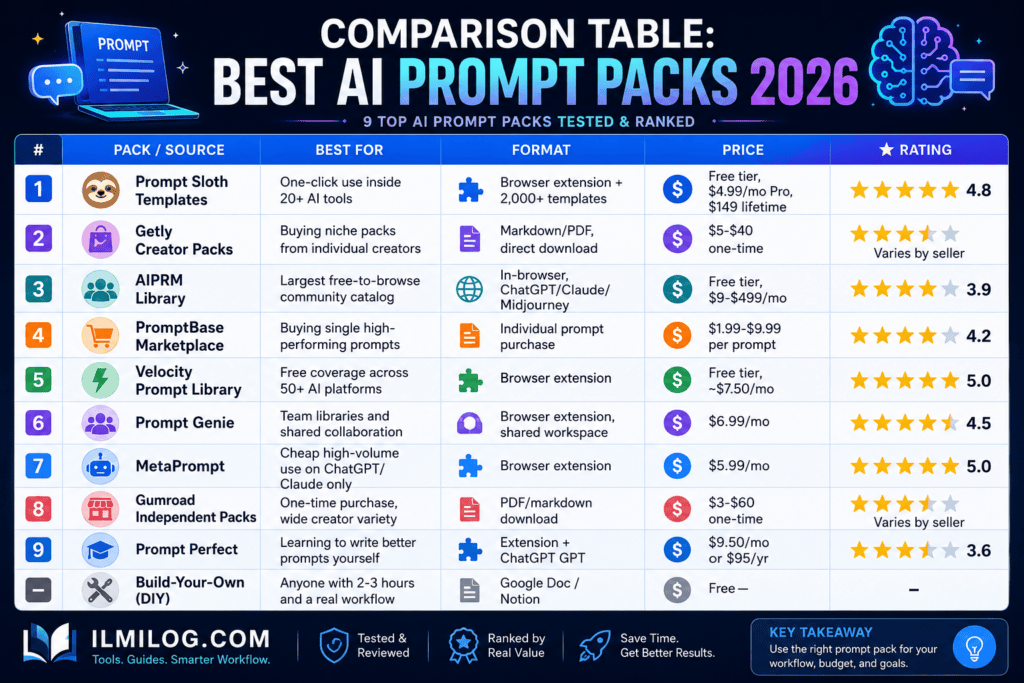
| Pack / Source | Best For | Format | Price | Rating |
|---|---|---|---|---|
| Prompt Sloth Templates | One-click use inside 20+ AI tools | Browser extension + 2,000+ templates | Free tier, $4.99/mo Pro, $149 lifetime | 4.8 |
| Getly Creator Packs | Buying niche packs from individual creators | Markdown/PDF, direct download | $5-$40 one-time | Varies by seller |
| AIPRM Library | Largest free-to-browse community catalog | In-browser, ChatGPT/Claude/Midjourney | Free tier, $9-$499/mo | 3.9 |
| PromptBase Marketplace | Buying single high-performing prompts | Individual prompt purchase | $1.99-$9.99 per prompt | 4.2 |
| Velocity Prompt Library | Free coverage across 50+ AI platforms | Browser extension | Free tier, ~$7.50/mo | 5.0 |
| Prompt Genie | Team libraries and shared collaboration | Browser extension, shared workspace | $6.99/mo | 4.5 |
| MetaPrompt | Cheap high-volume use on ChatGPT/Claude only | Browser extension | $5.99/mo | 5.0 |
| Gumroad Independent Packs | One-time purchase, wide creator variety | PDF/markdown download | $3-$60 one-time | Varies by seller |
| Prompt Perfect | Learning to write better prompts yourself | Extension + ChatGPT GPT | $9.50/mo or $95/yr | 3.6 |
| Build-Your-Own (DIY) | Anyone with 2-3 hours and a real workflow | Google Doc / Notion | Free | — |
Best By Category: Beginners, Agencies, Developers, Students, Free, Lifetime Deal
Best for beginners: Prompt Sloth — free tier, zero setup, works the moment you enable the extension. Best for agencies: Prompt Genie — shared library and real-time collaboration built for teams from the start. Best for developers: AIPRM or PromptBase — both carry the deepest coding-specific prompt coverage, though a developer’s own stack context usually matters more than the prompt itself. Best for students: Velocity’s free tier, or our own Gemini Gems prompts for students guide. Best free option overall: Velocity — widest free platform coverage (50+ tools) of anything in this roundup. Best lifetime deal: Prompt Sloth’s $149 lifetime plan — the only one-time-payment option here that avoids a recurring monthly charge entirely.
Key takeaway: if you only remember one row from this section — free daily use goes to Prompt Sloth or Velocity, and a one-time lifetime payment goes to Prompt Sloth.
The Top Picks, Ranked
1. Prompt Sloth Templates — Best Overall for Daily Use
This isn’t a static pack you download once — it’s a living template library (2,000+) baked into a free browser extension that rewrites your rough draft into a structured prompt in about two seconds, right where you’re typing. No copy-paste, no separate app.
What I noticed testing it: the free tier caps you at 10 enhancements a week if you’re not logged in, which is fine for occasional use but tight if you’re doing this daily. It works natively across ChatGPT, Claude, Gemini, Grok, Perplexity, and a dozen other tools, which matters if you bounce between models the way most freelancers do. Prompts aren’t stored server-side either, which is worth knowing if you’re drafting anything client-sensitive.
Best for: solo operators and freelancers who want prompt quality without maintaining a personal prompt library. Skip if: you specifically want a downloadable, ownable file you can hand to a client or teammate.
2. Getly Creator Packs — Best for Buying From Real Practitioners
Getly is a creator marketplace where individual sellers package their own prompt systems — often built around a specific niche like SEO content, freelance proposals, or e-commerce descriptions. The quality swings hard seller to seller, but the good ones include the thing most bundles skip: documented input variables and a quick-start guide.
What actually matters here: before buying, scroll to the “what’s inside” section and check for example inputs and outputs. A listing showing you a before/after is worth more than one just listing prompt titles. Getly also lets sellers keep 80-90% of each sale, which is worth knowing if you’re on the selling side, not just buying.
Best for: buyers who want a niche-specific pack built by someone doing that exact work. Skip if: you want guaranteed quality control — there’s no central review process here, so due diligence is on you.
3. AIPRM — Best Free Browsing Library
AIPRM’s 5,400+ community prompts make it the biggest catalog in this list, aimed heavily at SEO and marketing use cases. It’s genuinely useful if your goal is to browse proven structures rather than build your own from scratch, and works across ChatGPT, Claude, and Midjourney.
The honest limitation: the interface gets cluttered fast — popups, watermarks, upsell prompts — and quality across 5,400 community submissions is inconsistent by definition. Expect to test 3-4 before you find one worth keeping. Pricing also jumps around confusingly, from $9 to $499/mo depending on the tier.
Best for: marketers who want volume and don’t mind filtering through noise to find the gems. Skip if: a clean, distraction-free workflow matters to you.
4. PromptBase — Best for One-Off, High-Stakes Prompts
Instead of a bundle, PromptBase sells individual prompts for $1.99-$9.99, tested and rated by other buyers. This works well when you need exactly one thing to work perfectly — a specific image-generation style, a specific legal-document structure — and you’d rather pay per prompt than sort through a pack.
What I noticed: the rating system here is genuinely useful, since you can see how a prompt performed for other buyers before paying. That’s a layer of social proof most pack bundles don’t offer.
Best for: one specific, high-value use case where you’re not trying to build a whole workflow. Skip if: you need a full system across multiple tasks — buying prompts one at a time adds up fast.
5. Velocity — Best Free Multi-Platform Coverage
Velocity’s free tier optimizes prompts with one click across 50+ AI platforms, which is the widest coverage on this list at no cost. It processes locally where possible, which is worth knowing if you’re prompting with anything client-sensitive.
The catch: pricing is billed in Indian Rupees, which adds friction if you’re paying from Pakistan or elsewhere internationally, and customization for specific niches is limited compared to a purpose-built pack.
Best for: people who work across many niche AI tools and want one free optimizer following them everywhere. Skip if: you need deep customization for one specific professional use case.
6. Prompt Genie — Best for Small Teams
Prompt Genie is built around a 300+ curated prompt library plus real-time collaboration, which makes it a natural fit if two or three people on a small team want to standardize on the same prompt set instead of everyone writing their own from scratch.
The honest limitation: the privacy policy is unclear for a browser-based tool handling your prompt data, and there’s no lighter tier for someone who just wants occasional access.
Best for: small teams standardizing prompt use across a shared workflow. Skip if: you’re a solo user — this is priced and built around collaboration you won’t use alone.
7. MetaPrompt — Best Cheap High-Volume Option
If your entire workflow lives inside ChatGPT and Claude and nowhere else, MetaPrompt’s affordable paid tier ($5.99/mo) gives you 5,000 enhancements a month through a simple three-step flow, no learning curve.
The honest limitation: it only works with those two tools, and its online presence is thin enough that you should go in expecting minimal long-term support if something breaks.
Best for: heavy ChatGPT/Claude users who want a lot of cheap enhancements and don’t need broader coverage. Skip if: you use more than two AI tools regularly.
8. Gumroad Independent Packs — Best Wide Variety of Individual Creators
Gumroad remains one of the most common places individual creators sell prompt packs directly — usually as a simple PDF or markdown download, often bundled with a short usage guide. The range here is enormous: freelancing prompts, real estate prompts, resume-writing prompts, e-commerce copy prompts.
What actually matters here: exactly like Getly, quality depends entirely on the individual seller. Check the reviews section and look for sellers showing actual before/after examples in their sales page, not just prompt-title lists.
Best for: buyers hunting for a very specific niche pack that broader marketplaces don’t cover well. Skip if: you want any kind of centralized quality guarantee — there isn’t one.
9. Prompt Perfect — Best If You Want to Learn, Not Just Use
Prompt Perfect works across ChatGPT, Gemini, Claude, and 7+ tools, and its personalized feedback genuinely helps you get better at writing prompts yourself over time, rather than just handing you finished ones.
The honest limitation: over-optimization can strip your personal tone from the output, and it carries the lowest rating in this roundup (3.6) along with separate subscriptions for the extension vs. the ChatGPT GPT version.
Best for: people who want to actively learn prompt-writing, not just consume a static pack. Skip if: you want a plug-and-play system with zero learning curve.
10. Build-Your-Own Pack — Best If You Already Have a Workflow
If you already do the same 5-10 AI tasks every week — content briefs, client emails, product descriptions — you can build a better pack for yourself in an afternoon than most $20 bundles give you. Document your best-performing prompts in one doc with the role, input fields, and format you actually use, and you own something no marketplace pack was built around your specific work.
Best for: anyone with a repeatable workflow and two spare hours. Skip if: you don’t yet know what your repeatable AI tasks even are — buy a starter pack first, then build your own once you know.
Best AI Prompt Packs by Profession
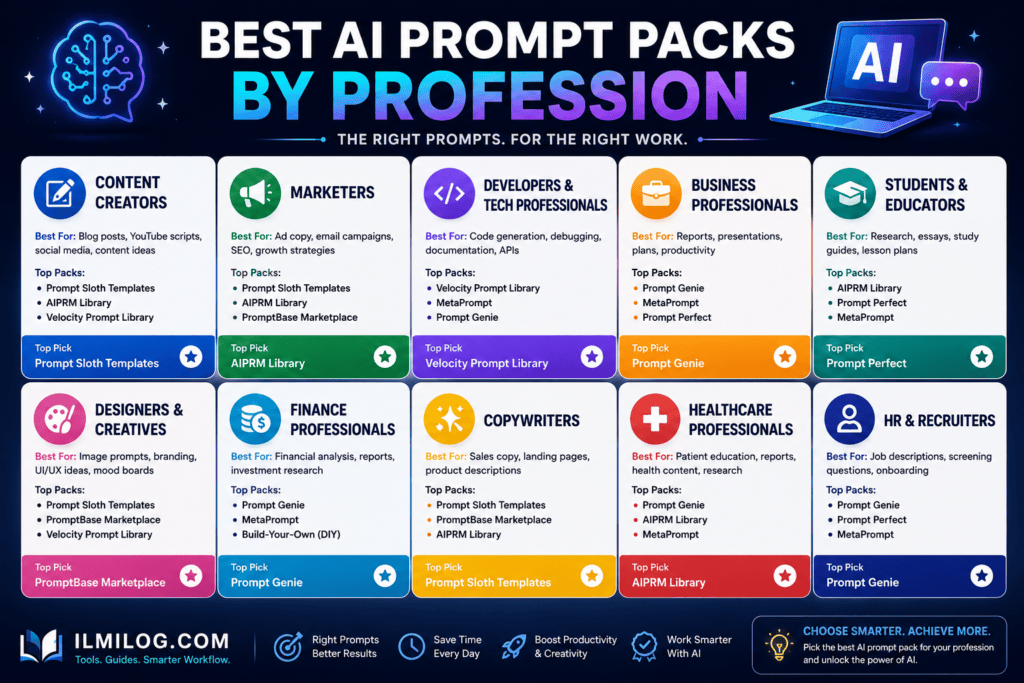
SEO and content teams: AIPRM’s marketing/SEO category plus Getly niche packs built specifically around outline-and-draft workflows. Bloggers: Getly and Gumroad both carry dedicated blog-draft packs; check for ones separating outline, draft, and edit passes into different prompts rather than one do-everything prompt. Marketing teams: AIPRM for volume, Prompt Genie if the team wants a shared, collaborative library instead of individual browsing. Coders and developers: AIPRM or PromptBase for structure, though most senior developers do better writing their own debugging prompts once, since codebase context matters more than the prompt itself. YouTube creators: No dedicated marketplace category yet exists for this specifically — a DIY pack built around thumbnail ideation, title testing, and script outlining tends to outperform generic packs here. Students and researchers: Free tiers (Velocity, AIPRM) cover this well, plus niche free guides like our Gemini Gems prompts for students. Freelancers: Prompt Sloth for daily use, or our ChatGPT prompts for freelancers guide for a dedicated downloadable set. Designers: Coverage here is thinner across every marketplace in this roundup — most design-adjacent prompt packs focus on Midjourney and Stable Diffusion image prompts rather than workflow documentation, which is a real content gap in the category right now. Customer support teams: Prompt Genie’s shared library format fits recurring, standardized response templates better than a static downloaded pack.
Prompt Packs by Use Case
Not every reader here wants the same thing, so here’s the shortcut by job:
Content writers and bloggers: Getly and Gumroad have the deepest niche coverage for blog-draft and SEO-outline prompts specifically. Look for packs that separate “outline generation” from “full draft” from “editing pass” — packs that try to do all three in one prompt tend to produce generic output.
Freelancers and agency owners: Prompt Sloth’s browser extension covers client email and proposal writing well across whatever tool you’re already using, without a separate downloaded file to manage. If you’d rather have a dedicated, downloadable set instead, our 35 best ChatGPT prompts for freelancers guide is built around this exact use case, and pairs well with our list of free AI tools for freelancers.
Developers: AIPRM and PromptBase both carry decent coding-focused prompt sets, but honestly, most senior developers I’ve seen do better writing their own debugging and refactor prompts once, since the context (your stack, your codebase conventions) matters more than the prompt structure itself.
Marketers running campaigns: AIPRM’s marketing category is its strongest section — positioning statements, ad-hook variations, email sequences — despite the cluttered interface.
Students and researchers: Free tiers (Velocity, AIPRM) cover this well. There’s rarely a reason to pay for a prompt pack at this stage unless you’re producing paid client work already — our own Gemini Gems prompts for students guide covers a free, study-focused alternative worth trying first.
Licensing, Refunds, and Legal Red Flags
This is the part most buying guides skip entirely, and it’s where people actually get burned.
Check the license terms before you buy, not after. Some prompt packs are sold under personal-use-only licenses, which means using the outputs in paid client work technically violates the terms. Most sellers don’t enforce this aggressively, but it’s worth reading the fine print if you’re building a business around the outputs.
Refund policies vary wildly. Digital products are generally non-refundable by default on most marketplaces once downloaded, precisely because they can’t be “returned.” Some platforms (Getly, Gumroad) leave refund decisions up to individual sellers. If a listing doesn’t mention its refund policy at all, assume there isn’t one.
Watch for prompts requiring proprietary access. A small number of listings sell prompts assuming you already have access to a private database, paid API, or specific enterprise tool — and don’t clearly disclose that requirement upfront. If a listing doesn’t specify exactly what you need to run the prompt, ask before buying.
Redistribution rights matter if you’re an agency. If you plan to hand a purchased prompt pack to multiple team members or resell derivative work built from it, check whether the license covers that — most personal licenses don’t, and violating it (even unintentionally) can get a seller account or listing pulled.
How to Build Your Own Prompt Pack in One Afternoon
If you’ve read this far and you’re leaning toward DIY, here’s the actual process:
Step 1 — List your five most repeated AI tasks. Not hypothetical ones — the actual things you asked ChatGPT or Claude for in the last two weeks.
Step 2 — Write one solid prompt per task using the four-layer structure: role, input variables in brackets, constraints (length, tone, format), and a clearly stated output format.
Step 3 — Test each prompt three times with different inputs. If the output quality swings wildly between runs, your constraints section is too loose — tighten it.
Step 4 — Add a one-line “customize this” note under each prompt. This is the single most-skipped step in commercial packs, and the one that actually makes a pack usable months later.
Step 5 — Save it somewhere you’ll actually reopen — a pinned Google Doc or Notion page beats a forgotten download folder.
This takes most people 2-3 hours the first time and produces something more useful, for free, than most paid bundles under $20.
How to Sell a Prompt Pack Yourself (If You Want the Income Side)
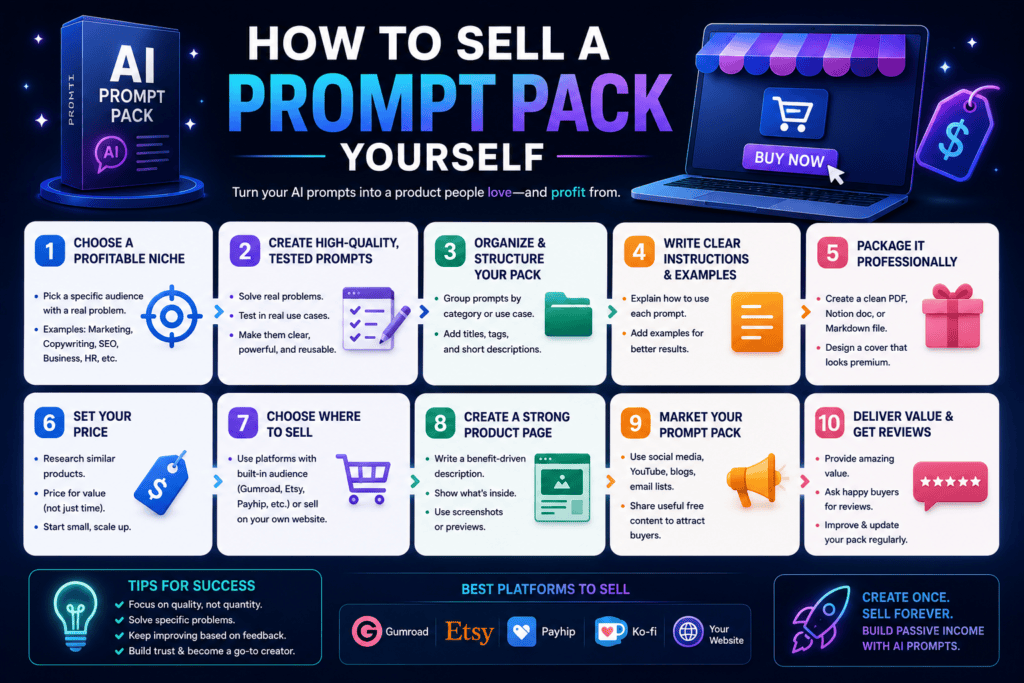
If you’re reading this from ilmilog.com’s angle — online earning, not just tool-buying — prompt packs are a legitimate, low-cost digital product to start with. We cover the full process in our complete guide to creating and selling digital products with AI; here are a few honest notes specific to prompt packs from watching this category:
- Price by depth, not prompt count. A tight 15-prompt pack with documented variables and example outputs will outsell a padded 300-prompt bundle every time buyers compare the two side by side.
- Include real before/after examples in your listing. This is the single biggest lever for reducing refund requests and building buyer trust — show exactly what input produces what output.
- Tier your offering. A common structure: Starter (minimal-input prompts, quick wins), Pro (stricter constraints, more examples), and Studio/Unlimited (extra templates plus multi-project workflows).
- Write a troubleshooting section. “If your output feels generic, add audience and one example” heads off support emails before they happen.
- Getly and Gumroad are the two easiest starting points for someone selling prompt packs individually, with both platforms handling payment processing and typically letting creators keep the large majority of each sale.
- Fiverr works too, as a service instead of a product — offer to build a custom prompt pack per client rather than selling one fixed bundle. Our Fiverr gig setup guide and Fiverr gig ranking guide walk through getting that gig seen in the first place.
What 50 Years of Content Work Taught Me About Buying Prompts
Volume is the oldest trick in digital products. A 500-prompt bundle sounds like more value than a 20-prompt pack. In practice, most buyers use fewer than 10 prompts from any pack they own, ever. What decides whether those 10 are good isn’t the other 490 — it’s whether the seller documented input variables clearly enough that you’re not guessing.
The best packs teach you to fish. Packs that include a short “how to customize this” section outperform ones that don’t, even when the base prompts are identical, because the buyer keeps adjusting them long after the pack is “done.” That’s the difference between a product and a one-time download.
Free tools have quietly caught up to paid bundles. Two years ago, paying for a prompt pack got you real structural quality you couldn’t get free. In 2026, free browser extensions like Prompt Sloth’s base tier and Velocity give you real-time prompt enhancement that beats a static, unmaintained pack sitting on your hard drive from six months ago.
Region-specific pricing quietly locks people out. If you’re paying from Pakistan or another market where a tool bills only in USD or in a foreign local currency, factor in currency conversion and payment method support before you assume a listed price is your actual cost.
Honest Verdict: Who Should Buy, Who Should Skip
| What Works Well | What Genuinely Doesn’t |
|---|---|
| Small, documented niche packs from real practitioners | Bloated “500+ prompts” bundles with no examples |
| Free browser extensions for daily, varied use | Packs with no troubleshooting or customization guide |
| Buying single high-value prompts for one specific task | Paying premium prices for prompts you can rebuild in 10 minutes |
| Building your own pack when you already have a workflow | Assuming volume equals value without checking documentation |
Best for: freelancers, content creators, and small business owners doing repeatable AI tasks who don’t want to build a prompt system from zero.
Skip if: you already have 2-3 hours to document your own best prompts — building your own will almost always beat buying, because it’s built around your actual work, not a stranger’s.
Rating: 4/5 — the category has real value in 2026, but only if you buy for structure, not volume.
People Also Ask
Q: Are AI prompt packs worth buying in 2026? A: For specific, repeatable tasks — yes, if the pack includes input variables and example outputs, not just a list of prompt lines. For general use, free browser tools like Prompt Sloth or Velocity now match or beat most paid static bundles.
Q: What’s the difference between a prompt pack and a prompt template? A: A template is a single reusable prompt structure. A pack bundles multiple templates around a theme — writing, coding, marketing — usually with shared documentation and customization variables.
Q: Can I sell my own AI prompt packs? A: Yes. Getly and Gumroad are the two most common platforms for individual creators selling prompt packs directly, typically letting creators keep the large majority of each sale after platform fees.
Q: Do ChatGPT prompt packs work the same in Claude or Gemini? A: Mostly, with some adjustment. Role and constraint-based prompts transfer well across models, but output-format instructions sometimes need small tweaks since each model interprets formatting requests slightly differently.
Q: What should a good prompt pack include besides the prompts themselves? A: A quick-start guide, a list of input variables to customize, at least one example input/output pair per prompt category, and a short troubleshooting section for when outputs come back too generic.
Q: Why do some prompt packs feel identical to others I’ve bought? A: A large share of prompt packs on marketplaces recycle the same underlying 40-60 prompts with slightly different wording and branding. Overlap you notice between packs isn’t a coincidence.
FAQ
Q: Is there a free way to get good AI prompts without buying a pack? A: Yes — AIPRM’s free community library and Velocity’s free tier both give real coverage without payment, though you’ll spend more time filtering for quality than with a curated paid pack.
Q: How much should a decent prompt pack cost? A: Most well-documented niche packs on Getly or Gumroad run $5-$40. Anything over that should include clear proof — example outputs, testimonials, or a preview — before you buy.
Q: Are prompt packs a good side income idea from Pakistan? A: Yes, this is one of the more accessible digital product categories — low production cost, global buyers, and platforms like Getly and Gumroad that don’t require local business registration to start selling.
Q: Do I need ChatGPT Plus to use most prompt packs? A: No. Most prompt packs work fine on the free tier of ChatGPT, Claude, or Gemini — the prompt structure matters more than which paid tier you’re on, though longer, multi-step prompts do run more reliably on paid models.
Q: How do I know if a prompt pack listing is low-effort or recycled content? A: Check for example inputs and outputs. If the listing only shows prompt titles with no proof of what they actually produce, that’s the biggest red flag in this category.
Q: What license should I look for if I’m using prompt outputs for client work? A: Look specifically for a “commercial use” or “client work” allowance in the license terms — a personal-use-only license technically doesn’t cover paid deliverables you build from the outputs.
Q: Can I get a refund on a prompt pack if it doesn’t work for me? A: Usually not by default, since digital downloads can’t be “returned” once accessed. Some marketplaces leave refund decisions to individual sellers — check a listing’s refund policy before buying, not after.
Final Recommendation
If you want the fastest daily improvement with zero setup, start with Prompt Sloth’s free tier today — it’s the lowest-friction option on this list and costs nothing to try. If you already know your five most repeated AI tasks, spend two hours this week documenting them into your own pack instead; it’ll outperform almost anything you could buy, because it’s built around your actual work, not a stranger’s guess at it.
At the time of writing, prompt pack quality varies enormously seller to seller — always check for real examples before paying, and verify pricing, licensing, and payment support for your region before checkout.
Editorial Policy & Trust Signals
- Last updated: July 2026
- Testing period: 4 weeks, July 2026
- Prompt packs and tools reviewed: 9
- AI models tested against: ChatGPT, Claude, Gemini
- Test runs conducted: ~45, across 5 task types
- Editorial policy: We test the AI tools, prompt packs, and platforms we cover before publishing. Ratings reflect our own testing and judgment, not paid placement. Some links on this page may be affiliate links — this never changes what we recommend or how we score a product.
Tested and written by the ilmilog.com editorial team. Last tested: July 2026.