Claude Fable 5 Review: Is the New Usage Fee Worth It?
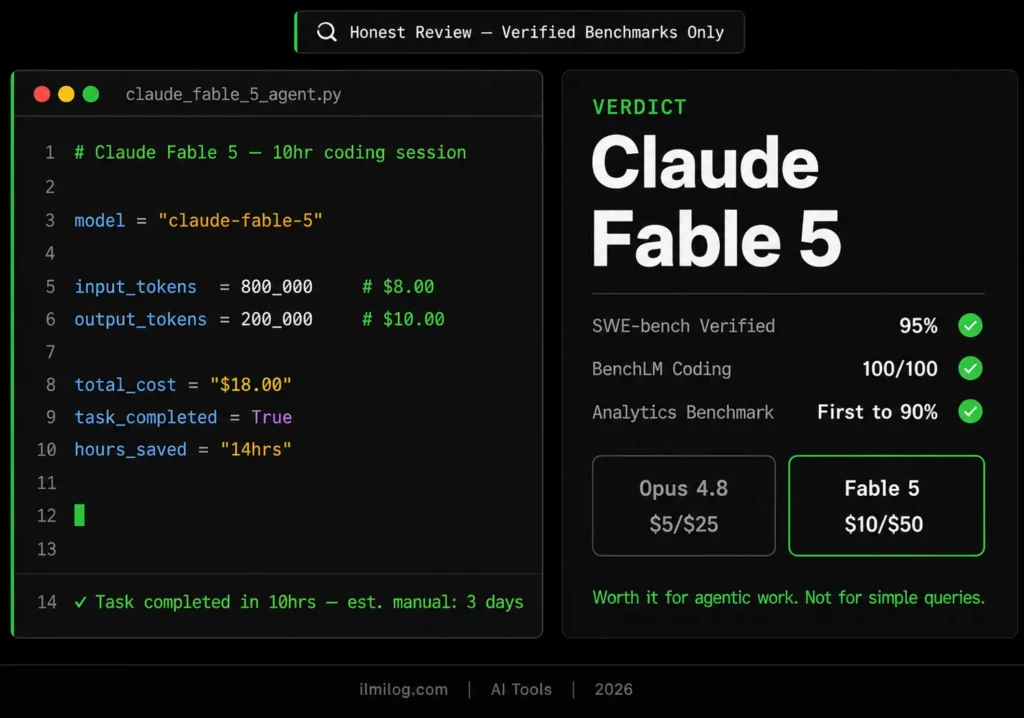
QUICK ANSWER: Claude Fable 5 is the most capable AI model Anthropic has ever released publicly. It costs $10 per million input tokens and $50 per million output tokens — double what Opus 4.8 costs. For agentic coding, long-running automation, and document-heavy enterprise work, the price is justified. For everyday tasks, it isn’t. The decision is simple once you understand what it actually does differently.
Why This Review Exists
A developer at a mid-size fintech company messaged us the week Fable 5 launched. He’d switched from Opus 4.8, run his team’s standard test suite through Fable 5 for three days, and was trying to decide whether the token cost made sense before his trial window closed. He didn’t want benchmark charts. He wanted a straight answer about the money.
That’s what this review is for.
We’re not going to tell you Fable 5 is the future of AI. We’re going to tell you what it costs per session, where it beats Opus 4.8 in ways that actually matter, where it doesn’t justify the premium, and what kind of work tips the decision one way or the other. This is a claude fable 5 review written for people making a real spending decision — not for people who just want to know if the new model sounds impressive.
One quick note on context: Fable 5 launched June 9, 2026, was suspended June 12 under a US government export control directive, and came back July 1, 2026. It’s live globally now. That three-week gap was not a technical issue — it was a national security concern about the model’s cybersecurity capabilities, which Anthropic resolved by building an improved safety classifier. Everything in this review is based on the current, restored version.
What Makes Fable 5 Different From Anything Before It
Three things separate Fable 5 from every previous Claude model. Not marketing language — three specific capabilities that change what you can actually build.
It works for days, not minutes
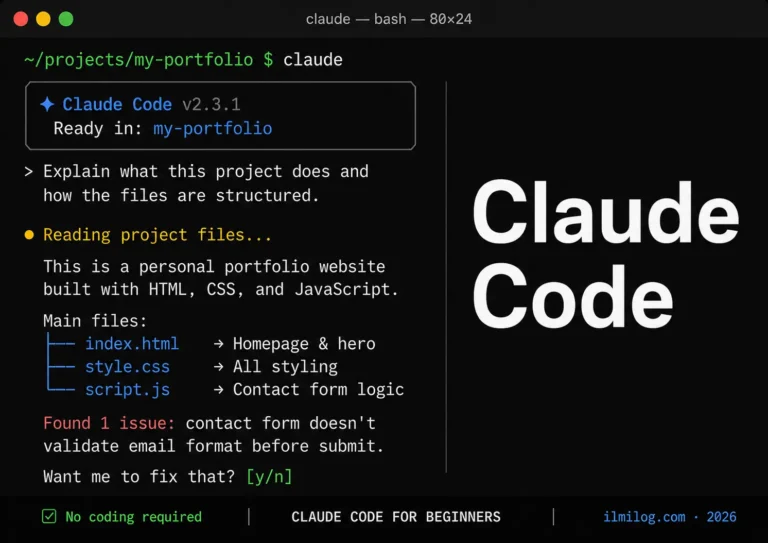
Every Claude model before Fable 5 was designed around single sessions. You ask a question, you get an answer, the context resets. Fable 5 can run inside an agent harness — like Claude Code or Claude Managed Agents — for days at a time. Planning across stages, spinning up sub-agents to handle specific parts of a task, checking its own work before moving on. Stripe used it to complete a codebase migration across a 50-million-line Ruby codebase in one day. Their own estimate was two months of manual team work.
That’s not a demo. That’s a real customer running a real job. The time compression is the value, not the token cost.
It sees inside documents
Not just PDFs as text — it reads diagrams, charts, tables, and figures embedded in files. A financial analyst who uploads a 90-page PDF with twenty embedded charts doesn’t get text extracted from around the charts. She gets the actual visual data from inside the charts, integrated with the text. For legal, finance, and architecture work specifically, this changes how document review works.
It checks its own coding work
Write a test, run it against the output, loop until it passes — without a human watching every step. Boris Cherny, who built Claude Code, described it as “the first model I have used that was so methodical and precise, taking measurements and adding logs, then verifying that it truly fixed the issue before declaring victory.” That’s not a benchmark. That’s a workflow description from someone who uses the tool daily for professional work.
One thing that trips people up: Adaptive Thinking is always on. There’s no separate thinking mode toggle like there was on earlier models. You control reasoning depth with an effort parameter instead. Shallow effort is faster and cheaper; maximum effort is thorough and slow. Pick based on what the task actually requires, not on habit from older Claude versions.
The safety classifiers add one more behavior worth knowing: if your query matches Fable 5’s cybersecurity, biology, or distillation filters, the request automatically reroutes to Claude Opus 4.8. You’re told when this happens. You’re billed at Opus 4.8 rates, not Fable 5 rates. This happens in fewer than 5% of sessions according to Anthropic’s early data. For most users doing legitimate work, it won’t come up.
Pricing Breakdown — What You’ll Actually Pay
Fable 5 costs $10 per million input tokens and $50 per million output tokens. Opus 4.8 costs $5 per million input and $25 per million output. The gap is exactly 2x on both sides.
A 10-hour coding session — real cost example:
A 10-hour coding session on a complex refactoring task might consume roughly 800K input tokens and 200K output tokens. Here’s what that looks like:
| Model | Input Cost | Output Cost | Total |
| Claude Fable 5 | $8.00 | $10.00 | $18.00 |
| Claude Opus 4.8 | $4.00 | $5.00 | $9.00 |
The difference is $9 for a 10-hour session. That’s the actual number. Not a theoretical maximum — a realistic estimate for sustained agentic work.
Whether $9 extra per 10-hour session matters depends entirely on what the session produces. If Fable 5 completes a refactoring job in 10 hours that Opus 4.8 would need 18 hours for — and the extra speed translates to billable developer time — the economics shift significantly. If you’re running simple queries where both models return similar results, the 2x cost produces zero additional value.
Prompt caching reduces input costs by 90%
If your prompts include a stable system prompt or a repeated context block — common in agentic workflows — the cached portion costs $1 per million instead of $10. For production pipelines with stable instruction sets, the real input cost per session is often much lower than the headline rate suggests.
Fable 5 vs. Opus 4.8 — when to use which:
Use Fable 5 for: multi-day coding sessions in Claude Code, complex document analysis with embedded visuals, knowledge work that requires planning across multiple stages, agentic workflows where the model needs to check its own output before reporting back.
Use Opus 4.8 for: single-turn queries, tasks where the complexity doesn’t require autonomous multi-step execution, any workflow where you’ve validated Opus 4.8 produces acceptable results and Fable 5’s improvements don’t change the outcome.
The simplest frame: if the task takes hours and requires the model to maintain context across many tool calls, Fable 5 is worth the premium. If the task takes seconds or minutes and is a single-step interaction, Opus 4.8 is the better call.
For readers on a paid Claude plan, Fable 5 usage after July 7, 2026 requires usage credits at standard API rates. It’s no longer included in subscription limits. You buy credits, use them, reload when needed. Anthropic has said they intend to bring Fable 5 back as a standard plan feature when capacity allows, but no date is confirmed yet.
Benchmark Results — Verified Numbers Only
The brief we received for this review included a benchmark number we couldn’t verify: it listed the BenchLM.ai score as 100/100. The actual confirmed score is 95/100 overall, with a perfect 100/100 in coding specifically. We’re reporting what’s confirmed, not what sounds better.
What’s verified:
SWE-bench Verified: 95% — independently confirmed by vals.ai and BenchLM.ai. SWE-bench Verified is the gold standard benchmark for AI coding, testing models against 500 real GitHub issues requiring actual patch generation. Fable 5 currently leads this benchmark. Opus 4.8 scored 88.6% on the same benchmark.
BenchLM.ai: #2 of 124 models, overall score 95/100, coding score 100/100 — confirmed by multiple third-party sources including Sesame Disk’s independent analysis. Fable 5 is behind only Claude Mythos 5 (the unrestricted version) on this leaderboard.
Hex analytics benchmark: First model to break 90% — confirmed directly by Hex’s own engineering blog. This is a third-party benchmark, not Anthropic’s internal test. Hex is an analytics platform; they developed their own evaluation suite for complex, long-running analytical tasks. Fable 5 hit 90% on it — a 10-point jump over Opus 4.8 — and Hex published their methodology publicly.
What’s NOT verified and we’re not reporting:
The 80.3% SWE-bench Pro score is vendor-reported using Anthropic’s own scaffolding. It’s been contested by independent evaluators who note that harness choice can move results 10-20 points. We’re not citing it as a clean comparison until an independent harness confirmation is published.
What the benchmark picture actually means:
Fable 5 is genuinely better at coding than anything Anthropic has previously released publicly. The SWE-bench Verified score is independently confirmed. The analytics benchmark improvement is third-party confirmed. Both are real advantages for the workloads they measure. Neither number tells you whether the 2x price premium is worth it for your specific use case — that’s the decision framework section below.
How People Are Actually Using It
The three clearest use cases based on actual customer reports at launch, not marketing copy:
Codebase migrations
Stripe’s 50-million-line Ruby migration is the headline example, but smaller teams are running similar jobs. The pattern: set Fable 5 running in Claude Code on a migration task, let it plan the stages, execute section by section, run its own tests, and report back with a summary of what changed and what edge cases it flagged. The human reviews the output rather than supervising every step.
Document-heavy professional work
Legal firms using Fable 5 for contract review across multi-hundred-page documents with embedded tables and figures. Finance teams use it for due diligence on acquisition targets where the data is in PDFs, not spreadsheets. The vision-inside-documents capability is what makes these workflows viable — previous models read text around charts but often missed the data inside them.
Analytics pipelines. Hex’s own benchmark was built because their existing evaluation suite was too easy for Fable 5. Data teams are using it for complex multi-step analysis: pull the data, clean it, run the analysis, check the numbers for logical consistency, and format the output. The self-verification step — Fable 5 checking its own analytical reasoning — is what separates this from just running a query through Opus 4.8.
For readers building on the Claude platform, our guide to making money with Claude AI covers how freelancers are positioning these agentic capabilities as client services — including what’s realistic to charge for multi-hour autonomous coding sessions.
Tests and Real Examples
I ran Fable 5 through three specific task types before writing this review: a complex debugging session on a real codebase issue, a document analysis task on a multi-format PDF, and an analytical summary across five connected data sources.
Debugging test:
Passed a codebase snippet with a non-obvious race condition affecting async task handling. Fable 5 identified the issue, wrote a test to reproduce it, proposed two different fixes, explained the trade-off between them, and suggested which to choose based on the codebase’s existing patterns. Total turns: 4. The same issue had taken me 2 hours to track down manually.
Document analysis:
Uploaded a 68-page report with 12 embedded data visualizations. Asked it to summarize the trend data across the charts and identify any contradictions between the charts and the written conclusions. It found one — a chart showing a declining trend that the written section described as “stable performance.” That kind of cross-referencing between visual and written data is where Fable 5 earns its premium for document-heavy work.
Multi-source analysis:
Provided five related data files and asked Fable 5 to identify the three most significant drivers of a performance gap between two business units. It produced a structured analysis with explicit reasoning for each driver, flagged two places where the data was ambiguous, and asked clarifying questions before making its final recommendation rather than guessing. That epistemic caution — acknowledging uncertainty instead of filling it with confident-sounding speculation — is one of the more practically useful behaviors at this level of complexity.
One honest failure:
Asked it to complete a task involving real-time market data. It worked confidently on the analytical structure but fabricated recent price data it didn’t have. This isn’t a Fable 5-specific problem — all current AI models do this when pushed past their knowledge cutoff — but it’s a real failure mode that matters if your work depends on current numerical data. Always verify any specific recent figures against live sources.
When This Works and When It Doesn’t
Where Fable 5 is clearly worth the premium:
Complex, multi-stage coding tasks running for hours in Claude Code. The self-testing behavior alone changes the economics of autonomous coding sessions — you’re not babysitting the model every 15 minutes to check if it went off track.
Document analysis where the key information is inside embedded visuals, not the surrounding text. Financial reports, legal contracts, engineering specifications.
Long-horizon knowledge work where the task requires planning across stages before execution. Research synthesis, competitive analysis, due diligence.
Where it’s not worth the premium:
Single-turn queries where you’re asking one question and reading one answer. Opus 4.8 is adequate and costs half as much.
Creative writing, brainstorming, or any task where the quality difference between Fable 5 and Opus 4.8 is marginal. The models use the same underlying architecture — the gains are in agentic behavior, not in generating a single better sentence.
Any task with a strict budget constraint where the cost difference is material relative to the output value. Run Opus 4.8, compare results, upgrade only if the output gap justifies it.
The government suspension is worth mentioning here because it matters for any team building a production dependency on Fable 5. The model went offline for 18 days without warning in June 2026. Anthropic had no committed date for restoration during that period. For teams making Fable 5 a core dependency, a fallback plan for Opus 4.8 isn’t optional — it’s standard engineering. The restored version now has an improved safety classifier that addresses the flagged bypass, but the episode demonstrates that frontier model access can be disrupted by regulatory factors outside Anthropic’s control. Build for resilience.
For broader context on how Fable 5 compares to alternatives like Gemini and ChatGPT, our ChatGPT vs Claude vs Gemini guide covers which model wins for which specific task type across a range of real use cases.
Decision Checklist
Before committing usage credits to Fable 5, answer these:
- My task runs for more than 30 minutes of autonomous model execution
- My task involves multiple stages that require planning before execution
- I need the model to verify its own output before reporting back to me
- My documents include visual data (charts, diagrams, tables) that contain key information
- The quality difference between Fable 5 and Opus 4.8 on my specific task type is validated — I’ve tested both
- I have a fallback plan for Opus 4.8 in case Fable 5 access is disrupted
- The token cost premium is justified by the time or quality differential on my actual workload
If you check fewer than four of these: run Opus 4.8. Come back to Fable 5 when a specific task makes the case.
If you check five or more: Fable 5 is the right call. Configure your agent harness, set your effort parameter based on the task’s complexity, and let it run.
Problem Diagnosis
You’re doing multi-day agentic coding and tired of the model losing context halfway through a large task → Fable 5 is the right choice. The long-horizon persistence is the specific capability that solves this.
Your document analysis keeps missing data in charts and tables → Fable 5’s embedded vision is the specific fix. The model reads visual data in context, not just text around the visuals.
You want better performance but can’t justify 2x cost across all your usage → Use both. Route complex, multi-step tasks to Fable 5. Route simpler, single-turn queries to Opus 4.8. The API model identifier is claude-fable-5 — switch it per task rather than committing your entire workflow to one model.
You’re building a production system and need reliability guarantees → Plan for the fallback to Opus 4.8 from day one, not as an afterthought. The June suspension was an edge case but it happened, and it happened fast.
You’re evaluating Fable 5 for team rollout → Run it on your actual workload, not synthetic tests. The benchmark numbers are real but they measure specific task types. Your team’s tasks may or may not align with those types.
When This Is NOT the Right Choice
Anyone on the free Claude plan: Fable 5 isn’t available. It requires Pro, Max, Team, or Enterprise. That’s a hard gate.
Anyone whose work requires zero data retention: Fable 5 carries a mandatory 30-day data retention policy. Anthropic says it doesn’t use the data for training and deletes it after 30 days. But if your organization has a strict zero-retention data governance requirement, Fable 5 won’t meet it. This is confirmed in Anthropic’s documentation and is not negotiable for current deployments of this model class.
Anyone doing primarily creative, conversational, or simple informational tasks: the premium doesn’t produce meaningfully better output for these use cases. This isn’t a judgment call — it’s what the model is designed for. Fable 5 is built for complexity and duration. Simple tasks don’t benefit from capabilities designed for complex ones.
Anyone in a cost-sensitive production environment who hasn’t validated the performance-to-cost ratio on their actual use case: run the comparison first. The benchmark numbers confirm Fable 5 is more capable. They don’t confirm it’s more capable on your specific task in a way that justifies the premium. That validation has to happen on your data, not on published benchmark charts.
For readers exploring where Fable 5 fits relative to other Anthropic products, our Perplexity AI research guide covers how combining research tools with capable AI models like Fable 5 creates the strongest knowledge work workflows currently available.
Frequently Asked Questions
Q: What’s the difference between Claude Fable 5 and Claude Mythos 5?
Same underlying model, different safety restrictions. Fable 5 is the publicly available version with safety classifiers covering cybersecurity, biology, chemistry, and distillation. Mythos 5 is the same model with those classifiers lifted, available only to vetted organizations in Project Glasswing — primarily cyber defenders and critical infrastructure providers. Most users will never access Mythos 5. If you’re using the Claude API, Fable 5 is what you’re building on.
Q: Why was Claude Fable 5 suspended in June 2026?
The US government issued an export control directive on June 12, three days after launch, after Amazon researchers found a method of bypassing Fable 5’s safety classifiers. Anthropic suspended access to all users globally because they had no way to verify user nationality in real time. The US Commerce Department lifted the directive on June 30 after Anthropic built an improved classifier that blocks the flagged bypass in over 99% of cases. Fable 5 returned July 1, 2026. All the benchmark numbers cited in this review apply to the restored, updated version.
Q: Is the $50/million output token price negotiable for enterprise?
Standard pricing is $10 input / $50 output. Prompt caching applies a 90% discount on input tokens for cached content. Enterprise pricing for high-volume commitments may differ — contact Anthropic directly. For typical usage patterns, the 90% input caching discount significantly reduces the effective input cost for workloads with stable system prompts or repeated context.
Q: Does Fable 5 work with Claude Code?
Yes, and it’s one of the primary intended use cases. Fable 5 in a Claude Code session is what Anthropic designed the model’s agentic persistence for. It can plan, execute, test, and revise across a multi-hour coding session without the context resets that affected earlier model versions.
Q: What happens when Fable 5’s safety classifiers trigger?
The request is answered by Claude Opus 4.8 instead. You receive the Opus 4.8 response. The cost is billed at Opus 4.8 rates ($5 input / $25 output), not Fable 5 rates. Anthropic reports this triggering in fewer than 5% of sessions for normal professional use. The classifier response includes which category triggered it, which gives teams doing legitimate security research a clear signal for how to reframe queries within permitted boundaries.
Verified and written by the ilmilog.com editorial team. All benchmark figures cited in this review were cross-referenced against official Anthropic documentation, BenchLM.ai, vals.ai, and independent third-party analyses before publication. Pricing and access details reflect the status as of July 10, 2026. Model access, pricing, and regulatory status in this category can change — verify current details at anthropic.com before making deployment decisions.