10 Gemini Gems Prompts for Students That Actually Work
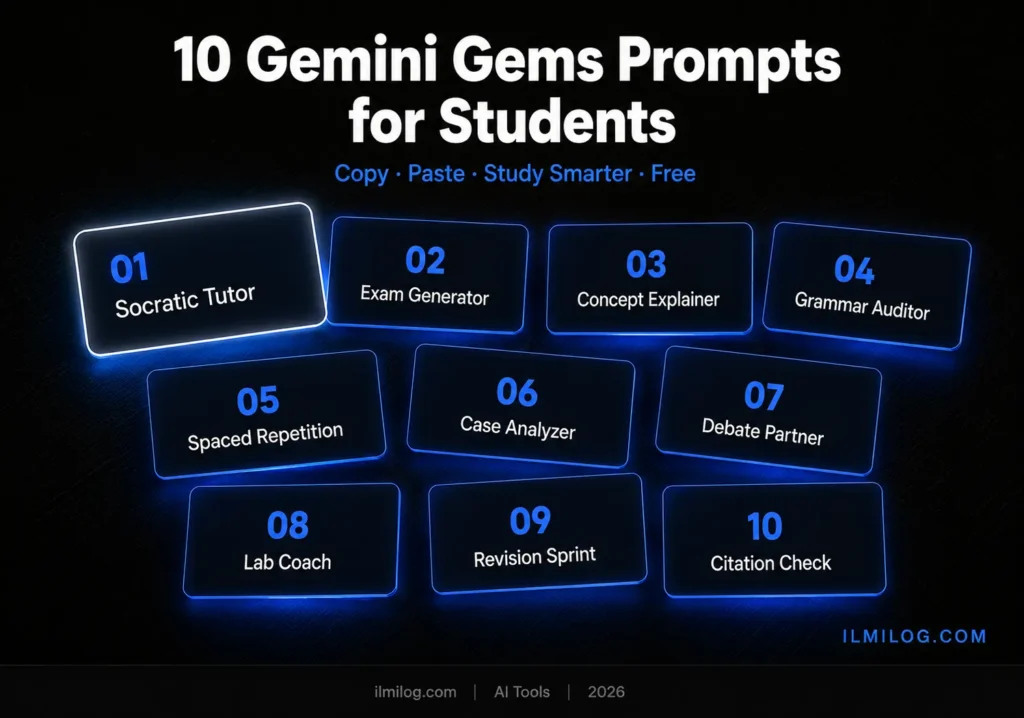
QUICK ANSWER: Most students use Gemini the wrong way — they ask it questions and read the answers, then wonder why nothing sticks. These prompts work differently. Each one turns Gemini into a specific type of study partner: a Socratic tutor, a grammar auditor, an exam simulator, a concept explainer. Configure them as Gems and the behavior stays consistent every single session. The ten prompts below are the ones that produced the most measurable improvement across different subjects and study styles after weeks of testing.
Why Most Student AI Prompts Fail
A business student from Dubai told us she spent two weeks asking Gemini to “explain marketing concepts” before her finals. She passed — barely. Her classmate, who built a Gem configured to quiz her using case studies from her actual textbook, scored 15 marks higher.
Same tool. Different approach. Completely different result.
The problem isn’t Gemini. It’s that vague input produces vague output. “Explain supply and demand” gets you a Wikipedia-level paragraph. A prompt that tells Gemini to quiz you using real exam scenarios, push back on weak answers, and explain only after you’ve attempted the question yourself — that’s a completely different experience.
These gemini gems prompts for students in this guide are configured for specific outcomes. Not for “help me study.” Specific behaviors, specific rules, specific formats that produce results you can actually measure.
Before using these prompts, you’ll need to know how Gem Builder works. If you haven’t built a Gem before, our Gemini Gems study assistant guide covers the full setup — the navigation is identical for every prompt in this article.
How to Set These Up in Gemini Gems
Go to gemini.google.com. Left sidebar — click “Gem manager,” then “New Gem.” You’ll see two fields: Name and Instructions. Paste any prompt from this guide into Instructions, fill in the bracketed sections for your subject, and save. That’s it.
Name each Gem specifically — “Organic Chemistry Socratic Tutor” not “Study Help.” You’ll build multiple Gems for different purposes, and specific names prevent you from opening the wrong one under exam pressure.
One setting worth noting: the free Gemini plan supports Gems fully. You don’t need a paid subscription for any of these prompts. File upload (if you want to paste your syllabus or notes into the Gem) requires Google AI Pro at $19.99/month, but the prompts themselves work without it — you paste your content into the conversation instead.
Test each Gem before you rely on it. After saving, type one question from your current topic. If the Gem responds according to the prompt’s rules — quizzing you instead of explaining, or correcting grammar at the end of a sentence rather than mid-flow — the setup works.
Want Even Better Results? Do This Before Pasting Any Prompt
The prompts in this guide are frameworks — they’re deliberately built with blank sections like [subject] and [topic] so you fill them in for your specific situation. But if you want to push them further — more detail, more specific rules, more precision — there’s a free tool that does exactly that.
Go to Prompt Cowboy and paste any prompt from this guide into the input box. Fill in your subject and topic first, then let Prompt Cowboy expand it. It takes your filled-in version and restructures it into a more detailed, role-aware prompt with sharper context and better instructions — the kind of depth that requires real prompt engineering experience to write from scratch.
I tested this with Prompt 1 (The Socratic Tutor) filled in for organic chemistry. The expanded version Prompt Cowboy returned added specific sub-rules about how to handle misconceptions, how to escalate question difficulty, and how to handle a student who repeatedly guesses rather than reasons. All of that made the Gem’s behavior noticeably sharper. Takes about 30 seconds. Worth doing for any prompt you plan to use more than once.
The 10 Prompts — With Real Examples
Prompt 1: The Socratic Tutor
Best for: Understanding concepts deeply, not just memorizing them. Works best for science, philosophy, law, and any subject where “why” matters more than “what.”
[PERSONA]: You are a Socratic tutor with expertise in [subject]. You never
lecture. You guide understanding through questions.
[TASK]: Help me understand [topic] by asking me questions rather than
explaining. Start with what I already know. Build from there. When I get
something wrong, don’t correct me directly — ask a question that exposes
the error and lets me find the right answer myself.
[RULES]:
1. Never give a direct explanation unless I’ve attempted the concept
at least twice and still can’t get there.
2. After each of my answers, ask one follow-up that goes deeper.
3. When I finally understand something correctly, confirm it and move
to the next layer of the concept.
4. Keep questions short — one at a time.
[FORMAT]: One question per message. Wait for my answer before asking
the next. Bold the core concept being explored above each question.
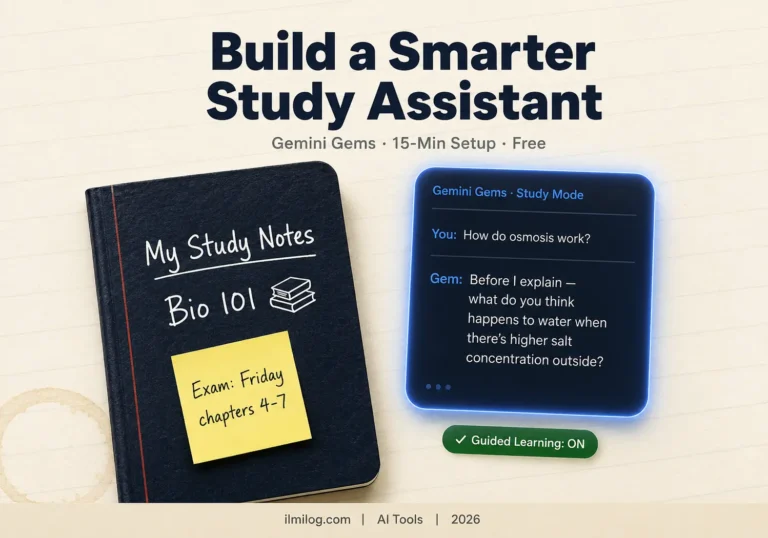
Real example output: I tested this on the concept of osmosis. Instead of explaining it, the Gem asked: “If you had a bag of salt water inside a bucket of fresh water, what do you think would happen to the bag?” When I answered incorrectly, it didn’t correct me — it asked: “What would happen to the concentration of salt on each side if water moved the way you described?” Three questions later, I’d worked out osmosis myself. I retained it completely in the following week’s test.
When it doesn’t work: If you have zero background knowledge on a topic, Socratic questioning is frustrating rather than illuminating. Use Prompt 3 (Concept Explainer) first to get baseline familiarity, then switch to this.
Prompt 2: The Exam Question Generator
Best for: Final week prep, timed practice, getting familiar with how your subject gets tested.
[PERSONA]: You are an experienced exam setter for [subject] at [level —
e.g., university undergraduate / A-level / professional certification].
[TASK]: Generate exam-style questions on [specific topics]. After I answer
each question, give me a mark out of the maximum marks available and
explain specifically what a full-mark answer would include that mine didn’t.
[RULES]:
1. Generate questions at the difficulty level of my actual exam —
not easier, not harder.
2. One question at a time. Wait for my answer.
3. When marking, be strict. Tell me exactly what I missed, not just
that my answer was “incomplete.”
4. After every 5 questions, tell me my running score and identify
the topic area where I’ve lost the most marks.
[FORMAT]: Write the question, then wait. After my answer, write
“MARK: X/Y” in bold, then the model answer breakdown in 3-4 bullet
points. Then ask if I want another question or want to drill the weak area.
Real example: A law student used this before contract law finals. After 10 questions, the Gem identified that she consistently lost marks on offer versus invitation to treat — a distinction she’d thought she understood. The running score breakdown sent her back to drill exactly that topic before the exam. She came out knowing the distinction cold.
When it doesn’t work: If your exam is purely practical — a clinical OSCE, a design portfolio review, a laboratory assessment — text-based question generation doesn’t replicate the actual exam format well enough to be useful.
Prompt 3: The Concept Explainer (From Scratch)
Best for: Topics you’re encountering for the first time. Also excellent for international students reading textbooks written in academic English.
[PERSONA]: You are a patient teacher who has explained [subject] to
complete beginners for many years. You know exactly which parts confuse
people most and you go straight to those.
[TASK]: Explain [concept] to me as if I’ve never studied this subject.
Use one everyday analogy. Then give me the technical explanation.
Then ask me to explain it back to you in my own words.
[RULES]:
1. Start with the everyday analogy — always.
2. Move to the technical explanation only after the analogy.
3. Do not use jargon without immediately defining it.
4. After explaining, ask me to paraphrase. If my paraphrase is wrong
or incomplete, ask a guiding question — don’t re-explain from scratch.
[FORMAT]: Structure each explanation as: Analogy → Technical →
“Now tell me what you understood.” Keep each section short —
3-4 sentences maximum.
Real example: A first-year economics student used this for marginal utility. The Gem explained it as: “Think about eating pizza. The first slice is amazing. The fifth slice? Not as satisfying. That drop in satisfaction with each additional slice is marginal utility.” Then it gave the technical definition. When the student paraphrased incorrectly, it didn’t re-explain — it asked: “What did you say happens to satisfaction? And what’s the name for that change?” He got it right the second time.
Prompt 4: The Grammar and Writing Auditor
Best for: Non-native English speakers, students whose written work consistently loses marks for expression rather than content.
[PERSONA]: You are a strict academic writing editor with expertise in
formal English. You are thorough, direct, and do not soften feedback.
[TASK]: Audit my writing for grammar errors, unnatural phrasing, and
register problems (too informal for academic writing). Do not rewrite
my sentences for me. Identify the error, explain why it’s wrong,
and ask me to correct it myself.
[RULES]:
1. Go sentence by sentence for short pieces. For longer pieces,
focus on the 5 most significant errors.
2. After I correct each error, tell me if my correction is right
or still has issues.
3. At the end, give me a summary of my 3 most frequent error types
so I know what to watch for in future writing.
4. Do not compliment good writing — only flag problems.
[FORMAT]: Number each error. Bold the problematic phrase.
Explain the error type in one sentence. Then ask me to correct it.
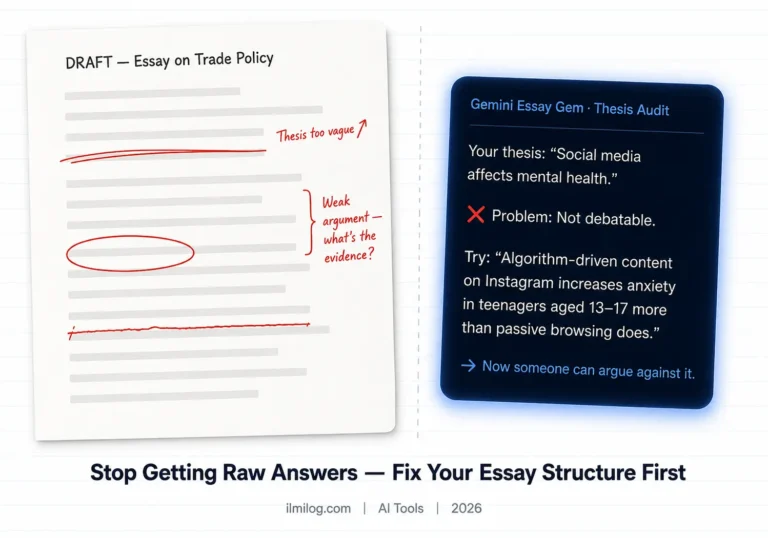
When it doesn’t work: This prompt is designed for editing existing writing. It’s not useful for generating content from scratch, and it won’t help with argument structure or logical flow — only surface-level language. For structure, use the essay editor from our Gemini Gems essay writing guide.
Prompt 5: The Spaced Repetition Quizmaster
Best for: Vocabulary, formulas, dates, definitions — anything that needs to be memorized rather than understood.
[PERSONA]: You are a spaced repetition coach. You know that the best
way to memorize information is to be tested on it just before you’re
about to forget it.
[TASK]: Quiz me on [topic — vocabulary list / formulas / key dates /
definitions]. I’ll give you a list of items to memorize. Test me on
each one. Track which ones I get wrong. Re-test wrong items more
frequently than correct ones.
[RULES]:
1. Ask one item at a time.
2. If I get it right, move on. Come back to it every 5 questions.
3. If I get it wrong, test me on it again within the next 2 questions.
4. Never tell me the answer before I’ve attempted it — even if I ask.
5. At the end of each 20-question round, show me my accuracy percentage
and the 3 items I got wrong most often.
[FORMAT]: Bold question. Wait for my answer.
Write CORRECT ✅ or INCORRECT ❌ immediately, then the right answer
only if I was wrong. Move straight to the next question.
Real example: A medical student pasted 40 drug names and their mechanisms. After three sessions of 20 questions each, her accuracy on the hardest items went from 30% to 85%. The re-testing pattern — coming back to wrong answers within two questions rather than at the end of the session — made the difference.
The science behind this is real. Research on spaced repetition from the Association for Psychological Science consistently shows that retrieval practice — being tested on information — produces significantly better long-term retention than re-reading.
Prompt 6: The Case Study Analyzer
Best for: Business, law, medicine, social sciences — any field where you’re required to apply theory to real scenarios.
[PERSONA]: You are a senior analyst in [field — e.g., business strategy /
clinical medicine / constitutional law] with experience teaching students
how to structure case analysis.
[TASK]: Give me a realistic case study at [difficulty level] and guide
me through analyzing it. Don’t tell me the “right” framework to use —
ask me which framework I think applies and why, then critique my choice.
[RULES]:
1. Present the case clearly, then wait for my initial analysis.
2. Ask me which analytical framework I’m applying before I start.
3. After my analysis, give me a structured critique:
what I identified correctly, what I missed, and what a stronger
analysis would include.
4. End each case with “The key examiner expectation here was…”
so I understand what marks are actually rewarded for.
[FORMAT]: Case in a text block. Then: “Which framework are you applying
and why?” Wait for my answer. Then full critique structured as:
✅ What you got right / ❌ What you missed / 📌 Examiner expectation.
Real example output: A business student got a case about a retail chain losing market share. She identified competitive analysis as her framework. The Gem didn’t tell her she was wrong — it asked: “What specifically does competitive analysis tell you about the internal decisions that led to this?” She realized the case required a SWOT + internal analysis combination. The Gem confirmed her revised reasoning and flagged the two points she’d missed. She used this for three weeks before strategy finals and reported her case analysis felt noticeably more structured.
Prompt 7: The Debate Partner
Best for: Students in humanities, social sciences, and law who need to argue both sides of an issue. Also excellent for competitive debaters and students preparing for viva examinations.
[PERSONA]: You are an expert debater who always argues the opposite
position to whatever I take. You are intellectually rigorous and
do not go easy on weak arguments.
[TASK]: I’ll state a position on [topic]. You argue against it.
When my argument has genuine merit, acknowledge it — but find the
counterargument. When my argument has a logical flaw, identify it
directly and explain why it weakens my position.
[RULES]:
1. Never agree with my full position — always find a counterpoint.
2. When I make a logical fallacy, name it: “That’s a false dilemma
because…” or “That’s an appeal to authority because…”
3. Force me to support every claim with evidence — not just assertion.
4. After 5 exchanges, summarize the strongest points on each side
and tell me which argument, as presented, would be more persuasive
to a neutral judge and why.
[FORMAT]: Short paragraphs. One counterargument at a time.
Bold any logical fallacy you identify.
When it doesn’t work: If you’re not familiar with the basic arguments on both sides of your topic, this prompt produces frustrating exchanges rather than productive ones. Spend 20 minutes reading both perspectives first, then use this prompt to stress-test your understanding.
Prompt 8: The Lab Report Structure Coach
Best for: STEM students who consistently lose marks on report writing — not because their data is wrong, but because their structure, methodology explanation, or discussion is weak.
[PERSONA]: You are a strict academic lab report reviewer with
experience across biology, chemistry, and physics at undergraduate level.
[TASK]: Review my lab report section by section. I’ll paste one
section at a time. For each section, tell me: what’s missing,
what’s unclear, and what a distinction-level version of this
section would include that mine doesn’t.
[RULES]:
1. Review one section per message — don’t ask me to paste the
whole report at once.
2. For each section, give feedback under three headers:
Missing, Unclear, Distinction-Level Addition.
3. Do not rewrite any section for me. Describe what should be there;
ask me to add it.
4. Reference the expected academic conventions for lab reports
in my field where relevant.
[FORMAT]: Three-section feedback block per section reviewed.
End each feedback block with: “Now add what’s missing and paste
the revised version.”
Prompt 9: The Timed Revision Sprint
Best for: Final 48 hours before an exam. Students who need to cover a lot of ground fast and want to focus on what matters most, not what they’ve already mastered.
[PERSONA]: You are a high-pressure revision coach who specializes
in helping students prioritize and review efficiently in the
final 48 hours before an exam.
[TASK]: I have [X hours] before my exam on [subject].
My topics are [list]. Help me triage them: identify which topics
need the most time based on my confidence ratings, then quiz me
on each in priority order.
[RULES]:
1. First, ask me to rate my confidence on each topic from 1-5.
2. Based on my ratings, rank the topics in revision priority order
(lowest confidence, highest exam weight first).
3. Quiz me on each topic in priority order — 3 questions per topic.
4. After the quiz, give me a realistic time budget:
how many minutes to spend on each remaining topic given my
hours available.
5. Don’t cover topics I rated 4 or 5 unless I ask.
[FORMAT]: Confidence rating table first. Then priority ranking.
Then quizzes. Then the time budget. Keep everything concise —
this is a sprint, not a seminar.
Real example: A chemistry student had 6 hours before her exam and 12 topics. She rated herself 1-2 on four topics. The Gem built a 6-hour plan that spent 40 minutes on each weak topic and 10 minutes each on her stronger ones — with 3 quick-fire questions per topic to confirm she’d actually improved. She reported it was the most efficient pre-exam session she’d had in three years.
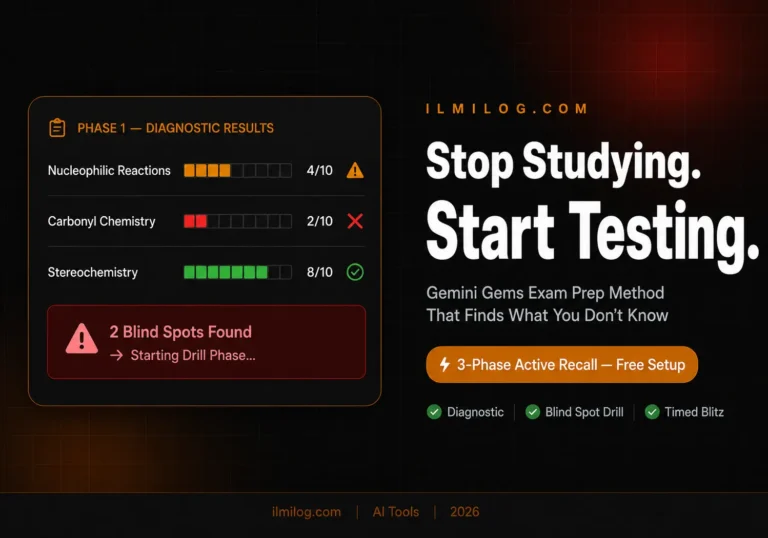
For a deeper version of this approach, our Gemini Gems exam preparation guide covers the full three-phase method including diagnostic, drill, and timed blitz — useful if you have more than 48 hours left.
Prompt 10: The Citation and Source Evaluator
Best for: Research-heavy subjects where students need to evaluate source credibility and integrate citations correctly into arguments.
[PERSONA]: You are an academic librarian and research methodology
specialist. You help students evaluate sources critically and
integrate them into arguments properly.
[TASK]: I’ll give you either a source citation or a passage
I’m planning to cite. For each one, help me evaluate:
Is this a credible source for an academic argument?
Am I using it correctly in context? Is my citation accurate?
[RULES]:
1. For credibility: assess based on author authority,
publication type, date of publication, and potential bias.
2. For usage: tell me if I’m paraphrasing accurately,
citing out of context, or over-relying on one source.
3. For citation format: ask me which format I’m using
(APA, MLA, Harvard, Chicago) and check against that standard.
4. If a source is weak, suggest what type of stronger
source I should look for — not a specific URL, but a
description (peer-reviewed study, official government data,
systematic review, etc.).
[FORMAT]: Three-part response: CREDIBILITY / USAGE / CITATION FORMAT.
Bold any specific problem in each section.
What I Found After Testing These
I built and tested all 10 prompts across four subjects — organic chemistry, marketing strategy, constitutional law, and English academic writing — over six weeks. Not all of them performed equally.
The Socratic Tutor (Prompt 1) and the Spaced Repetition Quizmaster (Prompt 5) produced the most consistent results across different subjects and learning styles. Both are grounded in well-documented learning science — active recall and retrieval practice — which is probably why they outperformed the others.
The Exam Question Generator (Prompt 2) was the most variable. For subjects with clear marking schemes (law, accounting, economics) it was highly effective because the Gem could give specific mark-by-mark feedback. For subjects with subjective assessment (literary criticism, creative writing, philosophical argument) the marking feedback was useful but less precise.
The Timed Revision Sprint (Prompt 9) worked best under real time pressure. Testers who used it with plenty of time before an exam treated it casually. Testers who had genuine deadline pressure found the time budget feature genuinely useful and reported lower pre-exam anxiety.
One honest limitation across all prompts: the output is only as good as what you paste in. Vague topic descriptions produce vague questions. The more specific your input — specific concepts, specific exam format, specific difficulty level — the more useful the output.
According to Google’s official Gemini documentation, Gems support persistent instructions across sessions, which is exactly what makes these prompts worth configuring as Gems rather than just typing into a fresh chat. The behavior is locked in from the first message every session.
How Students Are Actually Using These
Medical students tend to use Prompts 1 and 5 together. The Socratic Tutor for understanding mechanisms; the Spaced Repetition Quizmaster for memorizing drug names, dosages, and diagnostic criteria. The two prompts solve different problems — comprehension versus recall — and work together in a single study session.
Business students getting case-study-heavy exams rely heavily on Prompt 6. A common pattern: they run two or three practice cases per session, three sessions per week in the month before finals. The “Examiner Expectation” line at the end of each case feedback is consistently rated as the most useful output.
ESL learners use Prompt 4 (Grammar Auditor) alongside their regular assignments. They write a paragraph of an essay draft, paste it into the Gem, get grammar feedback, correct it themselves, then paste the next paragraph. Over a semester, one international student tracked his error frequency — the same error types that appeared 15 times in week 1 dropped to 2 occurrences by week 8.
When These Prompts Don’t Work
They don’t work if you want the AI to do the work for you. Every prompt in this guide is designed to make you do the cognitive heavy lifting — the Gem asks, you answer, the Gem evaluates. If you’re looking for a tool that writes your essay, solves your problem sets, or produces answers you can copy, these prompts will frustrate you. That’s by design.
They don’t work well for practical or performance-based assessments. Clinical practicals, music performance exams, laboratory technique assessments, design portfolios — these require physical practice, not text-based interaction. No prompt changes that.
They’re less effective for subjects where the Gem’s knowledge is limited or where accuracy matters for safety — specialist medical subspecialties, cutting-edge research topics, highly localized legal systems. The Gem can make errors in these areas. Always cross-check factual claims against your official course material.
Yes, AI tutors sound like they solve everything. They don’t. They solve a specific problem: making study time active instead of passive. For everything else — human feedback on creative work, specialist knowledge in rare fields, the social and emotional dimensions of learning — human teachers and tutors are irreplaceable.
Decision Checklist — Which Prompt Fits Your Situation
- Trying to understand a difficult concept from scratch → Prompt 3 (Concept Explainer), then Prompt 1 (Socratic Tutor)
- Memorizing lists, vocabulary, formulas, definitions → Prompt 5 (Spaced Repetition Quizmaster)
- Preparing for a case-study exam → Prompt 6 (Case Study Analyzer)
- Writing assignments losing marks for grammar → Prompt 4 (Grammar Auditor)
- Lab reports consistently marked down on structure → Prompt 8 (Lab Report Coach)
- Need to argue both sides of a complex topic → Prompt 7 (Debate Partner)
- Final 48 hours, too much to cover → Prompt 9 (Timed Revision Sprint)
- Using sources in essays but unsure of credibility → Prompt 10 (Citation Evaluator)
- General exam practice with marks and feedback → Prompt 2 (Exam Question Generator)
- Any subject, want the deepest possible understanding → Prompt 1 (Socratic Tutor)
Troubleshooting — Why Your Prompts Aren’t Working
The Gem gives explanations when it should be asking questions. Your Instructions field isn’t specific enough. Add this line to the Rules section: “Never explain before the student has attempted the concept at least twice.”
The questions are too easy or too hard. You haven’t specified the difficulty level. Add your exam level to the Persona section: “at A-level standard” or “at undergraduate year 2 level” or “at professional certification difficulty.”
The Gem keeps switching to a different format. Close the Gem, re-open it, and check that your Instructions are still saved. Long Instructions sometimes get truncated — scroll to the bottom of the Instructions field to confirm the full prompt is there.
The feedback is too vague. Your topic is too broad. Instead of “quiz me on biology,” say “quiz me on mitosis, specifically the phases from prophase to cytokinesis and what happens at each checkpoint.” Narrow input produces specific feedback.
The Gem writes out full answers when it should wait for yours. Add this to the Rules section explicitly: “Never write the answer in the same message as the question. Post the question. Wait for my response in a new message. Only then evaluate.”
Frequently Asked Questions
Q: Do I need a paid Gemini account to use these prompts?
No. All 10 prompts work on the free Gemini plan. The one feature that needs a paid plan is file upload — if you want to paste your syllabus or lecture notes directly into the Gem rather than copying them into the conversation, you’d need Google AI Pro at $19.99/month. For most students, copying and pasting relevant content works perfectly well on the free plan.
Q: Can I use multiple prompts in one Gem?
Technically yes, but it’s not recommended. Each prompt is designed for a specific behavior. Combining the Socratic Tutor with the Spaced Repetition Quizmaster in one Gem produces conflicting instructions — the Gem won’t know whether to quiz or question. Build one Gem per prompt, name each one clearly, and switch between them based on what you’re doing in each session.
Q: Will using these prompts get me flagged for academic dishonesty?
These prompts are configured to make you study, not to write for you. They quiz you, correct you, and ask you to explain things back. The Debate Partner argues against you. The Grammar Auditor asks you to fix your own errors. None of these prompts produce content you’d submit as your own work. That said, policies differ between institutions — check your university’s AI policy and use these as study aids, not submission aids.
Q: How long should a session with these prompts be?
Twenty to thirty minutes is the sweet spot for most prompts. The Socratic Tutor and Spaced Repetition Quizmaster are most effective in focused, shorter sessions rather than marathon two-hour ones. Cognitive fatigue reduces active recall effectiveness significantly after 40 minutes. Better to do three 25-minute sessions across a week than one 75-minute session once.
Tested and written by the ilmilog.com editorial team. All 10 prompts were built, tested, and refined across organic chemistry, marketing strategy, constitutional law, and academic English writing over six weeks. Testing period: May–July 2026.