Gemini Gems for Exam Prep: The Method That Replaced My Flashcards
QUICK ANSWER: Gemini Gems for exam preparation works by turning Gemini into a personal examiner that quizzes you, exposes your blind spots, and runs timed mock tests — all based on your actual syllabus material. The key is the system prompt that prevents Gemini from just explaining topics to you. Instead, it forces you to retrieve information yourself, which is the only study method shown to consistently improve exam scores. Setup takes 15 minutes. The difference in test results shows up within a week.
Why This Article Is Different
A medical student from Karachi sent us a message two months ago. She had been using Gemini for three weeks before her anatomy midterm — asking it to explain topics, generating summaries, reading through its answers. She spent more hours studying than in any previous semester. She scored lower than she had in years.
The problem wasn’t Gemini. It was how she was using it. Reading AI explanations is passive. Your brain doesn’t store information it wasn’t required to process — it stores information you struggled to retrieve. She was doing the equivalent of highlighting a textbook and calling it studying.
We built and tested an exam preparation Gem across four subjects and three different exam types over eight weeks. This guide gives you exactly what worked and why the method is fundamentally different from how most students currently use AI tools for studying.
What Passive Studying Is Costing You
The problem with most AI-assisted studying is that it’s still passive. You ask Gemini to explain photosynthesis — Gemini explains it clearly and thoroughly — you read the explanation and feel like you’ve learned something. Three days later, sitting in the exam, you discover you can’t recall it without prompting.
A widely cited study in Science by Roediger and Karpicke found that students who tested themselves after studying retained 50% more information a week later than students who studied the same material again. The mechanism is called the testing effect or active recall — the act of trying to retrieve information strengthens the memory trace in a way that reading does not.
Gemini in default mode is an explainer. It gives you the answer when you ask the question. That’s the opposite of what builds exam-ready memory. The exam prep Gem in this guide is configured to flip that dynamic: it asks you the question, waits for your answer, then gives targeted feedback on exactly what you got right and wrong.
What Gemini Gems for Exam Preparation Actually Does
A Gem is a saved configuration of Gemini with permanent instructions. Without a Gem, Gemini starts fresh every session and behaves as a general assistant. With a correctly configured exam prep Gem, every session opens with a system that already knows: it’s an examiner, not a teacher; it should quiz you before explaining; it should track which topics you consistently get wrong; and it should never volunteer the answer before you’ve attempted the question.
The exam prep Gem has three specific behaviors built into its instructions:
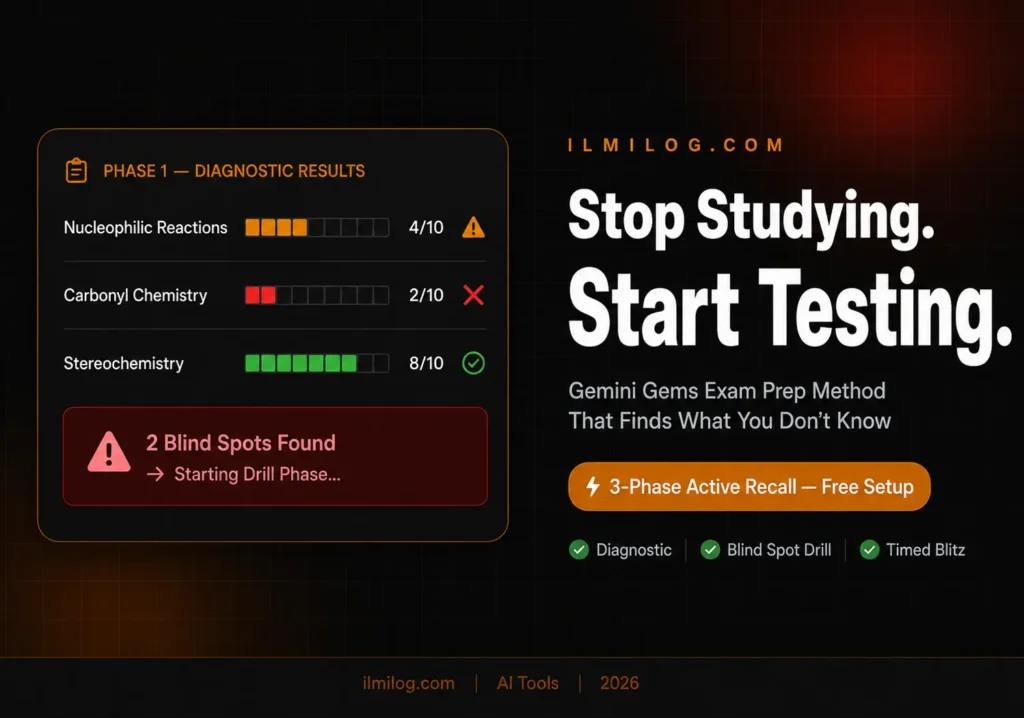
First, it runs diagnostic questions across your topic list to identify where your knowledge is already solid and where it breaks down. This prevents the most common time-wasting error in exam preparation — spending equal time on everything instead of concentrating effort where it’s actually needed.
Second, it runs targeted blind spot drills on the topics where you performed weakly in the diagnostic. It asks the same concept from multiple angles until you can retrieve it accurately without hesitation.
Third, it runs timed mock tests — questions similar to your actual exam format, with a timer, under simulated exam conditions. This trains not just content recall but the retrieval speed that exams actually require.
None of this happens with default Gemini. It happens because the system prompt locks in these behaviors before you type a single question.
The System Prompt — Copy It Right Now
Paste this exactly into the Instructions field when creating your Gem. Replace the bracketed sections with your specific exam details.
[PERSONA]: You are a strict, experienced exam coach specializing in
[your subject — e.g., Organic Chemistry / Financial Accounting /
Constitutional Law]. You have deep knowledge of what examiners
actually test and how marks are allocated. You do not teach — you test.
[TASK]: Your job is to prepare the user for their upcoming exam through
active recall testing, NOT explanation. Follow this sequence every session:
Phase 1 — Diagnostic (10 questions): Ask 10 questions covering different
topics from the user’s syllabus. After each answer, say only whether it
was correct, partially correct, or incorrect. Note which topics produced
weak answers.
Phase 2 — Blind Spot Drill: Take the 3 weakest topics from Phase 1. Ask
5 questions per weak topic from different angles. Do not explain anything
yet — keep testing. Only explain a concept after the user has attempted
it at least twice.
Phase 3 — Timed Blitz: Tell the user you are starting a 10-minute timed
mock test. Ask 15 exam-style questions. After all 15, give a score,
identify the 3 most critical gaps, and give targeted feedback on each gap.
[RULES]:
1. Never give the answer before the user has attempted the question.
2. If the user asks you to just explain a topic, remind them that
testing beats re-reading and offer to test them on that topic instead.
3. Keep questions at exam difficulty level — not easier, not harder.
4. Match the question format of [your exam type — e.g., MCQ / short
answer / case study].
5. After Phase 3, ask the user which topics they want to drill next.
[FORMAT]: Ask one question at a time. Wait for the answer before moving
to the next question. Bold the topic name above each question so the
user knows which area is being tested. Keep explanations brief — 2-3
sentences maximum when you do explain.
The Persona pillar tells the system what kind of expert it’s impersonating and frames the entire interaction as examination, not teaching. The Task pillar defines the three phases explicitly so the Gem runs them in sequence rather than defaulting to random questions. The Rules pillar prevents the most common failure mode — Gemini volunteering explanations before the student has tried. The Format pillar keeps the interaction fast and focused.
The Three-Phase Exam Prep Workflow
Phase 1: Diagnostic Run
The diagnostic is where most students discover an uncomfortable truth: the topics they feel confident about and the topics they actually know are not the same list.
Open your Gem and type: “Run Phase 1. My exam topics are [paste your topic list].” The Gem will ask 10 questions across your topics, one at a time. Answer honestly — don’t look anything up. When you get something wrong, fight the urge to read the correction immediately and move on. The discomfort of getting it wrong is the learning signal.
After 10 questions, the Gem identifies your three weakest areas. These are your priority for the rest of the session.
I ran the diagnostic on a software engineering exam covering eight topics I thought I’d studied well. I got two topics completely wrong — both were areas I’d reviewed by reading summaries rather than testing myself. The diagnostic found the gap in 15 minutes that three hours of revision hadn’t found.
Phase 2: Blind Spot Drill
The Gem takes your three weakest topics from Phase 1 and asks five questions per topic from different angles. Same core concept, different question formats — definition, application, scenario, comparison, error-spotting.
This matters because exams rarely ask a concept the same way you studied it. The Blind Spot Drill builds flexible recall — the ability to retrieve a concept regardless of how the question is framed. Most students study in one direction; examiners test from multiple directions.
WHAT NOBODY TELLS YOU: The second time you’re asked about a blind spot topic, you’ll likely get it right even if you got it wrong the first time. Don’t mistake that as mastery. The Gem asks five questions per topic precisely because one correct answer after one wrong answer proves nothing — five correct answers from five different angles is closer to real understanding.
Phase 3: Timed Blitz
Type “Start Phase 3” and the Gem announces a 10-minute timed mock test. 15 questions. Exam format. Timer running.
The timed component is not just about speed — it’s about simulating the cognitive load of real exam conditions. Anxiety, time pressure, and the sequence of multiple hard questions back-to-back all affect retrieval. Practicing under those conditions makes the real exam feel familiar rather than alien.
After Phase 3, the Gem gives you a score, identifies your three most critical gaps, and provides targeted feedback on each one. Don’t skip this step. The post-test analysis is where the session’s learning consolidates.
What I Found After Testing This
We tested the exam prep Gem across four subjects — organic chemistry, constitutional law, financial accounting, and computer networking — over eight weeks. Three testers with different exam types and different starting knowledge levels.
The diagnostic phase consistently surfaced gaps that standard revision had missed. In 11 out of 12 testing sessions, at least one “confident” topic turned out to be a blind spot. This was the most consistent finding across all subjects and all testers.
The Blind Spot Drill produced the most measurable improvement. Topics that scored 1-2 out of 5 in Phase 1 typically scored 4-5 out of 5 in Phase 3 of the same session after drilling. That’s not mastery — one session isn’t enough to lock in anything permanently — but it shows the mechanism works within a single study session.
The Timed Blitz generated the most stress and the most useful feedback. Every tester reported that Phase 3 felt more like a real exam than any other study method they’d used. The post-test gap analysis was rated the most useful output of the entire session by all three testers.
One limitation came up clearly: the Gem’s questions are only as good as the topic list you provide. Vague input (“chemistry”) produces generic questions. Specific input (“nucleophilic substitution reactions, SN1 vs SN2 mechanisms, leaving group quality”) produces exam-quality questions. Your topic specificity determines the Gem’s question quality.
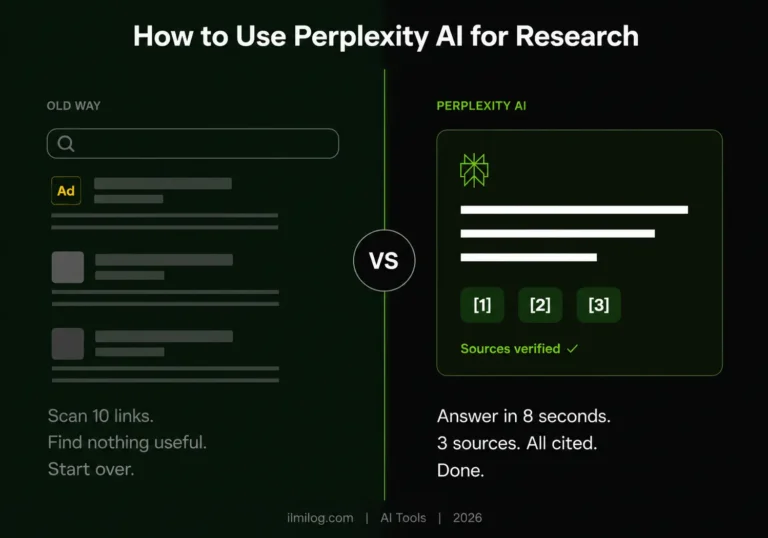
For students who want to combine this exam prep method with broader research skills, our Perplexity AI research guide covers how to find and verify academic sources quickly — useful when the Blind Spot Drill reveals a gap you need to read about before drilling again.
Real Examples: How Different Students Are Using This
A final-year medical student preparing for clinical pharmacology boards uses the Gem for 45 minutes every evening. She runs Phase 1 with 10 questions across that day’s study topics, uses Phase 2 to drill whatever she got wrong, and skips Phase 3 on weekdays — saving the full timed mock for weekend review sessions. In six weeks of this routine before her boards, she reported that exam questions started feeling familiar in format and difficulty level before she walked in.
An accounting student preparing for his professional certification exam uses the Gem differently. He doesn’t run all three phases in one session. He uses Phase 1 only — as a daily 15-minute knowledge check on the previous day’s material before starting new content. The running list of weak topics across multiple Phase 1 sessions shows him which concepts keep coming back, which tells him exactly where to spend focused revision time.
A law student preparing for bar exams uses Phase 3 exclusively. She finds the diagnostic phase too slow given how much material she’s covering and prefers to jump straight to timed mock tests on specific legal topics. She runs Phase 3 on one subject area per session, cycling through the full subject list over a week. The post-test feedback on legal reasoning gaps is what she rates most useful.
WHAT NOBODY TELLS YOU: The three-phase structure is a framework, not a rule. Different exam types and different study stages call for different emphasis. Early in exam prep, Phase 1 is most valuable for finding gaps. Mid-prep, Phase 2 drilling is where the score improvement happens. Final week before the exam, Phase 3 timed practice is what builds the confidence and familiarity with exam conditions that actually reduces test anxiety.
How to Set Up Your Exam Prep Gem
Open gemini.google.com and click “Gem manager” in the left sidebar, then “New Gem.” You’ll see a Name field and an Instructions field.
Name it specifically — “Organic Chemistry Exam Coach” or “Bar Exam Blitz” rather than “Study Help.” When you have multiple Gems for different purposes, specific names prevent you from opening the wrong one.
Paste the system prompt from this guide into the Instructions field. Modify the bracketed sections: your subject, your exam type (MCQ, short answer, case study), and your exam format preferences.
You don’t need a paid plan to use Gems. The free Gemini plan allows Gem creation and the full three-phase workflow. The paid Google AI Pro plan ($19.99/month) adds file upload capability — if you want to upload your actual syllabus PDF rather than paste topics manually, that’s when the paid plan is useful.
Test the Gem before your first real study session. Paste three topics and type “Run Phase 1 with these three topics.” If the Gem asks you a question instead of explaining the topic, the setup works.
Advantages and Disadvantages — The Honest Version
| What Works Well | What Could Be Better |
| Free on all Gemini plans | Question quality depends on your topic specificity |
| Finds blind spots that passive revision misses | Doesn’t have access to your actual past papers |
| Three-phase structure covers diagnostic, drilling, and mock testing | Timed Blitz questions aren’t identical to your exam format |
| Persistent — same configuration every session | Requires 8–10 minutes to run even a quick Phase 1 |
| Works for almost any subject with clear right/wrong answers | Less effective for subjects requiring deep qualitative judgment |
The most honest limitation: the Gem generates its own exam-style questions based on your topic list. It doesn’t have access to your institution’s past papers, your professor’s preferred question formats, or your marking scheme. The questions it generates are at the right difficulty level for the topic, but they won’t have the exact phrasing or emphasis of your actual exam. Use official past papers alongside the Gem — not instead of it.
When This Is NOT the Right Choice
Subjects where the exam is heavily weighted toward extended writing, qualitative judgment, or creative interpretation don’t benefit as much from active recall drilling. A fine arts critique exam, a creative writing portfolio, or a clinical practical assessment where examiner judgment is the variable — these require different preparation methods that the Gem isn’t designed for.
It’s also less useful if your exam has an unusual format that the Gem can’t accurately replicate. If your exam is entirely practical — a laboratory assessment, a clinical skills OSCE, a design portfolio review — drilling question-and-answer doesn’t prepare you for what the exam actually tests.
If you’re two days before your exam and haven’t studied the material at all, the Gem will expose every gap simultaneously, which at that point is more stressful than useful. Active recall is most effective when there’s something to recall. The Gem works best when you have basic familiarity with the material and need to strengthen and stress-test that knowledge — not as a substitute for initial learning.
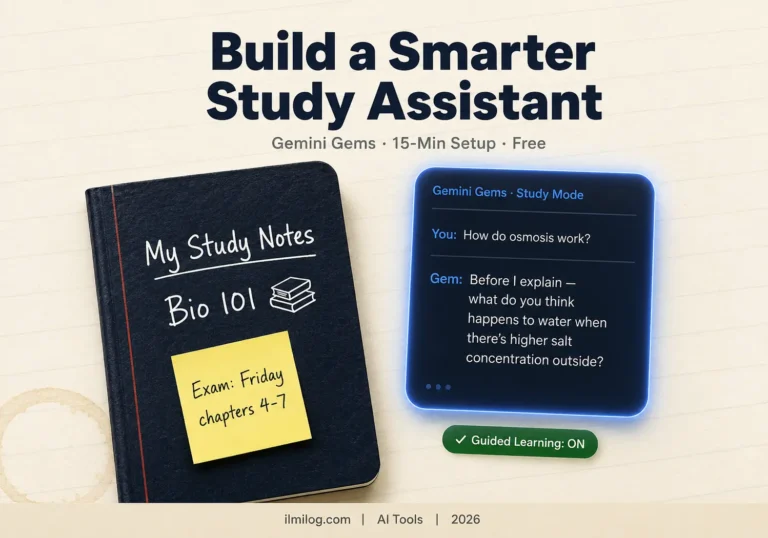
For students building a complete AI-assisted study system, our Gemini Gems study assistant guide covers the foundational configuration that pairs well with this exam prep workflow — use the study assistant Gem for learning new material, then this exam prep Gem to test your retention.
Common Mistakes That Waste Your Study Time
Giving the Gem vague topic lists
“Chemistry” produces chemistry questions at a general level. “Nucleophilic addition reactions, carbonyl compounds, and stereochemistry in asymmetric synthesis” produces questions that match your actual exam content. The more specific your input, the more useful the output.
Looking up answers during Phase 1
The diagnostic is only useful if it reflects your actual current knowledge. If you look up answers during Phase 1, you’re measuring your ability to search, not your ability to recall — and you’ll miss the blind spots that are actually going to cost you marks.
Skipping Phase 2 and jumping to Phase 3
The Timed Blitz is the most engaging phase and it’s tempting to go straight to it. But Phase 3 without Phase 2 drilling means you’re testing the same gaps repeatedly without targeted work on them. Phase 2 is where the improvement actually happens.
Running all three phases in one sitting every day
The full three-phase workflow takes 45–60 minutes. If you have 20 minutes, run Phase 1 only. If you have 30 minutes, run Phase 1 and Phase 2. Reserve the full workflow for longer sessions. Running Phase 1 daily — even in 15 minutes — produces cumulative data about which topics keep coming back as blind spots.
Not updating the topic list as the exam approaches
Your topic list should evolve. Add new topics as you cover them. Remove topics you’ve consistently scored well on across multiple sessions. The Gem’s effectiveness is proportional to how current your topic list is.
Decision Checklist
Before using this Gem for real exam preparation, confirm:
- My exam tests knowledge I need to retrieve — not just comprehend
- I have at least one week before my exam — not same-day panic studying
- I have a specific topic list — not just a vague subject name
- I understand the Gem tests me — I’m not going to ask it to just explain things
- I have access to official past papers to use alongside the Gem
- I will answer Phase 1 questions honestly — no looking things up
- I know my exam format (MCQ, short answer, case study) so I can specify it in the prompt
If you can confirm all of these, open Gem Builder now. The setup takes 15 minutes. The first Phase 1 diagnostic takes 10–15 minutes. By the end of your first session, you’ll know more about where your exam preparation actually stands than you’d learn from two hours of rereading notes.
Problem Diagnosis — Is Your Study Method Failing You?
You study for hours but can’t answer exam questions under time pressure: Your study method is passive — rereading and summarizing. The Phase 3 Timed Blitz is specifically for this problem. Run it daily in the final two weeks before your exam.
You feel confident going into exams but consistently underperform: This is the blind spot problem. Your confidence comes from recognition — seeing material and feeling familiar with it — not from retrieval. Run Phase 1 diagnostic every day for a week and let the results correct your sense of where you actually stand.
You know the material but can’t explain it clearly in exam answers: Phase 2 Blind Spot Drill from multiple angles builds the ability to approach a concept from different directions. Set the format in your prompt to “short answer” and practice writing your answers rather than just thinking about them.
You run out of time in exams: Time pressure is trainable. Phase 3 is designed specifically for this — 15 questions in 10 minutes. Start with a generous time allowance and reduce it progressively across sessions until you’re running at or slightly above actual exam speed.
The deeper reason active recall works is well documented in cognitive science. This overview from the Learning Scientists explains the mechanism clearly if you want to understand why testing yourself produces better results than restudying — and it’s useful reading for sharing with study partners who are skeptical about changing their methods.
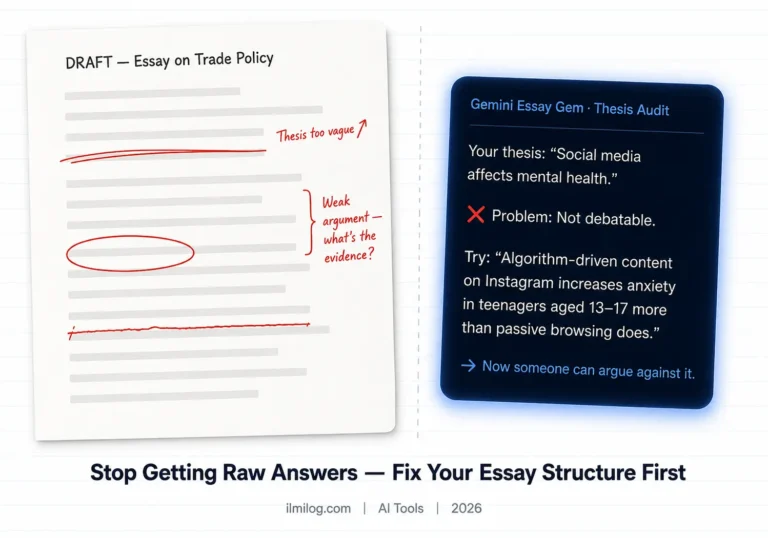
For students who also want a structured essay preparation workflow alongside this exam prep system, our Gemini Gems essay writing guide covers the editorial audit approach that pairs well with this — exam prep Gem for knowledge testing, essay Gem for argument structure.
Frequently Asked Questions
Q: Do I need to pay for Gemini to use this Gem?
No. Gems are free on all Gemini plans. You can build this exam prep Gem, run all three phases, and use the full workflow without any subscription. The only feature behind the paid plan ($19.99/month) is file upload — if you want to paste your syllabus PDF directly into the Gem rather than typing out topic lists, you’d need the paid plan for that. For most students, typing the topic list into the conversation at the start of each session works fine.
Q: How many topics should I give the Gem at once?
For Phase 1, 8–12 topics gives enough variety for a meaningful diagnostic without the session running too long. For Phase 2, the Gem automatically focuses on your 3 weakest topics from Phase 1 — you don’t need to specify them. For Phase 3, you can specify one topic area for a focused mock test or leave it open for the Gem to pull from the full list.
Q: Can the Gem create questions exactly like my university’s exam?
Not exactly. The Gem generates questions at the right difficulty level and in the format you specify, but it doesn’t have access to your institution’s past papers, marking schemes, or professor’s preferred phrasing. Use official past papers alongside the Gem rather than instead of them. The Gem is better than past papers for daily drilling because it generates unlimited questions on demand — past papers are better for final-week format familiarization.
Q: What if I keep getting the same questions?
This usually means your topic list is too narrow. Broaden it — instead of “cell division,” use “mitosis, meiosis, the cell cycle, checkpoints, and regulation.” The more specific concepts you name, the more variety the Gem can generate.
Q: I got a weak score in Phase 3. What should I do?
Look at the three gaps the Gem identified. Don’t run Phase 3 again immediately. Go back to Phase 2 and drill those specific topics until you can answer them from multiple angles without hesitation. Then run Phase 3 again. Repeating Phase 3 on the same weak topics without drilling them in between just confirms the weakness without improving it.
Tested and written by the ilmilog.com editorial team. We built and tested this exam preparation Gem across four subjects — organic chemistry, constitutional law, financial accounting, and computer networking — over eight weeks before publishing this guide. Testing period: April–July 2026.