Faceless Islamic YouTube Channels: What Works in 2026
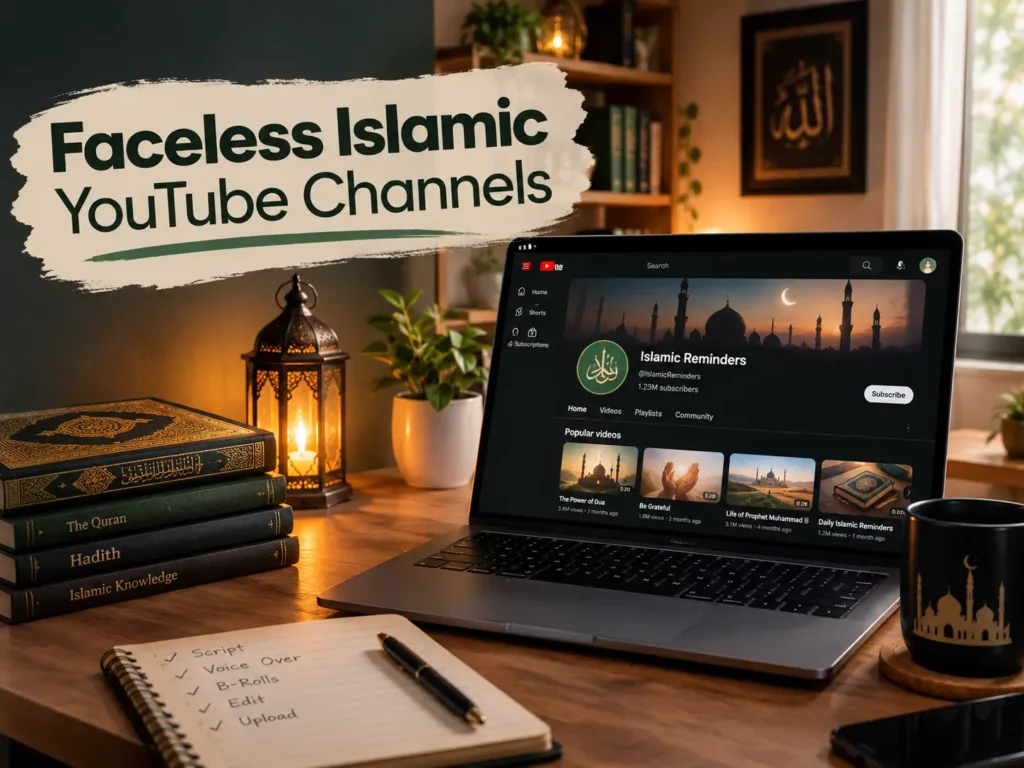
A channel without your face can earn on YouTube, and a channel about Islam can too. What doesn’t work is a channel that churns out template videos with an AI voice and stock footage. YouTube may refuse to pay for those, and a religious channel carries a second test on top: people trust it to be accurate and respectful. The first step is to pick one narrow topic you can verify from reliable sources, and write your first three scripts yourself before any tool touches them.
Think of the work as passing three gates. The first is religious accuracy and respect. The second is YouTube’s monetisation rules. The third is the money side, which in Pakistan has its own paperwork. A channel that clears all three can grow slowly and steadily. A channel that skips one usually fails at that one.
If the payment side is new to you, this guide to AdSense approval shows how Google’s verification works for Pakistani publishers.
I read YouTube’s published monetisation policies, reports on what Egypt’s Dar al-Ifta has said about AI and religious content, the text of Punjab’s law on printing and recording the Quran, and several guides on AdSense payments in Pakistan while preparing this. I’m not a scholar, and nothing here is a religious ruling. For rulings and anything sensitive, ask a qualified scholar you trust. The creators in the examples are illustrations, not real people.
Gate One: Get the Religion Right
Speed is the enemy here. A channel that publishes wrong information about the Quran, hadith, or history loses trust fast, and the comments will tell you.
Source everything
For every claim, write down where it comes from: the verse reference, the hadith collection and number, the book and page. Put the sources in the description. If you can’t find a source, don’t include the claim.
Don’t use AI to issue rulings
Egypt’s Dar al-Ifta has said that AI shouldn’t be relied on independently for fatwas or for interpreting the Quran. A MuslimMatters article on synthetic scholars and religious trust covers the reasoning. A faceless channel can quote qualified scholars and explain sources, but it shouldn’t present machine output as a ruling.
Be careful with recitation
Dar al-Ifta has also said that AI-assisted electronic Mushafs and synthetic recitations can be acceptable for teaching, provided qualified bodies review them for accuracy. Other Muslims consider the question contested. The safest path for a channel is to use recordings you have permission to use, or your own recitation reviewed by someone qualified. Recitation recordings are the work of the reciter and the publisher, so using one without permission is a copyright problem too.
Never fake a voice
Don’t clone a scholar’s or reciter’s voice, and don’t build an AI character that presents itself as a shaykh. That’s deception, and it’s one of the quickest ways to lose your audience.
Mind the visuals
Many Muslims avoid depicting the Prophets (peace be upon them) and the Companions in images or animation. If you’re unsure, ask a scholar you trust, and plan visuals that don’t depict them: calligraphy, architecture, nature, maps, and text on screen.
Don’t trust AI with Arabic
Image tools garble Arabic letters, and a spelling mistake in a verse or a dua is serious. Type Arabic text yourself from a verified source, then have someone who reads it well check the finished video. AI voices also mispronounce Arabic names and terms.
Know the local rules
Punjab has a law regulating the printing and recording of the Holy Quran, including audio and video, with a Quran Board that oversees it. You can read the Punjab law yourself. If you publish Quranic text or a recording as your own, check what applies where you live and where your audience is.
Gate Two: Pass YouTube’s Rules
YouTube pays channels that offer original value. Its monetisation policies are worth reading in full, and the parts below matter most for a faceless religious channel. You can find them on YouTube’s own monetization policies page.
Generic or repetitive content
YouTube says channels where videos feel interchangeable aren’t allowed to monetise. Its examples of what doesn’t qualify include image slideshows, templated storylines, and scrolling text with minimal narrative or educational value, and also AI-generated content made from generic templates without the creator’s own insight. A daily video with the same layout, a stock voice, and a different dua on each one is exactly that.
Reused content
Videos made mostly from other people’s material aren’t allowed either. YouTube lists content that exclusively features readings of materials you didn’t create, collections of songs from different artists, and the promotion of other people’s content, even if you have permission. For Islamic channels, that means re-uploading lectures, or simply reading out a text or a translation with nothing added, is risky. If we can’t tell the content is yours, YouTube says monetisation may be removed from the whole channel.
Unsatisfying or off-putting content
This covers channels that rely on emotionally manipulative formulas or on shock for its own sake. Fear-bait titles about the end of the world are the obvious Islamic-channel version.
AI personas on sensitive topics
YouTube won’t let channels monetise when they use AI-generated personas that present themselves as human experts giving advice on topics such as health, legal issues, finances, or politics. Religion isn’t named in that list, but the list says “such as” and isn’t exhaustive, and an AI “shaykh” would raise the same concerns. Don’t do it.
The same page makes clear what is fine. Using AI to edit your scripts or to generate a unique background visual is allowed, as long as the final video shows your own creative vision and gives viewers something of value. A recurring intro and outro are fine, and so is a series, as long as each video has its own focus.
Reviewers look at your channel’s main theme, most viewed videos, newest videos, biggest share of watch time, titles, thumbnails, descriptions, and the About section. So the whole channel has to look like one person’s considered work.
The numbers
To earn ad revenue you need 1,000 subscribers plus either 4,000 public watch hours in the last 12 months or 10 million public Shorts views in the last 90 days. An earlier tier at 500 subscribers unlocks fan features, not ad revenue. Several reports say that for new applicants from 1 February 2027, the bar rises to 8,000 watch hours or 20 million Shorts views. That hasn’t been confirmed in the sources I could read here, so check YouTube’s current Partner Program page before you apply.
Gate Three: The Money and the Paperwork
Even after approval, getting paid in Pakistan takes steps.
Payments go through AdSense for YouTube. Google’s payment-method table lists wire transfer for Pakistan, with EFT not offered, so a bank wire in rupees is the usual route. Check the current table, since methods change.
The payment threshold is $100. Earnings roll over each month until you pass it. You’ll also have to verify your address with a PIN that Google posts to you, which has been reported to arrive once your earnings pass about $10.
You must submit US tax information to Google, whatever country you live in. If you don’t, Google may withhold up to 24% of your worldwide earnings. Once valid information is in, withholding applies only to earnings from US viewers, at a rate that depends on tax treaties. Sources I read give different figures for Pakistan, so fill the form in and check the rate YouTube shows you.
Your bank may charge for receiving a wire and convert dollars into rupees at its own rate. Both take a bite from small payments.
And be honest about time. Reaching the thresholds often takes many months, and some months nothing arrives. Treat this as a project that earns later, not a way to cover this month’s bills.
Channel Ideas That Can Actually Be Original
A channel needs a reason to exist beyond reading texts aloud. These ideas can be done without showing your face, and each one only works if you add your own research and explanation.
| Idea | What makes it original | Main risk |
| Seerah and Islamic history timelines | Your own maps, timelines, and cited sources | Mistakes in dates or events, and depicting people |
| Tajweed rules explained with diagrams | Original diagrams and clear teaching, reviewed by a qualified teacher | Recitation rights and accuracy |
| Meanings of common duas with sources | A clear explanation and exact references for each one | Weak or invented sources |
| Ramadan and Eid practical guides | Timetables, planning tips, checklists in Urdu or English | Mostly seasonal viewing |
| Islamic architecture and travel stories | Licensed or original footage with your own narration | Footage rights |
| Kids’ manners and stories with original characters | Your own characters and lessons | YouTube’s rules for “made for kids” content |
Pick one and stay narrow. A channel with a clear promise, like “short timelines of the Seerah with sources,” is easier to grow and easier to defend if YouTube reviews it.
A Workflow That Keeps a Human in Charge
1. Choose one question per video. A specific question gives the video a shape.
2. Collect three reliable sources. Write down the exact references as you go.
3. Write the script yourself. Use AI, if at all, to outline or to tighten a draft, never to supply facts.
4. Have it reviewed. A knowledgeable person checks religious content before you record.
5. Record the voice. Your own voice, a hired narrator, or a text-to-speech voice for non-sensitive parts. Keep Arabic and Quranic text human.
6. Make the visuals. Use original footage, licensed footage, calligraphy you’ve checked, maps, and nature. If you generate visuals with AI, review every frame, and a guide to tools like Kling AI shows what they can and can’t do.
7. Publish with sources. Put references in the description, and disclose realistic synthetic content where YouTube requires it.
8. Read the comments. Corrections from viewers are useful. Fix mistakes openly and pin the correction.
Three Channels, Three Outcomes
These are illustrative scenarios based on how these channels usually behave. They are not reports about real people.
The student making Seerah timelines
He writes his own scripts from cited sources, builds simple maps, and records his own voice. It went smoothly in terms of quality, and comments were kind. It stalled on time, since each video took most of a week. He’s growing slowly, and his watch hours are on track for the long run.
The hobbyist automating daily dua Shorts
He built a template: a stock background, a text-to-speech voice, and a new dua every day. It went smoothly for the first month. Then a viewer pointed out that one hadith reference was wrong, and others noticed the videos all felt the same. Trust dropped, and the channel’s monetisation application was refused. His mistake was volume over accuracy.
The teacher explained Tajweed
She draws her own diagrams and has a qualified reciter’s permission to use short recitation clips. It went smoothly once permission was written down. It stalled earlier, when she used a clip without checking, and a rights claim came in. Now she asks first, every time.
Mistakes That End Channels
Publishing without sources. One wrong hadith reference can undo months of trust.
Using templates. Videos that feel interchangeable are exactly what YouTube says it won’t pay for.
Re-uploading or reading out other people’s work. Even with permission, it can count as reused content.
Presenting an AI voice as a scholar. It deceives viewers and breaks YouTube’s rules on AI personas.
Garbled Arabic. Check every letter yourself, and have someone check again.
Ignoring recitation rights. Recordings belong to reciters and publishers.
Fear and shock titles. They trigger YouTube’s off-putting content rules and push away the viewers you want.
Counting on income too early. Plan for many months of work before the first payment.
Warning Signs and What to Do
A monetisation refusal usually means the channel looked generic, reused, or templated. Read the reason in your email, change what it names, and don’t reapply until the channel genuinely changes.
A rights claim means someone owns material in your video. Remove or replace it, and keep a written record of permissions from then on.
Comments pointing out errors mean you have a quality problem. Correct it quickly and openly.
Limited ads on a video usually mean it doesn’t meet the advertiser-friendly guidelines. Look at the title, thumbnail, and topic.
Four Self-Checks Before You Publish
The source check. Does every claim have a reference you can show? If not, cut it or find one.
The template test. Watch your last three videos in a row. Do they feel interchangeable? If so, change the structure, not just the topic.
The reviewer checked. Has someone knowledgeable read the script?
The money check. Estimate your hours per video and your likely watch time. If the thresholds will take years, adjust your plan or your expectations.
Decision Checklist: Is a Faceless Islamic Channel Right for You?
Answer yes or no to each one.
- Can you verify religious claims from reliable sources, and cite them?
- Do you have someone qualified who will review sensitive scripts?
- Are you willing to write your own scripts, not publish template output?
- Can you do Arabic text and recitation properly, or avoid them?
- Are you willing to work for months before the first payment?
- Do you have a plan for AdSense verification, tax information, and a bank that accepts wires?
- Will you avoid cloning voices and depicting the Prophets?
If most answers are yes, start with one narrow topic and three carefully sourced videos. If the first or second is a no, solve that before you record anything.
When a Faceless Islamic Channel Is Not the Right Choice
It’s the wrong project if you want quick money. Thresholds, verification, and payment take months.
It’s wrong if you can’t check religious content or have no one to review it, since mistakes here cost more than on most topics. It’s wrong if your plan depends on AI-generated rulings, recitations, or scholar voices. And it’s wrong if you’d rather publish daily to a template, because that’s the model YouTube’s rules are built against.
If the real goal is income, a skill-based service may pay sooner while a careful channel builds in the background.
Quick Problem Diagnosis
| What you see | Likely cause | First thing to check |
| Monetisation refused as generic or repetitive | A templated channel | Make each video’s structure and substance clearly different. |
| Refused as reused content | Little original input | Add your own research, commentary, and explanation. |
| Viewers point out mistakes | Weak sourcing | Add references and have a reviewer check scripts. |
| A rights claim on a video | Unlicensed audio or footage | Remove it, and keep written permissions. |
| Payments are stuck | Missing verification or tax information | Check the PIN and tax forms in AdSense. |
| Views are low | An unclear promise | Narrow the topic and say what each video answers. |
Questions People Ask
Can an Islamic channel be monetised without showing my face?
Yes. YouTube judges the content, not whether you appear on camera. It has to be original, valuable, and policy-compliant.
Can I use an AI voice for narration?
For non-sensitive parts, many creators do. Keep Arabic and Quranic text human, and don’t present an AI voice as a scholar.
Can I use AI to generate Quran recitation?
Scholars differ. Egypt’s Dar al-Ifta has said AI-assisted recitation tools can be acceptable for teaching if qualified bodies review them. A channel is safer using recordings with permission, or a reviewed recitation of its own.
Is it okay to re-upload lectures with permission?
It may still count as reused content for monetisation. Add substantial original explanation, or use short clips inside your own analysis, and check rights.
How long until I can earn?
Often many months. You need 1,000 subscribers plus the watch-hour or Shorts requirement, then YouTube’s review, then AdSense verification and the $100 payment threshold.
Are there laws about Quran content in Pakistan?
Punjab has a law on printing and recording the Holy Quran, including audio and video. You can read the Punjab law yourself, and ask a qualified person if you plan to publish Quranic text or recordings.
How do I get paid in Pakistan?
Through AdSense, usually by wire transfer in rupees, once you reach $100. You’ll need address verification and US tax information first.
Your First Month
Pick one narrow topic. Write down three reliable sources for each of your first three videos. Write the scripts yourself and have them reviewed. Record, add original visuals, and publish with sources in the description. Then read the comments carefully and correct anything wrong.
For outlining and tightening scripts, these prompt packs can save time, but the facts, the review, and the final voice have to stay yours.