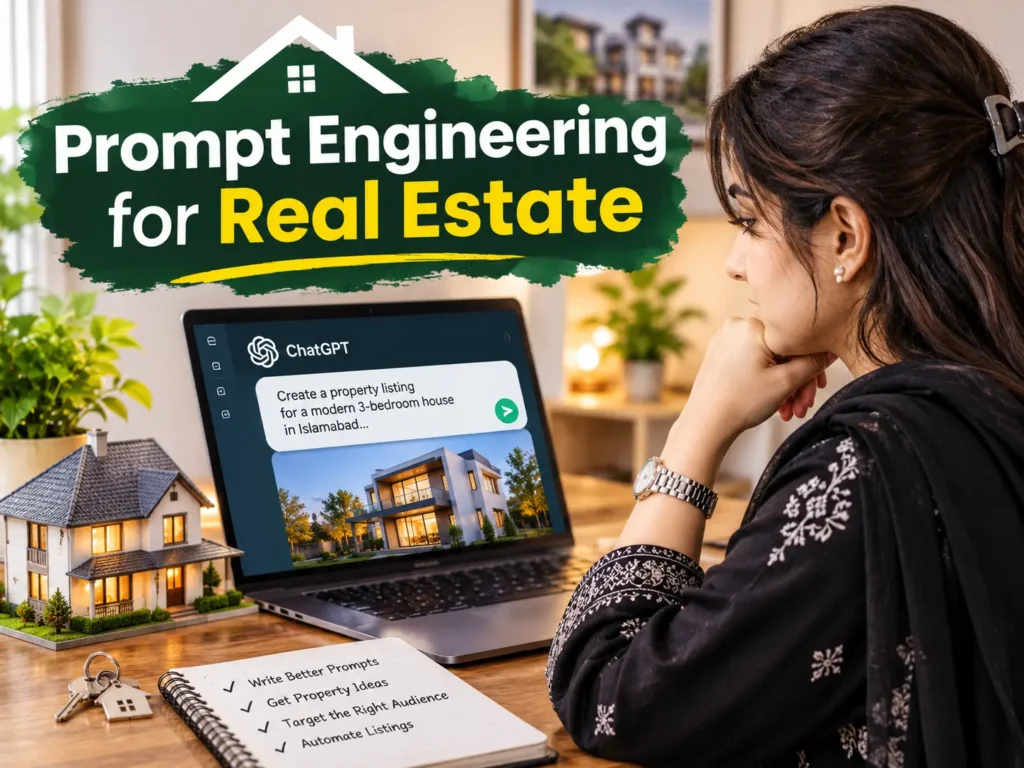
Prompt Engineering for Real Estate: 9 Prompts That Work
For a property agent, good prompting means giving an AI tool the real facts of a listing, the person who’ll read the message, a few firm rules, and the shape of the answer you want. Done that way, it can draft listing descriptions, WhatsApp replies, follow-ups, and client updates in minutes. The biggest risk is that it invents details, like a size, a price, or an approval, and in Pakistan a false claim about a plot or a housing scheme can cost a client real money. The first step is to write a fact card for one listing, paste it into a simple prompt frame, and check every number in the result before it goes out.
Everything below follows from that one idea: facts in, rules around them, and a human check before anything is sent.
If you’d like a bigger library of ready-made prompts to compare with the ones here, these prompt packs are a good place to browse.
I read the official prompting guidance from the AI companies, Zameen’s published advice on posting property ads and taking listing photos, and an August 2026 analysis of Pakistan’s real estate regulation while preparing this. I haven’t measured how much time any agent saves, so there are no time claims here. The agents in the examples are illustrations, not real people.
The Six-Part Frame
Anthropic’s prompting guide says the same thing most guides do: be clear and direct, give context, show examples where you can, and say what format you want. For property work, that turns into six parts.
1. Job. What you want done. “Write a listing description” is a job. “Help with my listing” isn’t.
2. Facts. Everything true about the property, from your fact card. This is the part that matters most.
3. Reader. Who will read it. A first-time buyer in Lahore, an overseas Pakistani deciding from far away, and a landlord all need different words.
4. Rules. What the tool must not do. Use only the facts given. Don’t guess. Don’t promise profits. Don’t claim approvals unless the card says so.
5. Shape. Length, language, and layout. A short title, a description of about 120 words, five bullets. Or a three-line WhatsApp message.
6. Check. Ask it to list any facts it assumes or any facts it needs. This catches gaps before they become mistakes.
Here’s the frame as one prompt you can reuse:
Job: Write a listing description for [portal]. Facts: [paste the fact card]. Reader: [who will read it]. Rules: Use only the facts above. Don’t guess or add details. Don’t promise returns or say anything is approved unless the facts say so. Keep the tone plain and honest. Shape: A title in one line, then a description of about 120 words, then five bullet points. Check: After the text, list anything you had to assume and anything missing.
Build a Fact Card First
A fact card is a short list of what you know to be true. The AI repeats what you give it, so a weak card gives you a confident, wrong description.
Include the property type, the city, the area, society, phase, and block, and the size with its unit written out. Add the price and whether it’s negotiable, the possession status, which utilities are connected, the condition, parking, nearby landmarks you’ve seen yourself, and the date you last verified it all.
Write the unit next to every number. Marla and square feet get mixed up constantly, and the size of a marla can differ by region and society, so use the local standard and a calculator, not the AI. Never ask a chat tool to do the conversion for you.
For anything you haven’t seen a document for, such as approval status, a society’s NOC (no objection certificate), or ownership papers, write “not verified.” That tells the tool to leave it out and reminds you to check.
Nine Prompts for Everyday Jobs
Each one uses the frame above. Swap in your own facts.
1. Listing title and description
Zameen’s guide to posting a property ad suggests putting the total area in the title and describing floors, layout, and best features simply. Prompt: Write a one-line title that includes the area and location, and a plain description of about 120 words, using only these facts. Check: every number against your card.
2. First WhatsApp reply to an enquiry
Prompt: Write a friendly first reply in Roman Urdu to someone asking about this property. Thank them, confirm two key facts, and ask when they’d like to visit. Under 50 words. Check: the facts, and that the tone sounds like you.
3. Follow-up after a viewing
Prompt: Write a short, polite follow-up in Roman Urdu for a client who saw the house yesterday. Ask what they liked and what concerned them. No pressure, no false urgency. Check: it doesn’t invent a deadline.
4. Replying to “the price is too high”
Prompt: Write a calm reply using only the facts below. Explain what the price includes, and offer to share two similar listings I’ve verified. Don’t pretend there are other buyers. Check: no made-up competition.
5. Social media posts
Prompt: Write a short post for Facebook announcing this listing. Mention the area, size, and price, and invite messages. No guarantees, no claims about future value. Check: any word like “guaranteed” or “risk-free” comes out.
6. Comparing two properties for a client
Prompt: Compare these two properties in a short table using only the facts provided: size, price, location, condition, and what’s missing. Don’t predict prices. Check: the table matches your cards.
7. Update for an overseas client
Prompt: Write a clear email in simple English to a client abroad. Summarise what I’ve done this week, the next two steps, and the documents I’ll need. Don’t give legal advice. Check: the steps are the real ones.
8. Questions to ask an owner
Prompt: List the questions a careful buyer would ask an owner about this type of property in Pakistan, such as ownership papers, utility bills, and possession. Check: use it as a prompt for your own thinking, not a substitute for checking documents.
9. Property tour script
Prompt: Write a 45-second voiceover for a video walking through the property, using only these facts and in the order of the rooms. Check: it doesn’t describe anything the video doesn’t show.
Keep the Claims Honest
AI makes it easy to write confident text. In property, confident text can be a legal and financial problem.
Pakistan’s rules are patchy. A Friday Times analysis in August 2026 cited government figures saying that 69% of housing societies operate without proper registration, with fraud cases above Rs300 billion. It also noted that the Real Estate Regulatory Authority law passed in 2020 has been slow to take effect, though other reports disagree on how far it’s now operating. Either way, an agent can’t assume a scheme is approved. The Friday Times piece is worth reading for the background.
So build these rules into every prompt and every habit:
- Don’t state that a scheme or plot is approved unless you’ve verified it with the relevant authority.
- Don’t promise returns, “double your money,” or guaranteed appreciation.
- Don’t say “limited plots” or “last chance” unless it’s true.
- Don’t edit or stage photos to mislead. Zameen’s photo guide tells sellers not to edit images to make rooms look larger. If you use virtual staging, say so.
- Don’t paste owners’ or clients’ CNIC numbers, phone numbers, or documents into an AI tool.
Three Agents, Three Setups
These are illustrative scenarios. They are not reports about real people.
The solo agent in Lahore
She keeps a fact card for each listing and uses prompts 1 to 3. It went smoothly for drafting descriptions and first replies, and it saved her typing. It stalled when the tool wrote “close to the metro” for a house that wasn’t. She’d mentioned the metro in her notes for a different property. Now she pastes one card at a time and uses the “list your assumptions” step.
The small agency in Karachi
They keep a shared document with the frame and one card per listing. It went smoothly because everyone’s output now looks consistent. It stalled on units. The tool mixed square yards and square feet in one description, and a client noticed. Now every number carries its unit, and the agent who posts the ad rechecks sizes against the card.
The new agent in Islamabad
He focuses on overseas clients and uses prompt 7 for weekly updates. It went smoothly once he learned to give the tool a short list of what had actually happened. It stalled when an early draft sounded pushy. He added “no pressure, no false urgency” to the rules, and the tone settled. If you want updates and reminders to go out on a schedule, the ideas in this guide to AI agents show how to keep a human check in the loop.
Build a Prompt Library
The real saving comes from reuse. Keep a document with your frame, your best prompts, and a blank fact card. When a prompt works, save it. When one fails, note why.
Ask the tool for two or three versions of important messages, then choose or combine them. Track which listing description gets more calls, and reuse the winning opening. Improve one thing at a time, so you know what made the difference.
Mistakes That Cost Agents Clients
Letting the tool fill gaps. If a fact is missing, it will invent one. Say “write ‘not verified’ for anything missing.”
Pasting private data. Owners’ and clients’ details don’t belong in a chat tool.
Using the same text for every listing. Generic fluff doesn’t help a buyer. Put the unique facts first.
Skipping the unit check. Marla, square yards, and square feet cause most of the errors.
Overselling. Buyers see the property, and an inflated description costs you trust.
Sending without reading. Read every message aloud before you send it.
Ignoring language. A Roman Urdu message that sounds stiff or odd won’t get a reply. Give the tool an example of how you write.
Four Quick Self-Checks
The fact check. Highlight every number and every claim, and match each one to your card.
The promise check. Look for any word that promises or guarantees something, and remove it.
The reader check. Would a first-time buyer understand it without asking you?
The read-aloud check. If it sounds unlike you, rewrite the first line.
Decision Checklist: Is Prompting Worth It for Your Property Work?
Answer yes or no to each one.
- Do you write the same kinds of messages and listings again and again?
- Can you write a fact card with verified details for each listing?
- Will you check every number before sending?
- Are you willing to keep owners’ and clients’ private details out of the tool?
- Do you know your local units and how to convert them?
- Are you comfortable saying “not verified” when you haven’t seen a document?
If most answers are yes, start with prompts 1 and 2 on a single listing. If the second is a no, fix your fact collection before you add AI.
When Prompting Is Not the Answer
It’s the wrong tool when you don’t have the facts. No prompt can fix a listing you haven’t verified.
It’s also the wrong tool for legal documents, agreements, and ownership checks, which need a qualified lawyer and the original papers. It isn’t a way to estimate a property’s value either. Use recent comparable listings and local knowledge, and treat a chatbot’s price as a guess.
And skip it for sensitive negotiations, where a phone call or a visit builds more trust than a polished message.
If you’d like a small tool of your own, like a size converter or an instalment calculator, this beginner guide to vibe coding shows how someone without a programming background can build one.
Quick Problem Diagnosis
| What you see | Likely cause | First thing to check |
| It invents details | Missing facts or no rule against guessing | Add “use only these facts” and write “not verified” for gaps. |
| The text is generic | No reader or specifics | Say who it’s for and put the unique facts first. |
| Numbers are inconsistent | Unit mix-ups | Write the unit next to every number and check it yourself. |
| The tone is pushy | No tone rule | Add “no pressure, no false urgency.” |
| Roman Urdu sounds odd | No example of your style | Paste two of your own messages as examples. |
| Every listing sounds the same | The same frame with thin facts | Add more unique facts to each card. |
Questions Agents Ask
Do I need a paid AI plan?
Not to start. A free assistant handles listing drafts and replies. Paid plans mostly give higher limits.
Can it be written in Urdu or Roman Urdu?
Usually, yes. Quality varies, so give it examples of how you write and read the result carefully.
Is it okay to share client details with an AI tool?
Avoid it. Keep CNIC numbers, phone numbers, and documents out of the tool, and use a placeholder instead.
Can AI tell me what a property is worth?
Not reliably. Use recent comparable listings, local knowledge, and your own judgment.
Is virtual staging allowed?
It’s common, but label it clearly so buyers aren’t misled, and don’t use it to make rooms look bigger than they are.
Will portals reject AI-written text?
I didn’t find a rule against it in the guidance I read, which focuses on accurate details and honest photos. Check each portal’s current terms.
How do I stop it from making false claims?
Give it only verified facts, add a “don’t guess” rule, and ask it to list its assumptions.
Your First Hour
Pick one listing. Write its fact card, marking anything unverified. Paste it into the frame and ask for two versions of the description. Check every number against your card, remove any promise or guess, and read it aloud.
Then try prompt 2 on your next enquiry. Once those two work, the other seven follow the same pattern.