
AI Freelance Rate Calculator: Find Your Ideal Hourly Rate (2026)
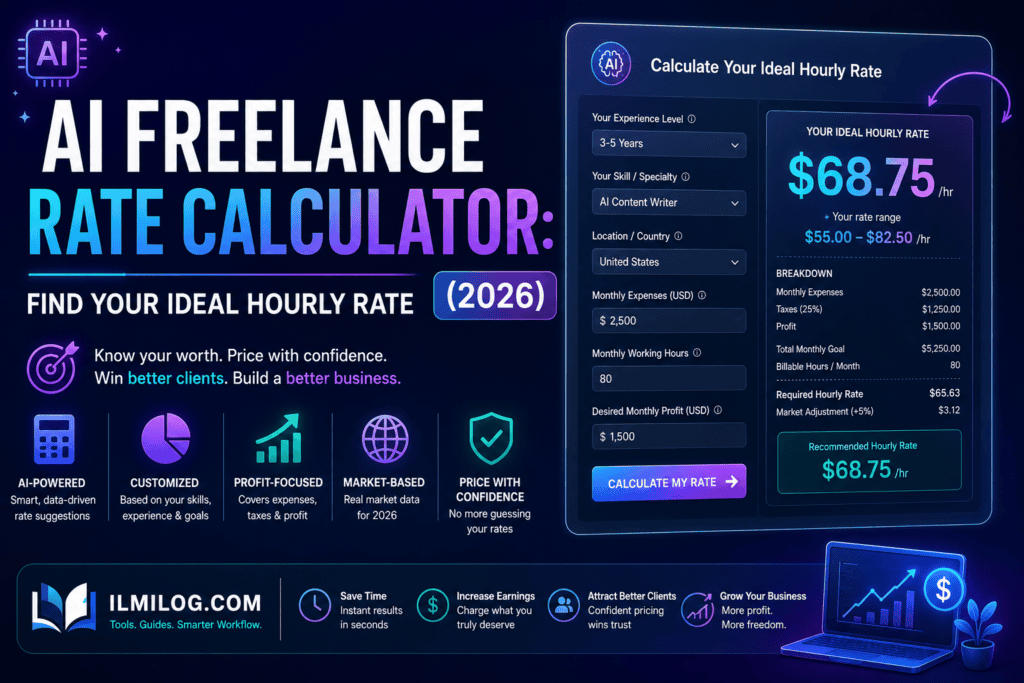
Quick Answer: To calculate your freelance rate, divide your desired yearly income (plus taxes and business expenses) by your actual billable hours per year — not total working hours. Most freelancers only bill 60–80% of their working time once admin, pitching, and unpaid work are subtracted. Then adjust up for experience, specialized AI skills, and your target client market. Use the calculator above for an exact number.
Most freelancers price themselves by copying a number they saw on a forum. That number was never built for their expenses, their tax bracket, their non-billable hours, or their skill level — so it either scares away clients or quietly bankrupts the freelancer who charges it. This calculator fixes that by building your rate from your actual numbers, then adjusting it for how the market is really pricing skills in 2026 — including the growing premium for freelancers who work fluently with AI tools. If you’re still deciding which skills to specialize in before pricing yourself, start with 30 Best Freelance Skills for Beginners in 2026.
How to Use the Calculator
- Set your income goal. Enter the yearly take-home income you want, after tax and after business costs.
- Enter your real work schedule. Days per week, hours per day, and weeks off — vacation, holidays, sick time.
- Be honest about non-billable time. Admin, client pitching, invoicing, and learning new AI tools all eat into billable hours — most freelancers underestimate this by half.
- Add your annual business expenses and tax rate. Software subscriptions, equipment, insurance, and your estimated tax bracket.
- Select your experience level and AI-skill tier. These act as market-tested multipliers, not guesses.
- Choose your client market. A US client budget is not the same as a South Asian or GCC client budget — the calculator adjusts for this automatically.
- Read your result. You’ll get an hourly rate, day rate, weekly rate, and project rate — plus a breakdown of exactly how much of that rate is profit, tax, and business cost.
AI Freelance RateCalculator
Stop guessing what to charge. Enter your income goal, expenses, and AI skills — get the hourly, day, and project rate you should actually quote clients.
How this is calculated
Billable hours/year = (52 − weeks off) × work days/week × billable hours/day × (1 − non-billable %).
Hourly rate = (yearly income ÷ (1 − tax rate) + expenses) ÷ billable hours/year, adjusted by experience, AI-skill premium, and target market.
Why “Just Charge the Market Rate” Doesn’t Work
Generic advice to charge what others in your niche charge ignores that the published averages span an enormous range. The commonly quoted freelance average of roughly $44–$48 an hour hides massive variation — AI/ML specialists can top $120–$400+ an hour, while beginner content writers may start at $15–$25. A single average is close to useless for pricing your own work — what matters is your specific niche, experience tier, and market, which is exactly what this calculator solves for instead of a single copy-pasted number.
Freelance Rate Benchmarks in 2026
Quick Answer: US freelancers earn an average hourly rate of about $47.71 in 2026, with most rates falling between $24 and $62 an hour — but the right number for you depends heavily on skill, experience, and client location, not a single national average.
| Segment | Typical Hourly Range | Notes |
|---|---|---|
| Entry-level / generalist | $15 – $50/hr | Beginners across disciplines typically fall in the $25–$60/hr range |
| Mid-level specialist | $50 – $100/hr | Median across disciplines sits around $65–$85/hr |
| Senior / expert specialist | $100 – $250+/hr | Senior specialists commonly reach $100–$250+/hr |
| AI/ML & prompt specialists | $100 – $400+/hr | Prompt engineering specifically now averages around $70.61/hr, with specialized project rates reaching $100–$300/hr |
| Freelance writers | $15 – $50/hr | Average base hourly pay is about $29.37, with the top 10% earning $49+/hr |
Regional variation is significant. North America has the highest average regional hourly rate at roughly $95, while the Middle East and Africa average around $40 — which is exactly why this calculator includes a client-market adjustment instead of showing one global number.
The AI-skill premium is real and growing. AI and ML freelance specialists are commanding a 40–60% premium over general development rates, while routine content writing rates have declined 10–30% as AI tools reduce the perceived complexity of the work. This is the exact dynamic the calculator’s “AI-tool skill premium” selector is built to capture.
Figures above are third-party 2026 market estimates, shared for context. Your calculator result is based on your own numbers, not a scraped average — see the methodology below.
How the Math Works
Billable hours per year equals (52 minus your weeks off), multiplied by work days per week, multiplied by billable hours per day, multiplied by (1 minus your non-billable percentage).
Gross revenue needed equals your desired yearly income divided by (1 minus your tax rate), plus your annual business expenses.
Your base hourly rate equals gross revenue needed divided by billable hours per year.
Your final hourly rate equals the base hourly rate multiplied by your experience multiplier, your AI-skill multiplier, and your client-market multiplier.
This is the same core method accountants and business coaches use to price any service business — the calculator just automates it and adds the experience, AI-skill, and market adjustments freelancers usually skip.
Common Pricing Mistakes This Calculator Prevents
- Billing against total hours, not billable hours. Working 40 hours a week does not mean 40 billable hours — admin and pitching typically eat 20–40% of that time.
- Forgetting taxes are a cost of the rate, not a deduction from it. A rate that only covers your take-home target, with no tax buffer, quietly underpays you every invoice.
- Ignoring the AI-skill premium. Freelancers who’ve built real fluency with AI tools are being priced differently than generalists — pricing yourself like it’s 2022 leaves money on the table.
- Using one global “market rate.” A rate benchmarked to a US client budget is not realistic for a freelancer pricing local clients, and vice versa.
Getting your rate right is only half the battle — you also need clients willing to pay it. Once you’ve calculated your number, How to Get Your First Freelance Client (No Portfolio) walks through landing your first paying client at that rate, and our Free Digital Life Blueprint Generator can help map a broader income plan around it.
Frequently Asked Questions
How do I calculate my freelance hourly rate?
Add your desired yearly income to your annual business expenses, divide by (1 minus your tax rate), then divide that total by your realistic billable hours per year — not your total working hours. Adjust the result up or down for your experience level and niche.
What’s a good hourly rate for a beginner freelancer?
Beginner freelancers across most disciplines typically charge in the $15–$50/hr range, with the exact number depending heavily on skill and client location. Use a rate calculator rather than a flat number, since your actual expenses and income goal change what “good” means for you specifically.
How many hours should I actually bill per week?
Most freelancers can realistically bill 60–80% of their working hours once admin, client communication, invoicing, and skill-building time are subtracted. If you work 40 hours a week, that’s often closer to 24–32 billable hours.
Does knowing AI tools increase my freelance rate?
Yes. Freelancers with strong AI-tool fluency — prompt engineering, AI workflow building, or AI agent development — are commanding meaningfully higher rates than general freelancers in the same field, while purely manual, commodity-style work has seen rate pressure downward.
Should I charge hourly or per project as a freelancer?
Project-based pricing tends to reward efficiency — once you can estimate accurately, it often pays more per effective hour than hourly billing. Many freelancers start hourly to learn their true speed, then shift to project pricing after 2–3 years.
How much should I charge if I’m freelancing part-time?
The same formula applies — but your available billable hours will be lower, which raises your required hourly rate if your income goal stays the same. Enter your real part-time schedule into the calculator rather than assuming a full-time freelancer’s rate applies to you.
Do freelance rates differ by country?
Significantly. Client markets in North America and Western Europe generally support higher rates than markets in South Asia, the Middle East, or Africa, sometimes by more than double. Price to your target client’s market, not your own cost of living, if you’re working internationally.
How often should I update my freelance rate?
Review it at least once a year, and any time your expenses, skills, or market shifts meaningfully — for example, after adding a specialized AI skill, after a tax-bracket change, or when your experience tier changes.