
How to Earn Money from Home for Students in Pakistan (Methods That Actually Work in 2026)
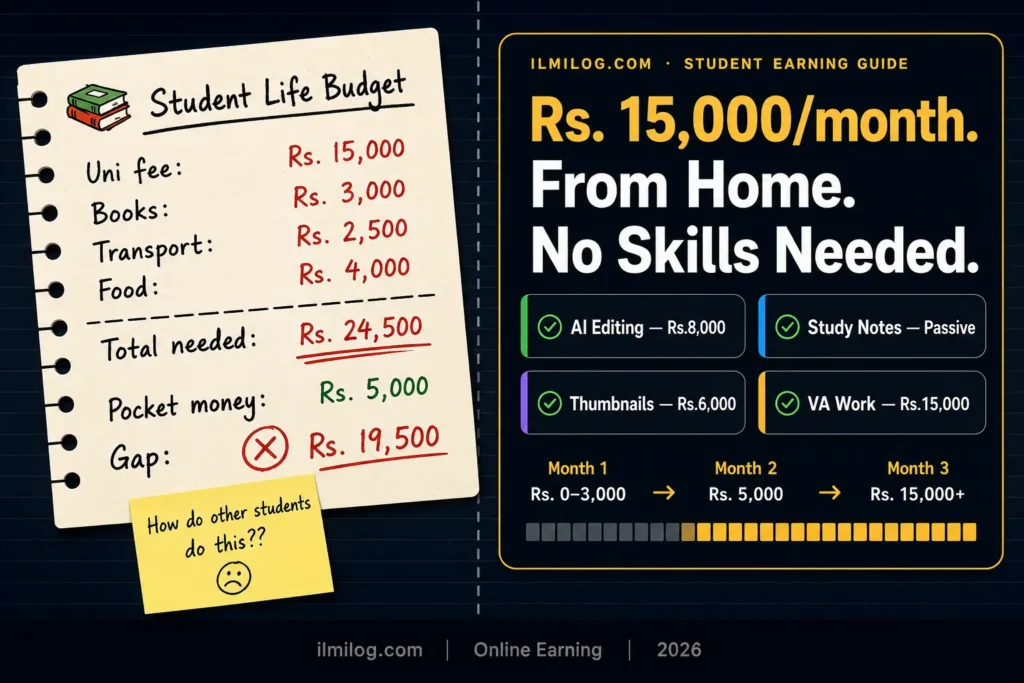
Quick Answer: Students in Pakistan can realistically earn Rs. 5,000–25,000 per month from home within 60–90 days using the right method. The keyword is “right method” — not the most popular one, not the one with the most YouTube videos, but the one that matches your actual schedule, your actual skills, and your actual ability to wait for money. This guide covers five methods that work specifically for students juggling classes, exams, and limited time — with honest timelines, honest earnings, and honest warnings about what goes wrong.
A second-year student from Faisalabad told us something that stopped us cold. She’d tried three different “student income” methods over four months — surveys, clicking ads, and some app that promised Rs. 1,000 per day — and earned a combined Rs. 340 across all three. She wasn’t doing anything wrong. She’d followed instructions correctly. The methods were genuinely bad for her situation.
That’s the problem with most student income guides. They list every possible way to make money online without filtering for what actually makes sense for a student with 2–3 hours per day, exam pressure every few months, and limited access to international payment methods. Most methods that look good on paper quietly require things students don’t have: a verified PayPal account, 20+ hours per week, or a portfolio that takes six months to build.
This guide works differently. Five methods that fit real student life. Honest income figures. Honest timelines. The exact situations where each one makes sense — and where it doesn’t. That’s what this guide is actually about.
Why Most “Student Income” Methods Fail Before Month Two
The pattern is consistent across almost every student who tries and quits. Month one: excitement, effort, low earnings. Month two: frustration, slower pace. Month three: quit.
The failure usually isn’t effort. It’s a mismatch between the method and the constraints.
Surveys sound easy until you realize most survey platforms pay Rs. 10–30 per survey, have 70%+ disqualification rates for Pakistani users, and the international platforms that pay more require PayPal — which Pakistani students under 18 can’t access and which many banks complicate for others.
General freelancing sounds straightforward until you realize building a Fiverr profile, getting your first review, and earning consistently takes 2–4 months of effort before income stabilizes. For a student with finals in month two, that timeline collapses.
The methods that work for students share three traits: they pay within 30–45 days of starting, they can be paused during exam season without losing everything you built, and they don’t require a large upfront portfolio before earning starts.
Method 1: AI Content Editing — The Fastest Entry Point for Students With Writing Skills
This is the method most guides miss entirely, and it’s the fastest to first income for a student who reads and writes clearly in English.
Here’s the situation: AI writing tools like ChatGPT and Gemini produce enormous volumes of text every day for bloggers, content marketers, and small business owners. The problem is that raw AI text sounds like AI text — flat sentences, repeated phrases, no real voice. Editors who can make AI content sound human are in genuine demand, and the barrier to entry is lower than traditional content writing because you’re not writing from scratch.
What you actually do: a client sends you an AI-generated article or product description. You read it, fix awkward phrases, add natural transitions, improve the opening paragraph, and return something that sounds like a person wrote it. If you’ve read the guide on how to edit AI content on this site, that’s the exact skill being sold here.
Real earnings: Rs. 500–1,500 per 1,000-word article on Pakistani freelance platforms and WhatsApp groups. International clients through Fiverr pay $5–$15 per article at beginner level, rising to $20–$40 once you have five reviews. A student doing 3–4 articles per week can earn Rs. 6,000–15,000 per month within 45 days.
How to test if this works for you: Find any recent AI-generated article online — there are hundreds on low-quality news sites. Rewrite three paragraphs to sound more natural. If you can do that in under 20 minutes and the result is clearly better, you have the skill. If it takes 45 minutes and you’re not sure it’s better, practice first.
What goes wrong: Clients who pay Rs. 200 per article exist in large numbers on Pakistani Facebook groups. At that rate, a 2-hour article earns Rs. 200 — far below what’s worth your time. Filter clients ruthlessly. Rs. 500 minimum per article from day one. Walk away from anything below that.
When this doesn’t work: If your written English isn’t strong enough for clients to trust your edits, don’t start here. Starting with poor editing quality and getting bad reviews kills your profile faster than starting slowly. Be honest with yourself about your English level.
The exam-friendly advantage: This method pauses and restarts cleanly. Stop taking orders two weeks before exams, resume after. Fiverr keeps your profile active. You lose no progress.
| Advantage | Disadvantage |
| Fast first income (15–30 days) | Requires solid English writing ability |
| Completely flexible hours | Per-article rate varies wildly |
| Improves your own writing skills | Some clients are difficult to satisfy |
| Grows with your reputation | Pakistani platforms pay less than international |
Method 2: Selling Study Notes and Digital Study Guides
This one uses something you’re already producing: your class notes.
Well-formatted, comprehensive notes for popular subjects sell consistently on platforms like Gumroad, on local WhatsApp groups for students, and on Telegram channels organized by university or subject. Students at the end of a semester who didn’t attend regularly, or students from other universities studying the same syllabus, pay for organized notes that cover exam-relevant content clearly.
The key word is “well-formatted.” A photo of handwritten notebook pages doesn’t sell. A clean, clearly organized PDF with headings, highlighted key terms, and practice questions sells for Rs. 150–400 depending on subject and depth.
Real setup: After each class, spend 10–15 extra minutes converting your notes to a clean Google Doc or Canva document. At the end of each major topic or chapter, export as PDF. After the semester exam, combine them into one subject guide and sell it. The work happens naturally alongside your studies — you’re not creating something extra, you’re improving something you’d do anyway.
Real earnings: Rs. 150–500 per guide on Gumroad or direct WhatsApp sales. A student with notes across 4–5 subjects can build a passive income stream of Rs. 3,000–8,000 per month by the second semester, with income continuing even during vacations because the files keep selling without any additional work.
Where to sell: Direct WhatsApp marketing to senior students’ groups: “Just finished finals, sharing comprehensive notes for [Subject Name] — covers all past paper topics. Rs. 200, send screenshot to [number].” This converts at 20–30% for relevant audiences.
Gumroad: Create a free account, upload PDFs, set price in USD ($1.50–$3.00), share the link. Payments come via PayPal or Stripe — if you don’t have access, use a family member’s account initially.
University Facebook groups: These exist for every major Pakistani university. A post with a sample page preview converts well.
Common mistake: Uploading an unformatted scan of your notebook. Students won’t pay for something they could photograph themselves. The value is in the organization and clarity. Take one chapter, format it properly in Canva (free), and use it as your sample. If people ask for more, your formatting standard is working.
When this doesn’t work: If you’re in a highly specialized program with only 20–30 students in your cohort, the market is too small. Works best for popular subjects: accounting, business, computer science, pre-med, engineering basics, and general humanities subjects at large universities.
Method 3: YouTube Thumbnail Design — Real Demand, Underserved by Students
Every YouTube creator, local or international, needs thumbnails. A good thumbnail increases click-through rate by 20–40%. Creators know this. Many of them can’t design and won’t pay a full design agency — but they will pay Rs. 200–500 per thumbnail, or $3–$8 on Fiverr, for someone who can produce consistent, clean thumbnails.
You need Canva (free). You need to study 20–30 thumbnails from successful channels in one niche to understand what makes them work. Then you recreate that pattern with a client’s content.
Real demand in Pakistan: Pakistani YouTube channels in cooking, vlogs, tech reviews, and Islamic content are growing rapidly. Most creators in this space — earning from Google AdSense — don’t have design skills and don’t want to learn them. A message to a mid-size Pakistani YouTuber (50K–500K subscribers) offering 3 free sample thumbnails as a trial converts surprisingly well.
Getting first clients without waiting for Fiverr orders: Go to YouTube. Search for any content category you watch regularly. Find channels with 10K–200K subscribers. Look at their thumbnails — are they inconsistent, poorly designed, or clearly made in phone apps? Message them on their business email (listed under About). Offer 3 free thumbnails as a trial, Rs. 300 per thumbnail after that. Most ignore you. Some respond. One convert is enough to start.
Real earnings: Rs. 2,000–8,000 per month for a student doing 5–15 thumbnails per week. International clients through Fiverr pay $3–$8 per thumbnail — at 10 thumbnails per week, that’s $30–$80, or roughly Rs. 8,000–22,000.
Timeline to first client: 15–30 days if you approach local Pakistani creators directly. 30–60 days waiting for Fiverr orders to come naturally. The direct approach is faster.
When this fails: When students copy popular thumbnail styles too closely and produce something generic. A thumbnail that looks like every other thumbnail in a niche doesn’t help the creator stand out. Study what makes the best thumbnails different, not just what they look like.
For students who want to go further with YouTube-related income, our detailed guide on making money on YouTube without showing your face covers the full channel-building side — thumbnail design is the fastest entry point into that world.
Method 4: Micro Jobs on Verified Platforms — No Skills, Immediate Income
This is the only method in this guide that can pay within your first week. The trade-off is that it pays the least per hour.
Clickworker and Microworkers are the two platforms that work reliably for Pakistani students without international payment complications. Both pay via Payoneer — Pakistani students can sign up for a free Payoneer account here — the process works with a CNIC and takes about 10 minutes online. . Tasks include categorizing images, transcribing short audio clips, evaluating search results, and completing simple web-based tasks.
Real earnings: Rs. 800–3,000 per week depending on task availability in your region and hours invested. This isn’t a path to Rs. 30,000 per month. It’s a path to immediate income while you build a more scalable skill.
How to use it correctly: Micro jobs are a bridge, not a destination. Use them to earn Rs. 3,000–5,000 in the first month while you’re simultaneously developing a more valuable skill (editing, thumbnails, notes). Stop relying on them the moment your higher-skill income replaces the amount.
Honest hourly rate: Rs. 80–150 per hour on good task days. Rs. 30–50 per hour on slow days. At maximum effort, 3 hours per day produces Rs. 240–450. That’s the ceiling.
Common mistakes: Rushing through tasks to maximize volume and getting flagged for poor quality. Once flagged on Clickworker, your task access drops significantly. Do each task properly, even if it takes longer. One quality rating demotion can cut your earning capacity by 50%.
For the complete breakdown of which micro job platforms pay reliably to Pakistani accounts without PayPal, our micro jobs guide covers every platform in detail — the same platforms work for students specifically.
Method 5: Becoming a Virtual Assistant for Local Businesses
This is the highest-earning beginner method for students who can communicate professionally and manage tasks consistently — but it takes 30–45 days to land a first client.
Small businesses — local stores going online, new e-commerce sellers on Daraz, Instagram boutiques, new restaurants on food delivery apps — need someone to manage their social media responses, write product descriptions, organize their inbox, and handle basic customer questions. They can’t afford a full-time employee. They absolutely can afford Rs. 8,000–20,000 per month for a part-time student who handles 2–3 hours of tasks daily.
The pitch that works: Find a local business that has an active Instagram account but slow response times to comments and DMs. Message them: “I noticed your page has great products but some unanswered comments from customers. I can manage your DMs and comments daily for Rs. 5,000/month, 2 hours per day. Would you like to try one week free?” This pitch works because it identifies a specific, visible problem and offers a low-risk trial.
Real earnings: Rs. 8,000–20,000 per month per client for part-time VA work. Two clients is a significant student income. Three clients start to compete with entry-level full-time salaries.
When this doesn’t work: If you can’t commit to daily availability, VA work fails fast. Clients expect consistency. If you disappear during exams without warning them in advance and arranging coverage, you lose the client and the reference. Plan exam seasons explicitly with every VA client you take on — “I’ll need reduced availability for two weeks in November” — before signing up, not after.
The advantage nobody mentions: VA work gives you real experience in business operations. By the time you graduate, you’ve managed social media, customer communication, and basic business admin for multiple businesses. That’s an employable experience, not just pocket money.
Getting Your First Income: The Most Honest Guide to Landing Clients
Finding methods is the easy part. Finding clients is where most students stall. Here’s what actually works.
University WhatsApp groups:
Every student has access to multiple university groups. Most students are scared to promote services there because it feels awkward. The approach that works isn’t advertising — it’s offering something specific to a real problem. “Does anyone need their assignment proofread? I’ll do the first one free to show quality.” One satisfied person tells two more. One becomes paying clients within two weeks.
Reddit for international clients:
r/slavelabour is a genuine marketplace where people pay for small digital tasks — thumbnail design, proofreading, transcription, data entry — at prices that convert well for Pakistani students even if they’re low by Western standards. A post there offering thumbnails at $3 each or proofreading at $0.01/word with a sample attached generates real orders. r/forhire is similar for slightly higher-value work.
Local Facebook groups:
Search “[your city] + business group” or “[your university] + marketplace.” These exist for every major Pakistani city. Posting your service with one concrete example of work performed converts better than advertising without proof.
Scam warning signs:
Any “client” who asks you to pay a registration fee before receiving work. Any platform promising Rs. 1,000+ per day for simple clicking or watching videos. Any “client” who asks for your bank details before you’ve completed and they’ve approved any work. These are scams. They appear constantly in student Facebook groups and always target people who need money quickly.
Not sure which method fits your overall income goals? The Digital Life Blueprint Generator takes 7 quick questions and maps out a personalized income plan based on your time availability, location, and skills. Free, no signup needed.
Income Reality — Month by Month
Month 1:
Rs. 0–5,000 for most methods. This is the learning, testing, and rejection phase. Don’t judge any method by month one. Your expectation for month one should be: complete one task, earn one payment, prove to yourself the system works. Rs. 500 in month one is a success if it’s your first real online payment.
Month 2:
Rs. 3,000–12,000 depending on method and effort. The compounding effect starts. One review leads to another. One satisfied WhatsApp group contact refers someone else. This is where most students quit — right before the momentum kicks in.
Month 3+:
Rs. 8,000–25,000 for students consistently applying one method. The range is wide because it depends entirely on which method, how many hours, and how effectively you found your first few clients.
Which methods scale and which plateau:
AI editing and thumbnail design scale — you can raise rates as your portfolio grows and eventually outsource to other students.
Micro jobs plateau — the earning ceiling is fixed by available task volume and your time.
VA work scales with clients — adding one more client doubles income in a way micro jobs can’t.
Study notes are passive — they keep selling without additional work, making them the best long-term passive income for students.
Which Method Fits Your Situation Right Now
If you need money this week: Method 4 (micro jobs). Start Clickworker today, complete tasks tonight, payment processes within days.
If you have writing skills and two weeks: Method 1 (AI editing). Pitch five clients this week, expect your first paid order within 10–14 days.
If you’re in second year or above with solid notes: Method 2 (study notes). This weekend, format one chapter from your best-performing subject into a clean PDF. Post it in one group. See if anyone buys.
If you’re comfortable with Canva and YouTube: Method 3 (thumbnails). Spend this week studying 30 successful thumbnails in one niche. Create 5 practice samples. Next week, pitch 10 local Pakistani YouTubers.
If you have consistent daily time and want the highest monthly income: Method 5 (VA work). Identify 3 local businesses with slow Instagram response times this week and send your pitch to all three.
When These Methods Are NOT the Right Choice
If you have less than 5 hours per week available, skip everything except micro jobs and study notes. The other methods require enough consistent time to build relationships and quality.
If you need Rs. 20,000 in the next 2 weeks, none of these methods will deliver that. Set a more realistic expectation: Rs. 3,000–5,000 in the first 30 days is achievable. Rs. 20,000 in 2 weeks from a standing start is not.
If you’re in final year with final exams approaching, don’t start a VA arrangement that requires daily commitment. Start with something fully pausable — micro jobs or study notes.
If you dislike self-promotion completely, VA work and thumbnail freelancing will feel extremely uncomfortable. The editing and notes methods require less direct selling and might fit better.
FAQ
How much can a student realistically earn per month?
In the first month: Rs. 0–5,000. By month three with consistent effort: Rs. 8,000–20,000 depending on method. The students who earn Rs. 25,000+ by month three typically started with VA work or AI editing and found 2–3 consistent clients. The students earning Rs. 3,000–5,000 typically used micro jobs without developing a scalable skill alongside it.
Which method pays the fastest?
Micro jobs (Clickworker, Microworkers) pay within days of completing tasks. AI editing via local WhatsApp groups can pay within one week if you find the right client immediately. Everything else typically takes 2–4 weeks before first payment.
Do I need a bank account, PayPal, or special payment setup?
For micro jobs and most international platforms: Payoneer (free to sign up with a Pakistani CNIC, works at 16+ with guardianship). For local clients: JazzCash or Easypaisa work for Pakistani-to-Pakistani payments. PayPal is difficult for Pakistani students — most workarounds involve family members’ accounts or third-party exchanges. Build Payoneer first; it’s the most accessible option for students in Pakistan.
Can I do multiple methods at once?
Yes, but don’t start multiple at once. Master one method, earn your first payment, then add a second. Splitting focus in month one is the most common reason students don’t earn from any method.
Are any of these methods scams?
The methods in this guide are real. The clients and platforms you find using them may not be. Filter ruthlessly: never pay to join a “client network.” Never share banking details before completing work. Never work for a client who communicates only through encrypted apps and won’t give a verifiable identity or business name. If something feels wrong, it usually is. Legitimate clients are not in a rush, don’t pressure you, and pay for completed work without drama.
What about taxes?
In Pakistan, individual income under Rs. 600,000 per year (Rs. 50,000 per month) is generally not subject to income tax as of the current tax year. Students earning below this threshold don’t need to file. If you scale above this — which is a good problem to have — consult a tax advisor. The FBR website has official guidance. Don’t let tax confusion stop you from starting.
Which method are you starting with? Drop your city and university year in the comments — useful for connecting students in similar situations.
Researched and written by the ilmilog.com editorial team. Income figures cross-referenced against Pakistani freelancer community reports, platform payment documentation, and direct student earning case studies. All platform payment methods verified for Pakistani users as of July 2026.