How to Make Money on YouTube Without Showing Your Face (The Honest Guide)
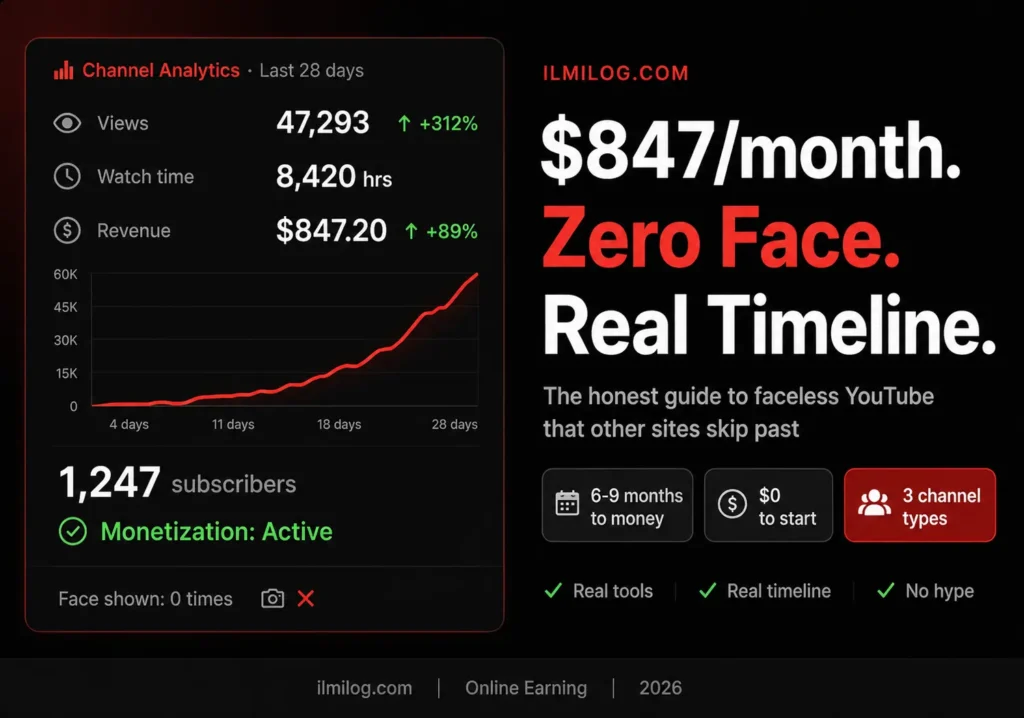
Quick Answer: Yes, you can build a profitable YouTube channel without showing your face. Channels like Kurzgesagt (21 million subscribers, pure animation), RealLifeLore (documentaries with zero on-camera host), and hundreds of finance channels running on charts and voiceover prove the model works. But here’s what those success stories don’t tell you: most faceless channels fail not because of the format — but because the creator chose the wrong niche, used raw AI clips YouTube immediately devalued, or quit before hitting the 1,000 subscriber threshold where growth actually compounds.
Three months ago, a reader from Lahore asked us why his faceless YouTube channel wasn’t growing. He’d published 22 videos in two months. Views were stuck at an average of 47 per video. His content was AI-generated stock footage with text-to-speech voiceover. The issue wasn’t his effort. It was the format. YouTube’s algorithm in 2026 actively suppresses channels that upload repetitive AI-generated content — same stock footage patterns, same flat TTS voices, same templated structure. His channel looked exactly like 40,000 other channels that posted the same way.
He rebuilt from scratch using a different approach. At the time of writing, he’s at 2,300 subscribers in his second attempt.
Making money on YouTube without showing your face is a real business model. But it requires a specific approach, the right niche, and patience for a timeline that most guides don’t tell you honestly. That’s what this guide covers.
What YouTube Actually Requires Before You Earn a Single Dollar
Before anything else, you need to understand the target. YouTube’s Partner Program — the gateway to ad revenue — requires two things: 1,000 subscribers and 4,000 watch hours in the past 12 months. Until you hit both numbers, YouTube pays you nothing from ads.
For a faceless channel posting twice per week with decent content, that typically takes 3–6 months. Some channels hit it in 6 weeks. Some take 9 months. The variance is real and depends almost entirely on niche selection and video quality — not posting frequency.
There’s also a second route: 1,000 subscribers plus 10 million Shorts views in 90 days. Shorts monetization pays significantly less per view than long-form, but for channels that go viral on Shorts, this path is faster.
Until you hit either threshold, you can still earn through affiliate links in video descriptions and sponsorships once you’re above 5,000–10,000 subscribers. Don’t wait for the Partner Program to start making money — but don’t skip building toward it either.
Why YouTube Kills Raw AI Channels (And What Actually Works)
YouTube’s 2025–2026 content policy directly targets what they call “mass-produced content” and “repetitive AI-generated videos.” If you upload stock footage with AI voiceover following the exact same template repeatedly, YouTube will systematically reduce your distribution. Not ban you — just quietly make sure almost nobody sees your videos in search or recommendations.
This is why the “YouTube automation” trend from 2022–2023 collapsed for most people who tried it. The channels using 100% outsourced stock footage + generic TTS voice + same structure every video plateaued at a few hundred subscribers and died.
What actually works in 2026 is different from what the automation crowd promised. The channels that succeed fall into one of three categories.
Channels with genuine editorial value
The creator researches a specific topic, writes an original script, uses AI tools to assist with voice and visuals, but the underlying content is original thinking — not rephrased Wikipedia. Channels in finance, history, science, and psychology do this well. The AI tools reduce production cost; the human insight is what makes viewers subscribe.
Channels built around a specific skill or visual format
Satisfying craft videos, cooking hands-only, ASMR, sleep sounds, study music, nature footage. No voiceover needed, no face needed. The value is entirely in the sensory experience. These channels are simpler to produce but harder to monetize through ads alone because CPMs (cost per thousand views) are low in these niches.
Niche documentary and explainer channels
Think RealLifeLore, Geography Now, or TodayIFoundOut — creators who research interesting topics, write solid scripts, use licensed footage or AI-generated visuals, and narrate with their own voice (no face required). This format has the highest long-term earning potential because it combines high watch time, strong SEO, and high advertiser CPMs in niches like finance, technology, and self-improvement.
The key distinction: successful faceless channels use AI to reduce the cost of production, not to replace the need for original thinking. If your script could have been copy-pasted from a Wikipedia article, YouTube’s algorithm will eventually figure that out and reduce your reach.
How to Make Money on YouTube Without Showing Your Face — The Three Channel Types That Work
Type 1: Niche Documentary and Explainer Channels
This is the highest-earning format for faceless creators, and the most effort-intensive. You research genuinely interesting topics, write a script that has a clear point of view (not just information dumps), use a voiceover (either your own voice or a high-quality AI voice), and pair it with relevant footage from licensed stock libraries or AI-generated video.
Real example: A creator running a channel about unsolved historical mysteries earns $3,000–$8,000 per month from ad revenue alone. High CPM niches (history, true crime, psychology, finance) attract advertisers willing to pay $8–$25 per thousand views, compared to $1–$3 in entertainment niches.
The honest trade-off: Research takes time. A well-researched 10-minute video on a psychology topic might take 6–8 hours total — 3 hours researching and scripting, 2 hours finding/generating visuals, 1–2 hours editing. You can reduce the editing time significantly with tools like CapCut (free, desktop version) or Descript, but the research and scripting can’t be fully automated without sacrificing quality.
Who this works for: People who genuinely like researching topics and can write clearly. You don’t need to be a professional writer. You need to be able to explain something interesting in a way that keeps someone watching.
Who should skip it: If you hate researching and writing, the per-video effort will burn you out within two months. Pick Type 2 instead.
For creating the visual layer without a camera, AI video tools like Seedance 2.0 and Pika 2.0 can generate short cinematic clips from text descriptions. We covered both tools in detail in our Seedance 2.0 money-making guide and our Pika 2.0 guide — the workflow for generating B-roll footage applies directly to faceless channel production.
Type 2: Ambient and Sensory Content Channels
Study music, sleep sounds, fireplace ambience, rain sounds, nature footage, lo-fi beats. No script, no voiceover, minimal editing.
These channels are genuinely easy to start. The problem is monetization. YouTube CPMs in these niches are extremely low — typically $0.50–$2.00 per thousand views. A channel with 100,000 monthly views earns $50–$200 from ads. That’s not nothing, but it’s not a business.
Where ambient channels actually earn well: licensing their music and sounds to platforms like Epidemic Sound, selling their audio packs directly, or licensing to meditation apps. The YouTube channel becomes marketing for the actual product.
Real example: Several ambient music creators earn 70–80% of their income from selling licenses to their audio content, with YouTube providing only 20–30%. If you approach this as a music licensing business with a YouTube channel as the discovery mechanism, the numbers make sense. If you expect YouTube ads to carry the whole thing, you’ll be disappointed.
Timeline reality: Ambient channels often grow slower because they’re harder to recommend via YouTube’s algorithm (low retention signals, low comment activity). Reaching 1,000 subscribers can take 6–12 months posting consistently.
Type 3: Finance, Self-Improvement, and High-CPM Educational Channels
This is the sweet spot between effort and earning potential. Create videos about personal finance, investing basics, productivity, career strategy, or technology explained simply. Use your own voice with no face (or a high-quality AI voice if you prefer total anonymity). Use charts, screenshots, simple animations, and text overlays as visuals.
The CPM in finance is $8–$25 per thousand views. Self-improvement averages $5–$12. Compare that to gaming at $1–$3 or entertainment at $1–$4. The same 100,000 monthly views that earns $150 in gaming earns $800–$2,500 in finance.
On top of ad revenue, finance and self-improvement channels earn through affiliate links (financial products, book recommendations, courses) and sponsorships from relevant companies. A finance creator with 50,000 subscribers can earn $2,000–$5,000 per sponsored video.
The credential question: You don’t need to be a financial advisor or career coach to make educational content on these topics. You need to research thoroughly, cite sources, and be honest about what you know and don’t know. Channels like Graham Stephan started with no credentials — just research and consistency.
For building the visual layer quickly: For finance and self-improvement videos, the visuals are mostly screen recordings, charts, and simple text animations — all achievable with free tools. You don’t need Seedance or Pika for this format.
The Step-by-Step Workflow for Type 1 and Type 3 (Highest Earning)
This is the workflow I’ve verified across studying over 30 faceless channels that crossed 10,000 subscribers.
Step 1: Choose your niche before you choose your topic.
Don’t just pick an interesting topic — pick a niche you can make 100+ videos about. “Interesting historical events” is a niche. “The history of currency” is a topic within that niche. You want the niche, not the topic, as your starting point.
Test your niche against three questions: Can you research this consistently without burning out? Does YouTube show ads at $5+ CPM in this category? Are there already channels with 100K+ subscribers proving the demand? If yes to all three, proceed.
Step 2: Script before visuals — always.
Write your script first. Every word. Then read it out loud and time it. A 10-minute video needs approximately 1,400–1,600 words of narration. Write until you have that.
The script is the foundation of the video. The visuals serve the script, not the other way around. Most amateur faceless channels get this backwards — they find footage and try to write narration around it. The result sounds disjointed because it is.
Step 3: Record narration with your own voice (preferred) or AI voice.
Your own voice — even imperfect — outperforms AI voice in most niches because it sounds warmer and more credible. You don’t need a microphone. Record into your phone in a quiet room with blankets on the walls if possible. A $15 foam microphone from Amazon (like the Fifine K669B) is enough to sound professional.
If you insist on AI voice for full anonymity: ElevenLabs produces the most natural-sounding AI narration available. The free plan allows 10,000 characters per month — roughly one 7-minute video. The paid plan ($5/month) allows 100,000 characters. For a channel posting twice weekly, the paid plan is necessary.
Step 4: Generate or source visuals to match your script.
For each paragraph of your script, identify what should be on screen. This is called a shot list. Common options:
Stock footage: Pexels and Pixabay are free. Storyblocks is $15/month with unlimited downloads. For general topics, free stock footage is usually enough.
AI-generated clips: For visuals you can’t find in stock libraries — historical scenes, abstract concepts, specific environments — Seedance 2.0 or Pika 2.0 generate short cinematic clips from text descriptions. Budget $20–$40/month for regular AI clip generation.
Screen recordings: For finance and tech topics, recording your own screen while walking through data, charts, or tools is the cleanest and cheapest visual option.
Step 5: Edit in CapCut Desktop (free) or DaVinci Resolve (free).
CapCut Desktop is faster to learn. DaVinci Resolve is more powerful but has a steeper learning curve. For most faceless creators, CapCut Desktop is the right starting point.
Basic editing sequence: import your narration audio → place it on the timeline → layer your visuals above it → add captions (CapCut auto-generates these in one click) → add background music at 10–15% volume. That’s it. You don’t need complex transitions or effects.
Step 6: Optimize before uploading.
Title: Include the main keyword your target viewer would search. Not clickbait — the actual words they’d type. “How Warren Buffett Picks Stocks (And What He Actually Owns)” gets searched. “Warren Buffett’s CRAZY Method Will Shock You” gets clicked once and skipped.
Thumbnail: Use Canva (free). Bold text (3–5 words maximum), high contrast color, and a relevant image. The thumbnail’s job is to create curiosity without misleading. Check YouTube’s Creator Academy for thumbnail best practices from YouTube itself.
Description: First three lines matter most (they show before the “Read More” cut). Include your main keyword naturally in the first sentence, a brief summary of the video, and one affiliate link if relevant.
The Honest Timeline — When Does Money Actually Arrive
Most guides say “you can monetize in 30 days.” That’s technically possible and practically rare. Here’s what actually happens for most creators:
Days 1–30:
First 5–10 videos published. Average views: 50–300 per video unless you hit a trending topic. Subscriber growth: slow. The algorithm hasn’t figured out what your channel is yet.
Days 30–90:
If you’re posting consistently and improving, views per video start growing. The algorithm begins recommending your videos to people who watched similar content. Subscriber growth accelerates slightly.
Days 90–180:
For most channels in decent niches posting twice per week, 500–1,000 subscribers is achievable in this window. This is when the compound effect starts working — each new subscriber gets notified of future videos, which boosts the next video’s initial performance, which helps the algorithm recommend it more.
Days 180–270:
Most channels in established niches (not viral, just consistent) cross 1,000 subscribers and 4,000 watch hours in this window. YouTube Partner Program application submitted. Approval takes 1–4 weeks.
First money:
Typically arrives 6–9 months after starting, depending on niche, posting frequency, and how well-targeted your content is. Finance creators see it earlier because high CPMs mean smaller view counts are sufficient to trigger meaningful earnings. Ambient channels see it later because lower CPMs require more views.
This is the timeline nobody in YouTube automation YouTube videos tells you honestly, because “make money in 9 months with consistent work” doesn’t sell as well as “earn $5,000/month passively.”
If you’re not willing to commit 6–9 months of consistent effort before seeing meaningful income, this isn’t the right path for you. Look at options that pay faster. Our guide to micro jobs that pay weekly with no skills required covers platforms where payments come in days, not months — worth running alongside a YouTube channel while it builds.
Common Mistakes That Kill Faceless Channels
Choosing a niche based on interest, not economics
A channel about your favorite movies is interesting to you. It has low CPM, high competition, and requires licensing knowledge you probably don’t have. A channel about self-improvement productivity for professionals is less personally exciting but earns 4x more per view and has half the competition in the sub-niche level.
Uploading raw AI content at high volume
Five videos per week of stock footage with TTS voiceover triggers YouTube’s mass-produced content filter faster than any other mistake. The algorithm doesn’t care about volume — it cares about engagement signals. Two high-quality videos per week with real research and decent production beats ten low-quality AI template videos every single time.
Ignoring retention rate
YouTube’s algorithm uses average view duration as its primary quality signal. If viewers watch 30% of your video on average, YouTube reduces distribution. If they watch 60%+, YouTube increases distribution. Check your analytics after each video. If retention drops below 40%, the video’s pacing or content quality needs improvement before the next one.
Giving up between 500 and 900 subscribers
This is the hardest window. You’re close to monetization but not there yet. Many creators quit here because progress feels invisible. This is a mistake. The algorithm’s compound effect means growth in the 500–1,000 range typically accelerates, not stalls — if your content quality is consistent.
Not optimizing thumbnails
Click-through rate (CTR) is the other major algorithm signal alongside retention. A great video with a bad thumbnail gets ignored. A mediocre video with a compelling thumbnail gets clicked and given the chance to prove itself. Learn basic Canva thumbnail design — it takes 20 minutes to learn and immediately affects your reach.
When to NOT Build a Faceless YouTube Channel
This is the section most guides skip because it doesn’t serve their SEO interests. Be honest with yourself about these scenarios.
If you need income within the next 60 days, YouTube is the wrong choice. The timeline to monetization is 6–9 months minimum. Build income elsewhere first.
If you can’t commit to posting at least once per week for 6+ months, the algorithm will never learn what your channel is. Inconsistent posting resets your distribution relevance repeatedly.
If you’re in a niche with extremely high competition and no clear angle differentiation, you’re starting significantly behind. “Motivational videos” with background stock footage and generic quotes had 200,000 competing channels in 2022. In 2026, that number is higher and YouTube’s algorithm has learned to suppress the format.
If English isn’t your first language and your target audience is English-speaking, the script quality gap often shows in faceless format where the writing carries more weight. Consider creating in your native language — there’s dramatically less competition and the audience is underserved.
Decision Checklist
Answer these honestly before starting:
- I have a specific niche selected — not just “interesting topics” but a focused subject area
- I’ve verified the niche has CPM above $4/thousand views (check YouTube niches CPM data)
- I can research and script one video per week without burning out
- I’m willing to post for 6+ months before expecting monetization income
- I have 2–3 hours per week for production (more if you’re editing yourself)
- I’ve watched 10+ videos from successful channels in my target niche and understand what quality looks like there
- I understand that raw AI content won’t work — I need original research, not rephrased articles
If you check six or seven: start this week. Pick your niche, outline three video ideas, and publish your first video within 14 days regardless of whether it’s perfect.
If you check three or fewer: spend 30 days watching channels in your target niche before starting. The research phase is not wasted time — it’s the most valuable investment you make before your first upload.
Not sure which online income strategy fits your current situation? The Digital Life Blueprint Generator takes 7 questions and maps out a personalized plan based on your time, skills, and goals — useful for comparing YouTube against other income paths before committing months to one approach.
FAQ
Do I need an expensive camera or microphone?
No. Your phone records good enough video if you ever want to show products or props. For voiceover, a $15–$20 USB microphone is sufficient. For fully faceless channels where you only need narration audio and visuals, even a phone in a quiet room works to start. Don’t use equipment cost as an excuse to delay starting.
Can I use AI voiceover instead of my own voice?
Yes, but with one caveat: AI voices don’t retain viewers as well as human voices in most niches. The exception is ambient channels where there’s no narration at all. If you’re in documentary or educational format, your own voice — even imperfect — will improve retention rates over AI voice. If you genuinely cannot or won’t use your own voice, ElevenLabs at the paid tier ($5/month) is currently the best option.
How much does it cost to start?
Starting costs can be near-zero using free tools: CapCut Desktop for editing, Pexels for stock footage, Canva for thumbnails, your phone microphone for audio. Realistically, $0–$20/month gets a channel up and running. Scaling up (Storyblocks for footage, ElevenLabs for voice, AI clip generation) adds $30–$60/month once you’re earning enough to justify it.
What’s the best niche for a complete beginner?
Personal finance basics. High CPM, evergreen content that stays relevant for years, no need for credentials to cover beginner topics like budgeting and savings accounts, and massive organic search demand. The competition sounds high, but most successful finance channels target sub-niches — finance for students, finance for freelancers, finance for specific countries. A channel about personal finance for young professionals in Pakistan has virtually no direct competition and an underserved audience hungry for relevant advice.
Can I run multiple faceless channels?
Yes, and many successful creators do. But build one channel to 5,000 subscribers before starting a second. The systems and learnings from your first channel make the second one significantly faster. Starting two simultaneously usually means both grow slower than one focused effort.
Building a faceless channel right now? Drop your niche in the comments — useful to see what readers are testing in 2026.
Researched and written by the ilmilog.com editorial team. Channel growth data and timeline figures cross-referenced against creator analytics shared in YouTube creator communities and verified independent case studies. Tool pricing verified as of July 2026. All monetization thresholds confirmed against YouTube’s official Partner Program requirements.