 Ilmilog

ChatGPT for Matric Prep: What Changed This Year (2026)
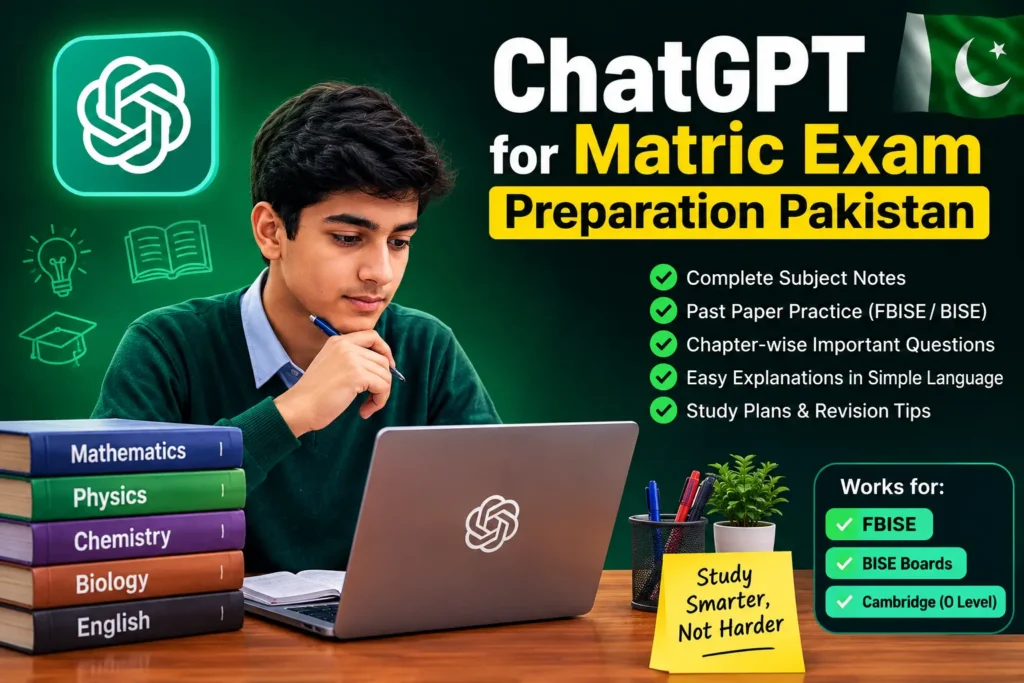
Quick Answer: Yes, ChatGPT genuinely helps with matric study, but it’s a preparation tool, not something you’ll ever touch during the actual paper — Pakistani board exams are closed-book and invigilated, so this is entirely about how you study beforehand. It works best for breaking down confusing steps in Math and Physics, practicing essay structure in English, and generating extra practice questions once you already understand the basics from your textbook. It works worst when students use it to skip understanding entirely and just copy explanations without checking them against a real past paper.
Gemini’s Gems feature works similarly for structured exam prep if you want a second option — our Gemini Gems exam prep guide covers that side of things.
What you’ll learn: → What changed in this year’s FBISE exam pattern, and why it affects how you should study → Which matric subjects ChatGPT genuinely helps with, and which ones it’s weaker at → How to ask it questions so you get useful answers instead of confusing ones → The specific mistake most students make that turns studying into copying → A simple weekly structure for using it alongside past papers, not instead of them
Table of Contents
What Changed About the Exam Itself This Year
Worth knowing before anything else: FBISE introduced a revised exam pattern for Mathematics, Biology, Chemistry, Physics, and Computer Science, splitting each paper into 50% multiple-choice questions and 50% descriptive answers, rolling out starting with the Second Annual Examination 2026. FBISE’s own official site publishes current pattern updates directly, worth checking if you’re unsure whether your specific subject has shifted to this format yet. If your studying has been built entirely around long descriptive answers, it’s worth checking whether your specific subject and board have moved this way, since MCQ practice is a genuinely different skill from writing full explanations.
This matters for how you use ChatGPT specifically: it’s useful for both formats, but you have to ask for them differently. Asking it to generate multiple-choice style questions with distractors trains a different kind of quick recognition than asking it to help you structure a full descriptive answer.
Which Subjects It Actually Helps With
Math and Physics are where it earns its place most clearly, specifically for breaking a multi-step problem into individual steps you can follow one at a time, rather than seeing only a final answer with no explanation of how it got there. Ask it to slow down and explain each step, and it generally does.
English essay and comprehension work also benefit — asking it to review your essay structure, check whether your paragraphs actually answer the question asked, or explain grammar rules you keep getting wrong tends to produce genuinely useful feedback. For Urdu and Islamic Studies content specifically, results are more mixed; nuance, exact wording expected by examiners, and culturally or religiously specific phrasing don’t always come through as reliably, which makes textbook and teacher guidance more important for those subjects than for Math or Physics.
Where It Gets Things Wrong
Be honest with yourself about this part. Numeric answers on multi-step calculations occasionally come out wrong even when the explanation sounds confident and clear — the tone of the answer doesn’t tell you whether the math is correct. Specific factual details, dates, or exact definitions expected by a particular board’s marking scheme sometimes don’t match what your textbook says word for word, even when the general concept is right.
None of this means don’t use it. It means treating every answer as a draft explanation to check, not a final answer to memorize and repeat on exam day without verifying it first.
How to Actually Ask It Questions
Vague questions get vague answers. “Explain photosynthesis” produces a generic paragraph. “Explain photosynthesis the way it’s covered in matric Biology, step by step, and include the specific terms I’d need to use in a descriptive answer” produces something far closer to what you’ll actually need to write on the exam. Asking it to explain a wrong answer you got on a past paper, rather than just asking it to solve the question fresh, often reveals exactly where your specific misunderstanding is.
For Math and Physics specifically, explicitly asking it to show every step, not just the final answer, catches more of its own occasional errors than accepting a short final result would. OpenAI’s own guidance on using ChatGPT covers general best practices for getting clearer, more accurate responses if you want to go deeper on prompting technique. Our Gemini Gems prompts for students is worth trying alongside this too, since having a second tool’s structured prompts on hand covers gaps either one might have on its own.
Checking Its Answers Against Past Papers
This is the habit that separates students who genuinely improve from students who feel like they’re studying without actually getting better. After ChatGPT explains a concept or solves a problem, find a real past paper question on the same topic and try it yourself without looking at the explanation again. Research on retrieval practice consistently shows this kind of self-testing, without the answer in front of you, builds stronger long-term recall than simply re-reading an explanation, which is exactly why this step matters more than it might seem. If you can solve it independently, the concept will stick. If you can’t, that gap is exactly what to revisit, either with ChatGPT again or with your textbook and teacher.
Past papers also show you the actual expected answer format and length for your specific board, which ChatGPT can’t fully replicate on its own since marking schemes vary and aren’t something it has direct access to.
Studying With It vs. Copying From It
There’s a real, honest line here, and it’s worth being clear-eyed about rather than pretending it doesn’t exist. Using ChatGPT to understand a concept before you write your own practice answer is studying. Copying an explanation word for word into a notebook without working through it yourself, or using it to write an assignment you’re meant to complete independently, crosses into territory your school likely has real policies against — and more importantly, it means exam day arrives with a gap between what you copied and what you actually understand, which shows up exactly when it matters most.
The honest test: if you closed the ChatGPT tab right now, could you explain the concept back in your own words? If yes, you studied. If not, you copied.
A Simple Weekly Structure
Spend the first pass on a topic with your textbook, getting the basic outline of what’s being covered. Bring the parts that don’t make sense to ChatGPT, asking it to explain those specific gaps rather than the whole chapter again from scratch. Then move to past paper questions on that same topic, working through them without help first. Only go back to ChatGPT for the specific questions you got wrong, asking it to walk through where your reasoning went off track rather than just giving you the correct answer to memorize.
Common Mistakes Students Make
Asking for the final answer instead of the explanation. This produces something to copy, not something to learn from, and it’s the single biggest reason ChatGPT-assisted study doesn’t translate into exam performance.
Never checking a ChatGPT explanation against a real past paper. Without this step, you have no way of knowing whether what you learned matches what your specific board actually expects.
Treating every answer as automatically correct. As covered above, confident-sounding explanations aren’t the same as verified-correct ones, especially on multi-step calculations.
Using it as a replacement for the textbook instead of alongside it. Your textbook and past papers reflect your specific board’s exact expectations in a way a general AI tool can’t fully replicate on its own.
Problem Diagnosis: Confusing or Wrong Answers?
If an explanation feels overly generic or doesn’t match your textbook’s terminology, ask it specifically to explain the concept “the way it’s taught in Pakistani matric [your board] syllabus” rather than accepting the first general answer. If a numeric answer doesn’t match your textbook’s worked example, work through the calculation yourself step by step rather than assuming either source is automatically right — this is exactly the kind of check that catches genuine errors on both sides. If you’re getting confused rather than clearer after several exchanges, that’s usually a sign to step back to the textbook’s original explanation before continuing.
When This Isn’t the Right Tool Yet
Skip leaning on ChatGPT heavily if: your foundation in a subject is genuinely weak — starting with your textbook and teacher for the core concepts first, then using ChatGPT to reinforce and clarify afterward, works better than trying to build understanding from scratch through back-and-forth chat alone. Skip spending significant new time on it if your exam is very close and you haven’t done real past paper practice yet; past papers under timed conditions matter more in the final stretch than new concept exploration.
This is worth building into your routine if: you already have a reasonable grasp of the basics and want a faster way to fill specific gaps, generate extra practice questions, or get a second explanation of something your textbook covers too briefly.
Decision Checklist
- I know whether my subject follows the new 50% MCQ format this year → changes how I should be practicing
- I ask for explanations and steps, not just final answers → the difference between studying and collecting answers to copy
- I check ChatGPT’s explanations against a real past paper afterward → confirms what I learned actually matches exam expectations
- I could explain the concept back in my own words without looking → the honest test for whether I actually studied it
- I’m using it alongside my textbook, not instead of it → keeps me aligned with what my specific board expects
Honest Verdict
| What Works | What Doesn’t |
| Asking for step-by-step explanations, not final answers | Copying explanations without working through them yourself |
| Using it to fill specific gaps after a first textbook pass | Replacing the textbook entirely from the start |
| Checking every answer against a real past paper | Trusting confident-sounding explanations without verification |
| Using it heavily once basics are solid | Leaning on it before understanding the fundamentals at all |
Best for: students with a reasonable grasp of the basics who want faster, clearer explanations for specific gaps and extra practice questions.
Skip heavy reliance if: your foundation in a subject is still shaky — textbook and teacher support matters more at that stage than AI-assisted study.
FAQ
Q: Can I use ChatGPT during the actual matric exam?
No. Board exams are closed-book and invigilated, so this only applies to how you study beforehand, not anything during the paper itself.
Q: Is using ChatGPT to study considered cheating?
Using it to understand a concept before writing your own answer is studying. Copying its output directly into work meant to be done independently crosses into territory most schools have real policies against.
Q: Which matric subjects does ChatGPT help with least?
Urdu and Islamic Studies tend to be less reliable for exact expected wording and nuance compared to Math or Physics, where step-by-step logic translates more cleanly.
Q: Does the new FBISE exam pattern affect how I should study?
Yes, for Math, Biology, Chemistry, Physics, and Computer Science specifically — the shift to 50% MCQ means practicing quick recognition questions matters alongside full descriptive answers now.
Q: How do I know if a ChatGPT explanation is actually correct?
Check it against your textbook’s worked example or a real past paper question on the same topic. Confident tone isn’t proof of correctness, especially on multi-step calculations.
Final Recommendation
Use your textbook for the first pass on any topic, bring specific confusing parts to ChatGPT for a clearer explanation, then confirm what you learned against a real past paper before moving on. For language-specific subjects like English or Urdu, our Gemini Gems language learning guide covers a complementary approach worth trying alongside this one.
Researched and written by the ilmilog.com editorial team. Exam pattern details confirmed against FBISE’s official current guidance as of July 2026. This article reflects general study strategy, not official exam board policy — always confirm your specific school and board’s current rules on AI tool use directly with your teacher or board.