AI Homework Help: The Giveaway Isn’t a Detection Tool
Quick Answer: The homework situation is genuinely different from exam revision, and treating them the same is where most advice goes wrong. Homework has a deadline measured in hours, not weeks, and it usually gets checked by a teacher who already knows how you normally write and think. The method that holds up: attempt the problem yourself first, use AI specifically for the part you got stuck on, then check the explanation against your own understanding before it goes anywhere near your submitted answer.
If you’re weighing whether this is even appropriate for a specific assignment, our ai rules guide covers that permission question directly.
Why Homework Isn’t the Same Situation as Exam Revision
Exam preparation happens over weeks, with no single piece of work directly graded until the final paper. Homework is graded far more often, on a much shorter cycle, and it’s reviewed by someone who already has a running sense of how you write and think, built up across dozens of previous submissions. That difference changes what actually matters here — not whether AI helps you understand a topic, but whether what you hand in still looks and reads like your own work.
A Simple Before-During-After Routine
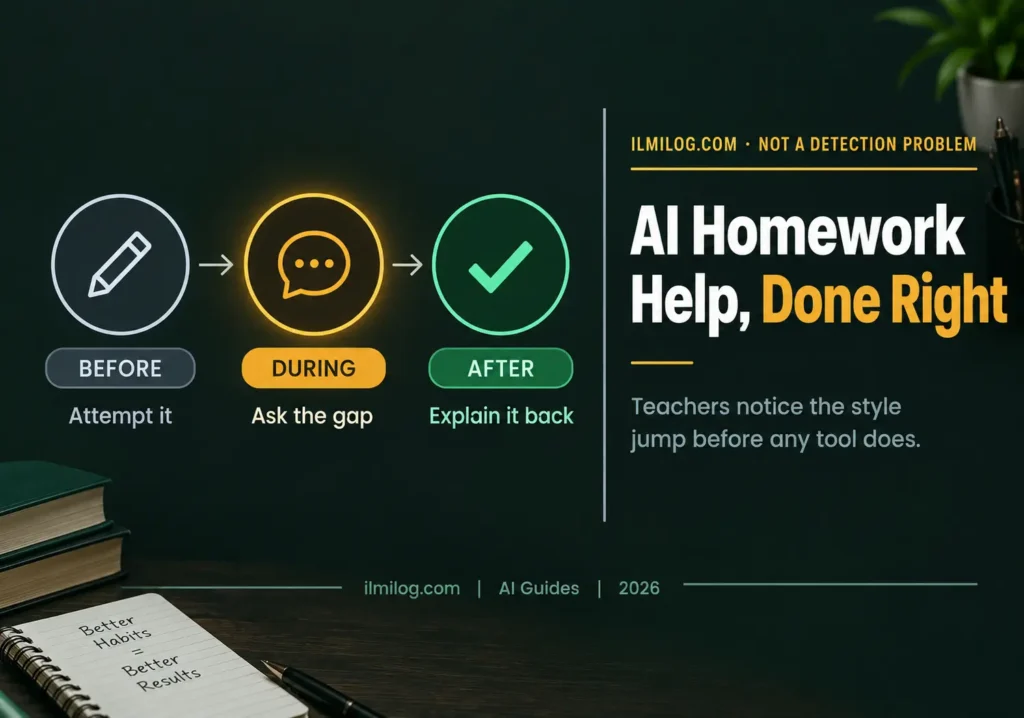
A structure worth adopting directly: before opening any AI tool, attempt the problem yourself and note specifically where you got stuck. During, ask AI about that specific gap rather than the whole assignment — this keeps the tool focused on the part you genuinely needed help with. After, close the AI conversation and try to explain the concept back in your own words, then finish or revise your answer without it open in front of you. Common Sense Media’s family-facing guidance on AI in schoolwork frames this same before-during-after structure as the difference between AI supporting learning and AI quietly replacing it.
The Real Giveaway Isn’t a Detection Tool
This is worth being honest about, because it matters more practically than any policy discussion. Teachers who see your work regularly notice a sudden jump in vocabulary, sentence complexity, or explanation style that doesn’t match how you usually write — long before any AI-detection software gets involved. This isn’t about getting caught by technology; it’s a simple, human pattern-matching problem. If an answer reads noticeably more polished or advanced than your normal homework, that gap is often obvious to someone who’s read your handwriting and phrasing all year.
The practical fix isn’t avoiding AI entirely — it’s using AI-provided explanations to build your own understanding, then writing your actual answer in your own words and at your own natural level, rather than copying phrasing directly from the AI output. OpenAI’s own usage guidance touches on this same expectation around academic contexts, worth reading alongside whatever your specific school has published. Our exam prep guide covers a version of this same reasoning applied to revision rather than daily assignments, if you want the broader picture.
Using It to Check Finished Work
The single most reliable use case here: complete your homework the normal way first, then ask AI to review it specifically for errors or gaps rather than to produce an answer from scratch. This flips the usual workflow in a way that keeps you doing the actual thinking while still catching mistakes before submission. Asking “what’s wrong with this answer” after you’ve already written something produces more useful, specific feedback than asking “solve this” before you’ve attempted it at all.
When a Parent Is the One Actually Using It
This is a genuinely common situation in Pakistani households that most guides skip entirely. A parent helping with a younger child’s homework in a subject they haven’t studied in years — a changed Math syllabus, an unfamiliar English grammar rule — can use AI themselves to refresh their own understanding before explaining it to their child, rather than the child using the tool directly. This sidesteps most of the concerns above entirely, since the child still does their own homework with a parent’s help, and the parent’s use of AI is no different from consulting a textbook or a tutor to prepare for that conversation.
This matters especially for subjects where the curriculum itself has changed since a parent was in school — a different approach to teaching Math, a revised English grammar framework, or terminology that’s simply unfamiliar decades later. Rather than a parent guessing at an explanation or avoiding helping altogether, a quick check with an AI tool beforehand often restores enough confidence to explain the concept clearly, without the child ever needing to use the tool themselves at all.
Which Subjects This Fits, and Which It Doesn’t
Math and Science homework benefit clearly from the check-finished-work approach, since a wrong step is usually identifiable and explainable. English composition and creative writing are where the vocabulary-jump problem shows up most obviously, since writing style is exactly what a teacher is evaluating — heavier reliance here carries more practical risk than in a subject graded mainly on correct working. Language subjects like Urdu benefit from AI explaining a grammar rule, but translating or generating actual sentences to submit runs into the same style-mismatch issue as English composition.
Common Mistakes Students Make
Asking AI to solve the whole assignment instead of the specific stuck part. This produces something to copy rather than something to learn from, and it’s the single biggest reason this approach backfires.
Copying AI phrasing directly into written subjects. The vocabulary and style mismatch this creates is often the most noticeable thing about AI-assisted homework, more than any factual error would be.
Skipping the “explain it back” step. Without this, you have no real way of knowing whether you actually understood the explanation or just accepted it.
Not considering that a parent’s own use of AI to prepare might solve the problem more simply than a child using it directly. This option gets overlooked constantly, especially for younger students.
Problem Diagnosis: Grades Not Reflecting Your Effort?
If your grades on AI-assisted homework don’t match how confident you felt completing it, that’s usually a sign the “explain it back” step got skipped — confidence in an explanation you read isn’t the same as understanding you can reproduce independently. If a teacher has specifically flagged a submission as inconsistent with your usual work, that’s the vocabulary-jump problem showing up in practice, and it’s worth being more deliberate about writing your own answers in your own words going forward, not necessarily avoiding AI help entirely.
When This Isn’t the Right Approach
Skip using AI for a specific assignment if: the point of that assignment is explicitly to assess your independent writing voice or creative expression, since that’s exactly where a style mismatch is most noticeable and most consequential. Skip it too if you haven’t attempted the problem at all yet — starting with AI instead of your own attempt removes the retrieval practice that makes this approach useful in the first place.
This is worth using if: you’ve made a genuine attempt and are stuck on something specific, or you want to check completed work for errors before submitting it.
Decision Checklist
- I attempt the homework myself before opening any AI tool → preserves the actual thinking the assignment is meant to build
- I ask about the specific part I’m stuck on, not the whole assignment → keeps the help targeted rather than total
- I can explain the concept back in my own words afterward → the real test of whether I understood it
- I write my own final answer rather than copying AI phrasing directly → avoids the vocabulary-jump problem in written subjects
- I’ve considered whether a parent using AI to prepare might solve this more simply for younger students → an option worth remembering
Honest Verdict
| What Works | What Doesn’t |
| Attempting the problem first, then asking about the specific gap | Asking AI to solve the whole assignment from the start |
| Checking finished work for errors before submitting | Generating an answer to submit as-is |
| Writing your own final answer in your own words | Copying AI phrasing directly into written work |
| A parent using AI to prepare, with the child doing their own homework | A student using AI to bypass the assignment entirely |
Best for: students who’ve made a genuine attempt and want targeted help with a specific gap, or completed work checked before submission.
Skip it for: assignments specifically assessing your independent writing voice, where a style mismatch is the most noticeable and consequential outcome.
FAQ
Q: Will my teacher be able to tell if I used AI for homework?
Often yes, and usually not through detection software — a sudden shift in vocabulary or explanation style from your normal work is the more common, practical giveaway.
Q: Is it better for a parent to use AI or for the student to use it directly?
For younger students especially, a parent refreshing their own understanding to help explain a concept often sidesteps most concerns entirely, since the child still completes their own work.
Q: What’s the safest way to use AI for homework?
Attempt the problem first, ask about the specific part you’re stuck on, then write your own final answer rather than copying the explanation directly.
Q: Does this approach work the same for every subject?
No. Math and Science, where a wrong step is identifiable, tend to work well. English composition and creative writing carry more practical risk since writing style itself is what’s being assessed.
Q: What if I already submitted something I’m now unsure about?
Raising it with your teacher directly is almost always a better outcome than staying quiet, especially compared to it coming up on its own later.
Final Recommendation
Attempt every assignment yourself first, use AI specifically for the part you’re genuinely stuck on, and always finish by writing your own answer in your own words rather than copying an explanation directly. UNESCO’s guidance on AI in education covers the broader reasoning behind this kind of balanced approach if you want the wider international context behind it. For the exam-specific side of this same reasoning, our study guide is worth reading too.
Researched and written by the ilmilog.com editorial team. Homework guidance cross-referenced against Common Sense Media’s family-facing AI education resources and general academic practice as of July 2026. This article reflects general study strategy, not official school policy — always confirm your specific school’s current rules directly with your teacher.