FBISE Past Papers: The Solution Key Most Students Skip
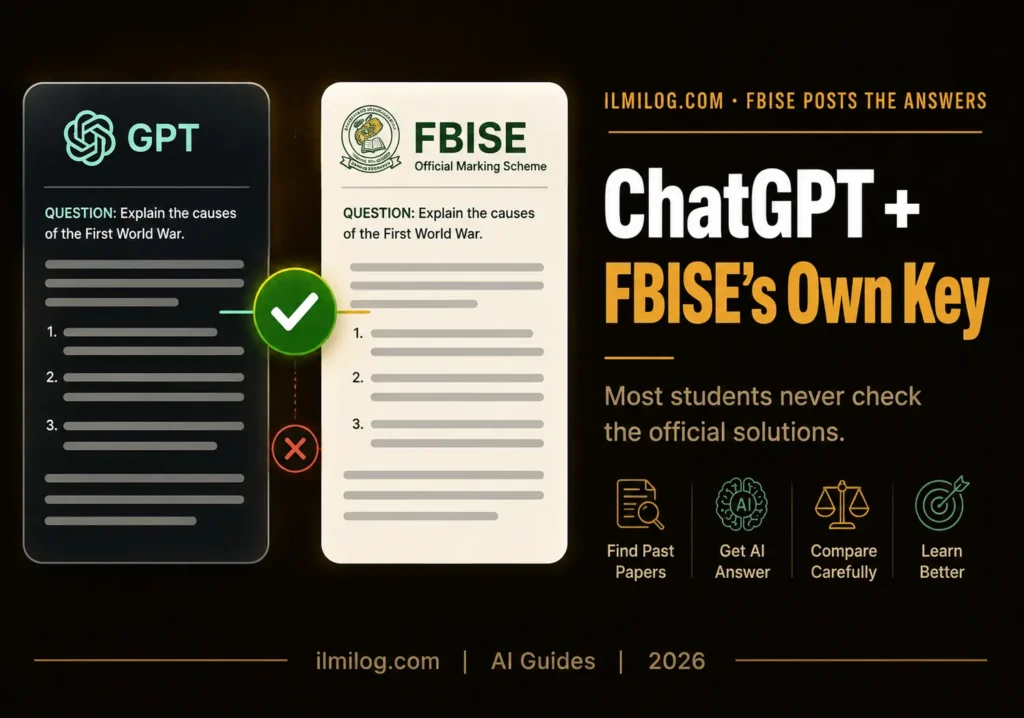
Quick Answer: The step most students skip is checking FBISE’s own website first. Since the board moved to an SLO-based exam system, official model papers with solutions have been posted directly on FBISE’s site, which is the actual source to verify against, not just trusting whatever ChatGPT produces. The practical method: treat each section of a paper differently — MCQs, short answers, and long answers each need a different kind of prompt — then check every explanation against the board’s own posted solution before you trust it enough to practice from.
If you haven’t worked through the broader concept-explanation side of this yet, our matric ChatGPT guide covers that groundwork first.
The Official Resource Most Students Skip
Since FBISE shifted to a fully Student Learning Outcome, or SLO, based exam system, the board has published official model papers along with their solutions directly on its own site. This is worth knowing before anything else, because it means there’s an actual authoritative answer key to check against, not just your own judgment about whether an AI-generated explanation sounds right.
Most study advice treats past papers purely as practice material and skips straight to solving them. The posted solutions are the missing verification step — without them, you have no way of confirming whether ChatGPT’s explanation actually matches what the board considers correct, versus a plausible-sounding answer that misses something specific to FBISE’s expected approach.
Section A: Getting More Out of MCQ Practice
FBISE papers open with a compulsory, time-boxed multiple-choice section. For this part, ChatGPT is most useful not for answering the MCQs themselves, which you should attempt on your own under timed conditions first, but for explaining why a specific wrong option is wrong after you’ve already picked an answer. Paste in the question and all four options, tell it which one you chose, and ask it to explain why each of the other three doesn’t fit — this catches subtle misunderstandings a simple right-or-wrong check doesn’t reveal.
Section B: Short Answers and the SLO Connection
Since every question maps to a specific Student Learning Outcome, asking ChatGPT to explain a short-answer question “in terms of the specific learning outcome being tested” produces a more targeted response than a generic explanation of the topic. Short answers on FBISE papers tend to reward precision and completeness within a tight scope rather than broad discussion, so asking for a concise, structured explanation, matching the length and format of a typical short-answer response, works better than requesting a full essay-style explanation you’d then need to condense yourself.
This SLO framing matters more than it might first seem. A concept can be technically correct while still missing the specific angle a particular outcome is testing — two students can both understand a topic broadly, yet only one of them answers in a way that actually addresses what that specific question is checking for. Asking explicitly which learning outcome a question targets, rather than just asking about the topic in general, keeps your explanation aligned with what’s actually being assessed.
Section C: Long Answers Need a Different Approach
Long answer questions reward structure as much as content — headings, clearly separated points, diagrams where relevant. Ask ChatGPT to draft a structured outline first, with clear subheadings matching how a full-marks answer would typically be organized, before asking for the full written explanation. Attempting the question yourself against that outline, then comparing your attempt to a completed version, reveals gaps in structure as clearly as it reveals gaps in content.
Verifying Against FBISE’s Own Posted Solutions
This is the step that turns AI-assisted practice into something reliable rather than something you’re hoping is accurate. After working through a question with ChatGPT, find the same or a similar question in FBISE’s posted model paper solutions and compare directly. Where they align, that’s confirmation you understood it correctly. Where they diverge, the board’s own posted answer is the one to trust, and it’s worth specifically asking ChatGPT why its approach differed, since that follow-up question often reveals a subtlety in the expected method you’d otherwise miss entirely.
Practicing at Speed Once the Pattern Is Clear
Once you’ve confirmed you understand a topic through this verification process, shift to timed practice without ChatGPT open at all. OpenAI’s own guidance on effective use covers general best practices for this kind of tool if you want a broader sense of what it’s suited for beyond exam revision specifically. The entire value of the method above is building accurate understanding beforehand; the actual exam rewards speed and independent recall, which only comes from practicing without assistance once you trust that understanding is solid. Using ChatGPT during timed practice defeats the purpose of the timed practice itself.
If you’re studying for board exams more broadly rather than just past paper practice, our general AI exam prep guide covers a wider range of study tasks beyond just this specific verification method.
Common Mistakes Students Make
Trusting an explanation without checking it against FBISE’s posted solution. This is the single biggest gap between students who genuinely improve and students who feel like they’re studying without confirming anything.
Using the same prompt style across all three paper sections. MCQs, short answers, and long answers reward different things, and a one-size prompt misses what each section specifically rewards.
Skipping timed practice because AI-assisted review felt productive. Understanding a question with help and answering it independently under time pressure are genuinely different skills, and only one of them is what the actual exam measures.
Not asking why an explanation diverged from the official solution. This specific follow-up question is often where the real learning happens, and skipping it wastes the one moment that would have caught a misunderstanding.
Problem Diagnosis: Explanation Doesn’t Match?
If ChatGPT’s explanation and FBISE’s posted solution genuinely disagree on a factual point, trust the board’s own solution and ask ChatGPT to explain the discrepancy directly — this usually surfaces the specific reasoning FBISE expects that a general explanation missed. If MCQ practice isn’t improving despite reviewing wrong answers, check whether you’re actually attempting the question cold first rather than reading the options with ChatGPT’s help before choosing, since that removes the retrieval practice that makes this method work. If long-answer structure keeps coming out disorganized, go back to the outline step rather than jumping straight to a full written explanation.
When This Method Doesn’t Fit Yet
Skip this specific method if: your foundation in a subject is still shaky enough that you’re not yet ready to attempt questions independently first — start with your textbook and teacher for the core concepts, then bring this verification method in once you have something real to check. Skip heavy reliance on it in the final days before an exam, when timed practice without any assistance matters more than continued explanation-based review.
This is worth building into your revision if: you have a reasonable grasp of the basics and want a structured way to confirm your understanding actually matches what FBISE expects, rather than guessing based on how confident an explanation sounds.
Decision Checklist
- I attempt questions independently first, before asking for an explanation → preserves the retrieval practice that makes this method work
- I use a different prompt approach for MCQ, short-answer, and long-answer sections → matches what each section actually rewards
- I check every explanation against FBISE’s own posted model paper solutions → the actual verification step, not an optional extra
- I ask why an explanation diverged when it doesn’t match the official solution → this follow-up often reveals the real gap
- I switch to fully timed, unassisted practice once understanding is confirmed → builds the speed and recall the actual exam requires
Honest Verdict
| What Works | What Doesn’t |
| Checking explanations against FBISE’s own posted solutions | Trusting a confident-sounding explanation without verification |
| A different prompt style for each paper section | One generic prompt style used across MCQs, short, and long answers |
| Attempting questions independently before asking for help | Reading an explanation before genuinely attempting the question yourself |
| Fully unassisted timed practice once understanding is confirmed | Practicing with ChatGPT open during timed sessions |
Best for: students with a reasonable grasp of the basics who want a structured, verified way to confirm their understanding before exam-speed practice.
Skip it if: your foundation in a subject is still shaky — textbook and teacher support for core concepts matters more at that stage than past paper verification.
FAQ
Q: Does FBISE actually publish official solutions, or just question papers?
Since the board’s move to an SLO-based system, official model papers have been posted with their solutions directly on FBISE’s own site, which is the authoritative source to check any AI-assisted explanation against.
Q: Should I answer MCQs with ChatGPT’s help or on my own first?
On your own first, timed. Bring ChatGPT in afterward specifically to explain why the options you didn’t choose are wrong, not to help you pick the answer initially.
Q: How is a long-answer question different from a short-answer one in terms of using ChatGPT?
Long answers reward structure as much as content, so asking for an outline first, before the full explanation, matches how these questions are actually marked more closely than requesting a complete answer immediately.
Q: What if ChatGPT’s explanation contradicts what my teacher taught?
Check FBISE’s own posted solution as the deciding source. If it aligns with your teacher, that confirms your teacher’s approach. If it aligns with ChatGPT, that’s worth raising with your teacher directly rather than assuming either source is automatically right.
Q: How close to the exam should I stop using this method?
Shift to fully unassisted, timed practice in the final stretch. The verification method builds understanding beforehand; the exam itself rewards independent speed and recall, which only comes from practicing without help. Checking FBISE’s official notifications page for current exam dates helps you plan exactly when that final stretch begins.
Final Recommendation
Check FBISE’s own posted model paper solutions before trusting any AI-generated explanation, use a different prompting approach for each paper section, and shift to fully timed, unassisted practice once your understanding is confirmed. For structured prompts covering other subjects and study tasks, our Gemini Gems prompts for students is worth trying alongside this method too.
Researched and written by the ilmilog.com editorial team. FBISE’s SLO-based system and official model paper resources confirmed against the board’s own current site as of July 2026. This article reflects general study strategy, not official exam board policy — always confirm current details directly on FBISE’s official site or with your teacher.