Best AI Tools for FSc & ICS Students: Not Just ChatGPT
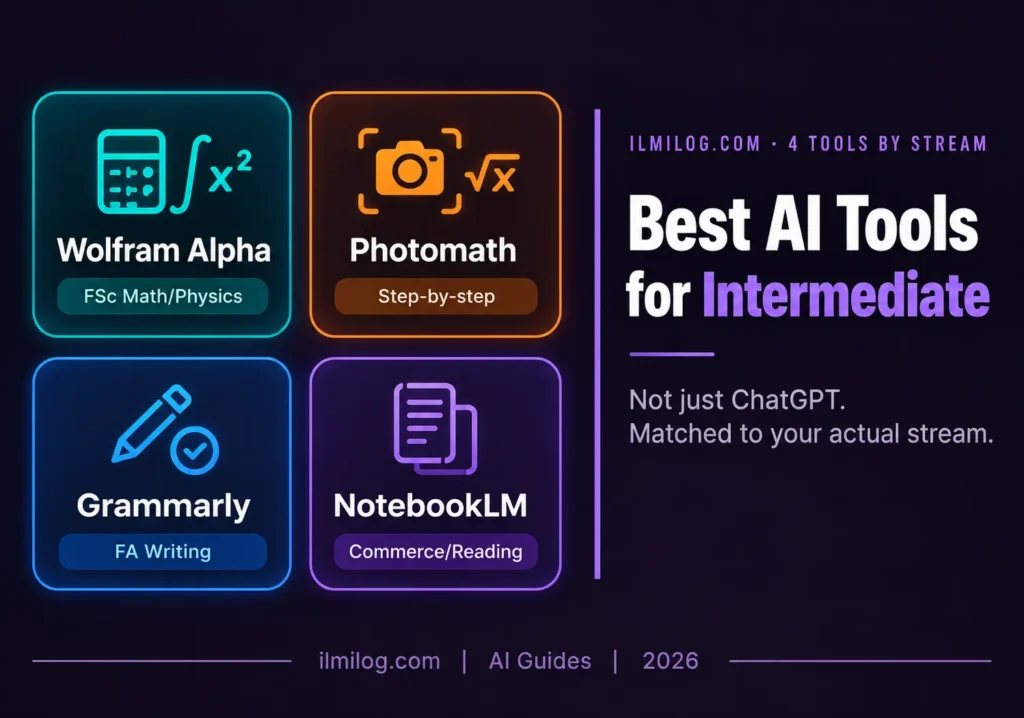
Quick Answer: Intermediate-level subjects push harder into territory a general chat AI handles less confidently — FSc numericals, ICS programming logic, Commerce accounting entries, long FA reading assignments. It isn’t just about using ChatGPT and Gemini more heavily; a few purpose-built tools most students never try to do specific jobs better than either one. Wolfram Alpha for actual computation, Photomath for step-by-step problem solving, Grammarly for polishing English writing, and NotebookLM for turning a whole textbook into something you can directly ask questions of each do one specific job better than a general chatbot does.
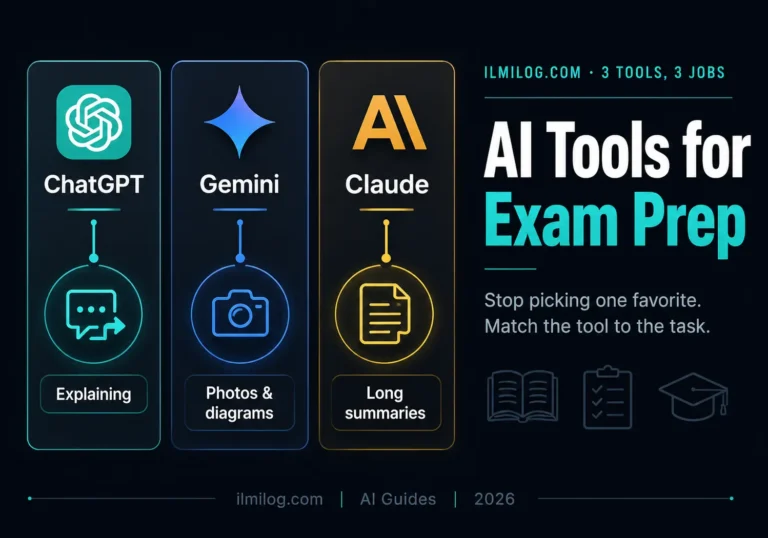
If you’re still relying entirely on general-purpose chat tools, our AI exam prep guide covers how to get more out of those first.
What you’ll learn: → Why intermediate subjects need a different toolkit than matric-level studying does → A computational tool that checks actual math and physics work, not just explains it → A step-by-step problem solver built specifically around photographed questions → How to turn an entire textbook PDF into something you can ask direct questions of → Which tools actually fit your specific stream — Pre-Medical, Pre-Engineering, ICS, or Commerce
Why Intermediate Needs a Different Toolkit
Matric-level studying leans heavily on concept explanation — understanding an idea well enough to write it out clearly. Intermediate subjects add a layer most general chat tools handle less reliably: actual computation you need checked, not just a concept explained in words. FSc Physics and Math numericals, ICS programming logic, Commerce accounting entries — these all involve a specific correct answer arrived at through a specific process, and a general-purpose chatbot occasionally gets the arithmetic wrong even while explaining the concept correctly. That gap is exactly what a few purpose-built tools close.
Wolfram Alpha: For When You Need the Computation Checked
Wolfram Alpha is a computational engine, not a chatbot — you type in an equation, a calculus problem, a statistics question, and it computes the actual answer along with the steps, rather than generating a written explanation that might contain a calculation error. For FSc Math, Physics, and Statistics specifically, this matters because it’s built to compute rather than to converse, which makes it more reliable for checking whether your own worked answer is actually correct.
It’s not built for essay questions or conceptual explanations — that’s not what it’s for. Use it specifically as a second check on numerical work you’ve already attempted yourself, not as your primary way of learning a new topic.
Photomath: For Working Through a Stuck Problem
Photomath is built around one specific job: photographing a math problem, and it walks through the solution step by step, showing the method rather than just the final number. This is different from asking a general chatbot to solve a photographed problem, since Photomath is purpose-built for this exact workflow and tends to handle handwritten or textbook-printed equations more reliably than a general-purpose tool asked to do the same thing as one task among many.
The honest limitation: it’s strong for algebra, calculus, and similar structured math, and it doesn’t extend well to Physics numericals that require applying a formula in context rather than solving a clean equation. For that, Wolfram Alpha or a general explanation-focused tool tends to work better.
Grammarly: For Polishing English and FA Writing
Grammarly isn’t an AI chatbot in the same sense as the others — it’s a writing tool that checks grammar, clarity, and structure directly inside whatever you’re writing, whether that’s an English essay, an FA assignment, or a Commerce report. For intermediate students specifically, running a completed essay through it catches structural and grammatical issues a general chatbot conversation about the same essay often misses, since it’s built specifically to analyze writing rather than generate it.
Use it as a final polish step after you’ve written your own draft, not as a way to generate the essay itself — the value here is in catching what you missed, not in replacing the writing process.
NotebookLM: For Turning a Textbook Into Something You Can Ask
NotebookLM does something genuinely different from a general chatbot: you upload your actual textbook chapter, lecture notes, or a full set of past papers as source material, and every answer it gives is grounded specifically in what you uploaded, with direct citations back to the source. This matters a lot for a subject like Commerce, Economics, or a reading-heavy FA subject, where you want answers based on exactly what your specific textbook says, not a generic version of the topic pulled from general training.
This is the tool that most directly solves the “does this match what my textbook actually says” problem that comes up constantly with general-purpose chat tools. Upload a full chapter, then ask it questions the way you’d ask a study partner who had actually read that exact chapter closely.
ChatGPT and Gemini Still Matter, Just Not for Everything
None of this means abandoning the tools you’re probably already using. For general concept explanations and working through confusing ideas conversationally, our matric-focused ChatGPT guide covers prompting techniques that apply just as well at intermediate level, even though it was written with matric board exams specifically in mind. The four tools above aren’t replacements — they’re additions for the specific tasks general chat tools handle less reliably.
Picking Tools by Stream
Pre-Medical:
Wolfram Alpha for Physics and Math computation checks, NotebookLM for working through dense Biology and Chemistry textbook chapters.
Pre-Engineering:
Wolfram Alpha and Photomath together cover most Math and Physics numerical work, with Photomath better suited to structured equation-solving specifically.
ICS:
A general chatbot remains more useful here than any of the four tools above, since programming logic and debugging benefit from conversational back-and-forth more than from a computation engine or a document-grounded Q&A tool.
Commerce and FA:
NotebookLM is the standout here, given how much of these subjects involves working precisely from assigned textbook content, with Grammarly for polishing written answers and essays.
Common Mistakes Students Make
Using a general chatbot for numerical work that needs checking, not explaining. This is exactly where Wolfram Alpha or Photomath produces more reliable results.
Asking Grammarly to write instead of to review. It’s built to catch issues in your own draft, not to generate content from scratch.
Skipping NotebookLM for reading-heavy subjects and relying on a general chatbot’s own knowledge instead. A general tool’s answer might not match your specific textbook’s wording or approach, even when the underlying concept is correct.
Trying to use all four tools for every subject regardless of fit. Matching the tool to the specific task, as covered above by stream, produces better results than using every tool for everything.
Problem Diagnosis: Not Getting Useful Results?
If a numerical answer from a general chatbot doesn’t match your textbook’s worked example, that’s specifically when to cross-check with Wolfram Alpha rather than assuming either source is automatically correct. If Photomath can’t parse a photographed problem cleanly, the issue is usually image quality or a Physics-context problem outside its structured-math focus — try Wolfram Alpha or a general tool instead. If NotebookLM’s answers feel too narrow or literal, that’s actually the tool working as intended — it’s grounded specifically in what you uploaded, which is the whole point, so uploading more complete source material usually solves this rather than switching tools.
When You Don’t Need All of These
Skip adding new tools if: your current combination of a general chatbot and your textbook is already working fine for your specific subjects — these four tools solve specific friction points, and if you’re not experiencing that friction, there’s no need to add complexity. Skip NotebookLM specifically if your subjects are mostly numerical rather than reading-heavy; it adds the least value there compared to Wolfram Alpha or Photomath.
This is worth trying if: you keep getting numerical answers from a general chatbot that don’t match your textbook, or you’re spending a lot of time re-reading dense chapters without a faster way to check your understanding against the actual source material.
Decision Checklist
- I know which of my subjects are numerical versus reading-heavy → determines which of these tools actually fits
- I’m using Wolfram Alpha or Photomath to check numerical work, not a general chatbot alone → reduces the risk of an uncaught calculation error
- I’m uploading real source material to NotebookLM rather than relying on a general tool’s own knowledge → keeps answers grounded in what my textbook actually says
- I’m using Grammarly to review my own draft, not to generate the essay itself → preserves the actual writing and thinking process
- I’m not adding tools I don’t have a specific friction point for → keeps the toolkit useful rather than cluttered
Honest Verdict
| What Works | What Doesn’t |
| Wolfram Alpha or Photomath for checking numerical work | Relying on a general chatbot alone for calculation-heavy subjects |
| NotebookLM grounded in your actual uploaded textbook | A general tool’s generic answer that may not match your syllabus |
| Grammarly as a final review pass on your own writing | Using a writing tool to generate the essay from scratch |
| Matching tools to specific subjects and streams | Using every tool for every subject regardless of fit |
Best for: intermediate students in numerical or reading-heavy streams who are already using a general chatbot and want to close the specific gaps it leaves.
Skip the extra tools if: your current setup is already working well and you’re not running into the specific friction points these solve.
FAQ
Q: Do I need all four of these tools, or just one?
Just one, based on your stream and subjects. Pre-Medical and Pre-Engineering students benefit most from Wolfram Alpha and Photomath; Commerce and FA students get more from NotebookLM and Grammarly.
Q: Is Wolfram Alpha better than ChatGPT for Math and Physics?
For checking whether a calculation is actually correct, generally yes. For understanding the underlying concept in the first place, a general chatbot’s conversational explanation is often more useful.
Q: Can NotebookLM replace reading my textbook?
No, and it isn’t meant to. It works from what you upload, so you still need the source material — it makes that material easier to query and review, not unnecessary to read.
Q: Are any of these tools free to use?
All four offer usable free access, though features and limits vary and can change, so checking each tool’s current plan directly before relying on it heavily is worth doing. Wolfram Alpha’s free tier covers most single-question lookups, though step-by-step solution details sometimes sit behind a paid tier depending on the query. Photomath’s core step-by-step solving is free for most standard problem types. Grammarly’s free tier handles basic grammar and clarity checks, with more advanced style suggestions reserved for the paid version. NotebookLM’s free tier is generous enough for typical student use, covering multiple uploaded sources per notebook without requiring payment for normal studying volume.
Q: Which tool should ICS students use instead of these four?
A general chatbot like ChatGPT or Gemini remains more useful for programming logic and debugging than any of the four specialized tools covered here.
Final Recommendation
Pick based on your actual subjects rather than trying to adopt every tool at once — Wolfram Alpha or Photomath if your work is numerical, NotebookLM if it’s reading-heavy, Grammarly as a review step either way. For structured prompts to use alongside whichever tools you pick, our Gemini Gems prompts for students is worth trying too.
Researched and written by the ilmilog.com editorial team. Tool capabilities confirmed against each provider’s own current documentation as of July 2026. This article reflects general study strategy, not official exam board policy — always confirm your specific school and board’s current rules on AI tool use directly with your teacher or board.