Freelance Contracts in Pakistan: The Clause Backward

Quick Answer: A contract for a Pakistan-based freelancer working with international clients isn’t really about courtroom enforcement — suing a foreign client in a foreign court is rarely realistic for an individual freelancer, and being honest about that changes what a contract should focus on. Its real value is filtering out bad clients before work starts, creating a clear record you can point to during a dispute, and locking in payment terms and IP transfer conditions that protect you without needing a lawsuit to matter. Five clauses do almost all of that work: scope, payment terms, revision limits, IP transfer tied to payment, and termination.
Once a contract’s signed, the next question is usually how you’ll get paid — our invoicing guide covers that step directly.
What you’ll learn: → Why courtroom enforcement isn’t the realistic protection a contract gives you, and what is → The five clauses that matter most, and why the rest is often unnecessary padding → The IP clause almost every free template gets backward → How much formality to use without scaring off a new client → What to do when a client refuses to sign at all
What a Contract Actually Protects You From
Most advice on this topic implies a contract is a legal weapon you’ll eventually use in court if a client doesn’t pay. For a Pakistan-based freelancer working with clients abroad, that’s mostly not realistic — pursuing a foreign client through a foreign court over a $500 project costs far more than $500, and almost nobody does it. Being upfront about that isn’t discouraging; it’s what points you toward what a contract genuinely does instead.
A signed contract filters out a real share of problematic clients before any work happens, simply because clients planning to underpay or disappear often hesitate at formal terms. It creates a documented record you can point to if a platform, a payment processor, or even a future client’s own legal team asks what was agreed. And it locks payment and ownership terms into writing clearly enough that a dispute gets resolved by reading the document instead of arguing about what someone remembers being said. None of that requires a courtroom to matter.
The Five Clauses That Do Most of the Work
Scope of work
State exactly what’s included, in specific enough language that “is this covered?” has an obvious answer. Vague scope is the single biggest source of unpaid extra work.
Payment terms
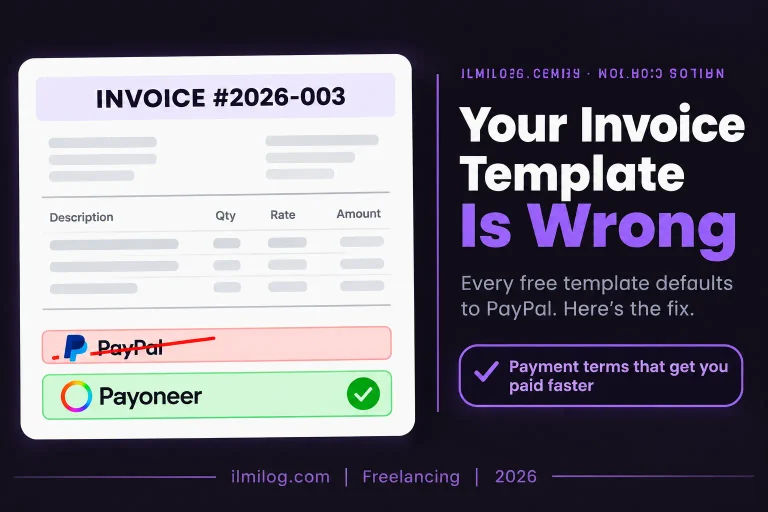
Include the amount, the schedule (a deposit before starting, milestones for larger projects), and what payment method the client will use — Payoneer or bank transfer for most Pakistan-based freelancers, spelled out clearly rather than left as a detail to sort out later. If you haven’t settled on which of those fits your situation, our best bank guide covers how the two options actually compare.
Revision limits
A stated number of included revisions, with anything beyond that billed separately, prevents “just one more small change” from quietly consuming hours you never priced in.
IP transfer conditions
Covered in more detail below, but the short version: ownership should transfer to the client after payment, not before or automatically at project start.
Termination terms
What happens if either side wants to end the project early — what’s owed for work already done, and how much notice is expected. This one gets skipped constantly and is exactly the clause that matters most when a project goes sideways.
The IP Clause Most Free Templates Get Backward
A lot of free templates include a blanket line saying all work becomes the client’s property immediately upon creation. That protects the client entirely and you not at all — if payment falls through after that point, you’ve already legally handed over the thing you made and have nothing left to withhold as leverage.
The fix is straightforward: state that intellectual property transfers to the client upon full payment received, not before. Until that payment clears, ownership stays with you. This single change turns your finished work into genuine leverage instead of something you’ve already given away for free the moment you delivered it.
How Formal Is Too Formal
A dense, multi-page contract with aggressive legal language can scare off a smaller client or a first-time collaborator who reads it and assumes you’re expecting problems before you’ve even started. A one-page agreement covering the five clauses above, in plain language, does the actual protective work without reading like a lawsuit waiting to happen.
Save the longer, more detailed version for larger projects or clients who are themselves clearly operating at a more formal, corporate level — they’ll often expect that level of structure and may be mildly surprised by its absence rather than put off by its presence.
Presenting a Contract Without Scaring a New Client
Frame it as standard practice rather than something specific to this client — a short line like “this is the same agreement I use with every project” removes any implication that you’re singling them out as a risk. Sending it alongside a warm, professional message rather than as a cold, unexplained attachment matters more than the contract’s content in terms of first impression. If a client wants to negotiate a specific clause, treat that as normal business discussion rather than a red flag on its own — the actual warning sign is a client who refuses any written terms at all, not one who wants to adjust a revision count.
When Platform Work Already Covers This
If your client found you through Upwork, most of what a contract would otherwise need to establish is already built into the platform. Upwork’s own payment protection system holds funds in escrow for fixed-price work and includes a structured dispute process for both hourly and fixed-price contracts, which covers a meaningful share of what a standalone contract exists to do. A separate written contract still adds value for platform work involving unusually large scope or sensitive intellectual property, but it’s not the same urgent necessity it is for a direct client relationship with no platform behind it at all.
Common Mistakes That Undo a Good Contract
Accepting a client’s own contract without reading the IP clause closely. As covered above, a blanket immediate-transfer clause protects them and not you — it’s worth pushing back on this specific point even when you’re otherwise fine with their terms.
No stated payment schedule for longer projects. A single lump payment due at the end leaves you fully exposed for the entire project duration. Milestones spread that risk out.
Treating the contract as optional for “small” projects. Small projects are exactly where informal verbal agreements most often turn into disputed scope, since neither side wrote anything down to check against later.
Sending an overly aggressive template to a small or first-time client. Matching the contract’s formality to the actual relationship and project size avoids unnecessarily scaring off someone who was never a real risk.
Problem Diagnosis: Client Won’t Sign?
If a client hesitates on the contract as a whole rather than a specific clause, that’s worth taking seriously as a genuine warning sign — legitimate clients are generally fine with reasonable written terms. If they’re negotiating one specific clause, particularly payment timing or revision limits, that’s normal and worth discussing rather than treating as a dealbreaker. If a client insists on using their own contract instead, read it closely for the IP transfer timing and payment terms specifically before signing, since those are the two places one-sided language tends to hide.
When a Formal Contract Isn’t the Right Choice
Skip a full formal contract if: it’s a very small, one-off project with a client you already trust from prior work — a simple written confirmation of scope and price over email covers the same ground without the formality. Skip an aggressive, heavily layered template for a first small project with a new client; it more often reads as distrust than professionalism at that stage.
This is worth using properly for: any project with a new direct client, any project involving real intellectual property changing hands, and any recurring relationship where consistent terms matter more over time than they do for a single small job.
Decision Checklist
- My contract states payment transfers before or with delivery, not after → protects your cash flow directly
- IP ownership stays with me until full payment clears → the single most commonly reversed clause in free templates
- Scope is specific enough that “is this included?” has an obvious answer → prevents the most common source of disputes
- I’ve matched the contract’s formality to the actual project size and client relationship → avoids scaring off a small, low-risk client
- I have a plan for what happens if a client refuses to sign entirely → treat this as a real signal, not just friction to push through
Honest Verdict
| What Works | What Doesn’t |
| IP transfer tied to full payment, not immediate | A blanket immediate-transfer clause that gives away your leverage |
| A one-page agreement for smaller, lower-risk projects | An aggressive multi-page contract for a first small job |
| Milestone payments for longer projects | A single lump payment due only at the very end |
| Treating a total refusal to sign as a real warning sign | Ignoring hesitation and starting work anyway |
Best for: freelancers working directly with clients outside a platform, where nothing else is establishing terms or holding funds on your behalf.
Skip overthinking it if: the work is happening entirely through a platform like Upwork — its own payment protection system already covers most of what a contract exists to do.
FAQ
Q: Can I actually sue an international client if they don’t pay?
Technically in some cases, but practically almost never for typical freelance amounts — the cost and complexity of pursuing a foreign client through a foreign court usually exceeds what’s owed. This is exactly why a contract’s real value sits elsewhere, in filtering clients and documenting terms clearly.
Q: Do I need a lawyer to write my contract?
Not for standard freelance work. A well-structured template covering the five core clauses handles most situations. Legal review becomes worth the cost for unusually large projects or complex IP situations specifically.
Q: What’s the most important clause if I can only get one right?
IP transfer tied to full payment. It’s the clause that gives you real leverage if payment falls through, and it’s also the one most commonly written backward in free templates.
Q: How do I actually get a contract signed remotely?
A free e-signature tool like DocuSign handles this cleanly for both sides without needing to print, sign, and scan anything.
Q: Should I use my own contract or the client’s?
Your own, when you have the option. The side that drafts the terms generally sets them in their own favor, even unintentionally, so starting from your own template protects you more consistently than reviewing someone else’s from scratch each time.
Final Recommendation
Keep your standard contract to the five clauses that matter, tie IP transfer to full payment rather than immediate delivery, and match the formality to the actual size of the project. Organizations like Freelancers Union maintain broader resources on contract practices if you want to go deeper than the core template covered here. Once terms are agreed and signed, our Payoneer account guide covers setting up the payment method your contract’s payment section should be pointing to.
Researched and written by the ilmilog.com editorial team. Contract clause standards cross-referenced against established freelance contracting practices and Upwork’s own payment protection documentation as of July 2026. This article is general information, not legal advice — consult a qualified professional for guidance specific to your situation.