Best Bank for Freelancers in Pakistan (The 2026 Rule Change)
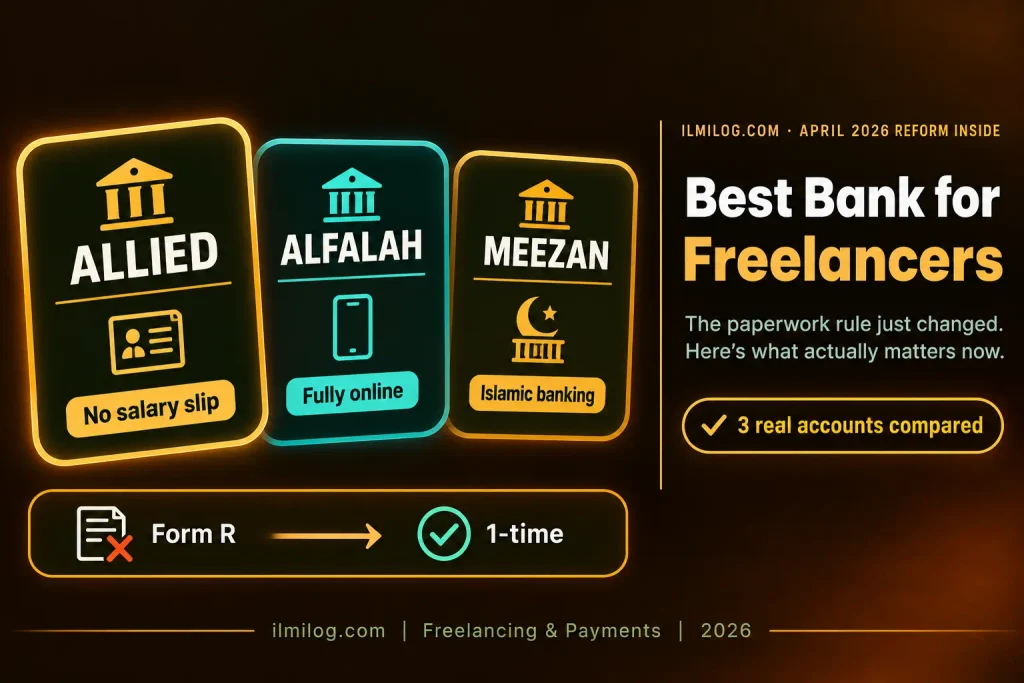
Quick Answer: There’s no single universal winner here, but Allied Bank, Bank Alfalah, and Meezan Bank stand out because they run dedicated freelancer accounts that accept a self-declaration instead of salary slips. More importantly, a real regulatory change from April 2026 changed what “good” even means here — the State Bank of Pakistan scrapped the old per-transaction paperwork freelancers used to deal with on every single incoming payment, replacing it with a one-time declaration. That single change matters more than which specific bank logo is on your card.
If you’re weighing a bank account against a Payoneer setup, our Payoneer account guide covers that side of the picture.
What you’ll learn: → The April 2026 rule change that quietly fixed the biggest banking headache freelancers used to deal with → What actually makes a bank account freelancer-friendly, beyond just accepting foreign money → Three real accounts worth comparing, with what sets each apart → A currency-retention option most freelancers don’t know exists → What to do if a payment still gets stuck despite the new rules
The Rule Change That Matters More Than the Bank Logo
This is worth understanding before comparing any specific banks, because it changes what a good freelancer banking experience even looks like now. The State Bank of Pakistan’s own circular, issued April 6, 2026, eliminated Form R as a per-transaction requirement. For years, every single incoming foreign payment meant separate paperwork, filed manually, which was a genuine source of delays and occasionally lost payments.
That’s now replaced with a single declaration made when you open the account. Coverage of the reform confirms banks are also required to process inward export receipts within one business day, and the reporting threshold was raised to $25,000. This applies to every authorized bank in Pakistan, not just a handful of freelancer-focused ones, so the baseline experience across almost any bank improved at once.
What Actually Makes an Account Freelancer-Friendly
With the paperwork burden reduced across the board, what actually separates a good freelancer account from a mediocre one now comes down to a few specific things. Does the bank accept a self-declaration of freelance income instead of demanding salary slips or an employer letter you don’t have? Is there a linked foreign currency option so you’re not forced to convert every dollar to rupees immediately? Is there a minimum balance requirement that doesn’t fit an irregular freelance income? And does the bank’s frontline staff actually understand freelancer accounts, rather than treating your situation as unusual?
That last point matters more than people expect. Even with the same national rules applying everywhere, a bank whose staff regularly handles freelancer accounts moves faster and makes fewer mistakes than one where you’re the first freelancer a particular branch has dealt with.
Three Real Options Worth Comparing
Allied Bank’s Freelancer Account requires just a CNIC and a self-declaration of freelance income — no salary slips or employer letters. Allied Bank’s own page confirms there’s no minimum balance requirement, and the account comes with a free debit card at no issuance cost. It’s built specifically around recognizing freelance income as a legitimate, documented source of funds rather than treating it as an exception.
Bank Alfalah’s Freelancer Digital Account can be opened entirely online through their digital onboarding portal, with no branch visit required — a genuine convenience if you’d rather not spend a morning at a branch explaining what Upwork is to someone who’s never heard of it. It also offers a linked foreign currency option with no minimum balance.
Meezan Bank, Pakistan’s largest Islamic bank, has built a strong presence in the freelance space with linked PKR and USD accounts. If Islamic banking matters to you specifically, it’s the most established option among freelancer-friendly banks currently.
All three, along with UBL, HBL, and Faysal Bank, come up consistently as freelancer-friendly options — the differences between them tend to come down to convenience details like digital account opening and card issuance rather than dramatically different core capability, especially now that the underlying paperwork rules are the same everywhere.
The Currency Retention Option Worth Knowing About
If you’re registered with PSEB or P@SHA, most of these banks let you open a linked Exporters’ Special Foreign Currency Account alongside your regular freelancer account. This lets you retain up to $5,000 a month, or 50% of your export proceeds — whichever is higher — in actual USD rather than converting everything to rupees immediately.
This matters if you regularly pay for anything in foreign currency yourself — software subscriptions, tools, contractor payments abroad — since holding some of your income in USD avoids converting back and forth and losing a little to exchange spreads each time. It’s a genuinely underused feature; a lot of freelancers who’d benefit from it simply don’t know to ask for it by name when opening an account.
A bank account isn’t necessarily a replacement for a mobile wallet or Payoneer either — plenty of freelancers run more than one payment method at once, using each where it fits best. Our Easypaisa vs Payoneer guide covers how a mobile wallet fits into that same picture if you’re weighing several options together rather than picking just one.
Setting Up an Account, Step by Step
Walk in with your CNIC, and if you have one, your PSEB or P@SHA registration. Ask specifically for a freelancer or IT exporter account by name — several banks market dedicated bundles, but general branch staff don’t always default to mentioning them unprompted. You’ll give a one-time declaration describing the services you provide; being specific and accurate here matters more than it might seem, since this is what determines how your incoming payments get tagged going forward.
If you want the linked foreign currency account alongside it, ask for that specifically too, rather than assuming it’s included automatically.
Getting Your Purpose Code Right
This is a detail that causes real problems when it’s skipped. Every incoming payment gets tagged with a purpose code describing what kind of transaction it is. If your freelance income gets classified under the wrong code — treated as a personal gift instead of an IT export or freelance service payment, for instance — the transaction can get flagged, delayed, or even reversed.
Getting your declaration specific and accurate when you open the account is what sets this correctly from the start. It’s also what makes your Proceeds Realization Certificates come out clean later, which you’ll need for tax filing and for accessing schemes tied to documented freelance income.
If a Payment Still Gets Stuck
Even with faster processing rules in place, an individual payment can still occasionally get delayed. If that happens, start with a written complaint to your bank rather than a verbal one, referencing the specific transaction, invoice, and client. If your bank isn’t resolving it, both the State Bank of Pakistan and the Pakistan Software Export Board maintain facilitation channels specifically for IT exporters and freelancers dealing with banking issues, and escalating through one of those is a real, documented path rather than just waiting indefinitely.
Common Mistakes That Cost Freelancers Money
Not asking for a dedicated freelancer or IT exporter account by name. Being defaulted into a standard account means missing features built specifically for irregular, foreign-sourced income.
Skipping the ESFCA option without knowing it exists. This is a real, sanctioned way to hold part of your income in USD, and a lot of eligible freelancers never ask about it.
Being vague in the service declaration at account opening. A vague or generic description makes it harder for the bank to apply the correct purpose code to future payments, which is exactly what causes delays down the line.
Assuming every branch understands freelancer accounts equally well. Even within the same bank, experience varies by branch — a branch that regularly handles freelancer accounts is a real advantage worth seeking out.
Problem Diagnosis: Account Feels Wrong for Your Situation?
If you’re being asked for salary slips or an employer letter, you’re likely in a standard account rather than a dedicated freelancer one — ask specifically about switching. If payments are landing but showing up incorrectly classified or triggering questions, your purpose code is likely the issue, and it’s worth revisiting your declaration with the bank directly. If everything about the account itself seems fine but a specific payment is delayed past the one-business-day standard, that’s the point to escalate in writing rather than assume it will resolve on its own.
When a Traditional Bank Isn’t the Right Choice Yet
Skip opening a dedicated freelancer account if: you’re not yet receiving regular international income and are still in the early, unpredictable stage of freelancing — a standard account is fine until foreign payments become consistent enough to justify the extra paperwork of switching.
This is worth setting up now if: you’re receiving regular payments from international clients or platforms and want documented, bank-level proof of income for tax filing, visa applications, or loan eligibility down the line.
Decision Checklist
- I’m asking for a dedicated freelancer or IT exporter account by name, not defaulting to a standard one → unlocks the features actually built for this situation
- I know whether I’m eligible for a linked foreign currency account → worth asking about even if you’re not certain
- My service declaration is specific and accurate, not vague → sets the correct purpose code from the start
- I understand the one-business-day processing standard now applies → helps you recognize an actual delay versus normal timing
- I have a written escalation plan if a payment gets stuck → SBP and PSEB both have real complaint channels
Honest Verdict
| What Works | What Doesn’t |
| Asking for a dedicated freelancer account by name | Accepting a standard account and missing built-in features |
| Being specific and accurate in your service declaration | A vague declaration that leads to purpose code confusion |
| Using the ESFCA option if you’re PSEB or P@SHA registered | Converting every dollar to rupees when USD retention was available |
| Escalating in writing through SBP or PSEB if a payment stalls | Waiting indefinitely without a documented complaint |
Best for: freelancers with regular international income who want documented, bank-level proof of earnings alongside faster, simpler processing than before.
Skip overthinking the specific bank if: you’re just starting out — any of the major freelancer-friendly banks now benefit from the same underlying rule changes, so the differences between them are smaller than they used to be.
FAQ
Q: Do I still need to file paperwork for every international payment I receive?
No. As of April 2026, a one-time declaration at account opening replaced the old per-transaction Form R requirement.
Q: How long should a foreign payment take to clear now?
Banks are required to process inward export receipts within one business day under the current rules, a significant improvement over the older timeline.
Q: What is an ESFCA, and do I need one?
It’s a linked account that lets PSEB or P@SHA registered freelancers hold part of their foreign earnings in USD instead of converting everything to rupees. It’s optional, but worth asking about if you’re eligible.
Q: Which bank is genuinely the easiest to open an account with as a freelancer?
Bank Alfalah’s digital onboarding lets you open an account without a branch visit, which is the most convenient starting point for many freelancers.
Q: Is a bank account better than Payoneer for a freelancer in Pakistan?
They’re not really competing options — many freelancers use both, with Payoneer as the receiving platform for certain clients and a dedicated bank account for documented, direct international payments.
Final Recommendation
Ask specifically for a dedicated freelancer or IT exporter account, be precise in your service declaration, and ask about the linked foreign currency option if you’re eligible. If a direct bank transfer from a specific platform is what you’re trying to set up, our Upwork withdrawal guide covers that process in full.
Researched and written by the ilmilog.com editorial team. Regulatory details confirmed directly against the State Bank of Pakistan’s own circular and independent coverage of the April 2026 reform. Bank account features confirmed against each bank’s own official documentation as of July 2026. This article is general information, not financial or tax advice — confirm current requirements directly with your chosen bank or a qualified professional.