Freelancer Tax in Pakistan: 1% vs 0.25% (One Fix Closes It)
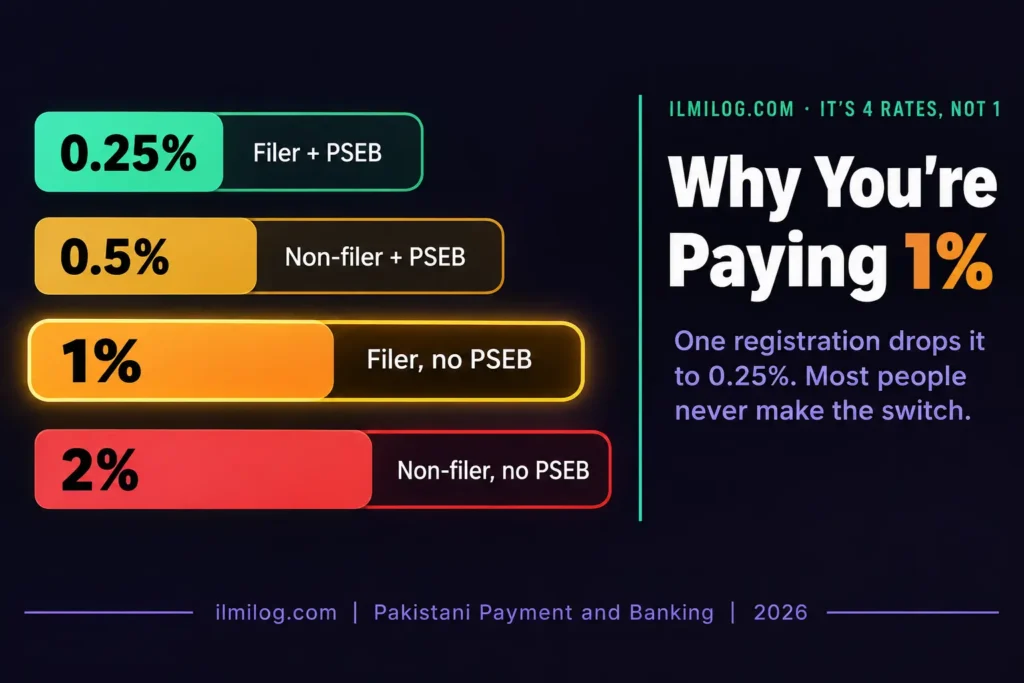
Quick Answer: The 1% isn’t a special separate tax just for freelancers — it’s the default rate under Section 154A of the Income Tax Ordinance that applies to a filer’s foreign freelance income when they haven’t registered with the Pakistan Software Export Board. Register with PSEB and stay on the Active Taxpayer List, and that same income gets taxed at 0.25% instead, a 75% reduction. Most freelancers stuck paying the higher rate aren’t paying it because of anything complicated — they simply haven’t taken the one extra registration step that unlocks the lower one.
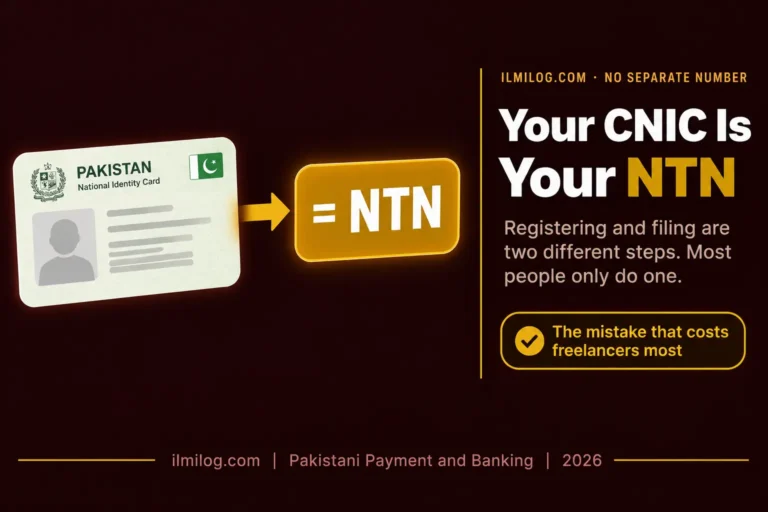
If you haven’t confirmed your filer status yet, our NTN guide covers that foundation, since everything here depends on it.
What you’ll learn: → The actual four-tier rate structure most explanations oversimplify into one flat number → Why the 1% rate specifically signals a missing registration step, not a fixed cost → What qualifies as eligible income, and the banking requirement most freelancers don’t know about → Whether this is genuinely your final tax obligation or just the starting point → A real calculation showing what the rate difference costs over a year
What the 1% Actually Is
Most explanations of this topic present a single number, which flattens what’s really a four-tier structure depending on two separate factors: whether you’re an active tax filer, and whether you’re registered with PSEB. A filer with active PSEB registration pays 0.25%. A filer without PSEB registration pays 1% — this is the rate the majority of Pakistani freelancers are paying, and it’s the one this topic usually refers to. A non-filer with PSEB registration pays 0.5%, and a non-filer without it pays 2%.
Recent coverage in Business Recorder confirms this exact gap is a live policy conversation — freelancer associations have specifically flagged that a large share of the freelancer population is paying the 1% rate simply because PSEB registration hasn’t been completed, not because of any structural barrier preventing it.
Why Most Freelancers Are Stuck at the Higher Rate
The 1% rate isn’t a penalty or a special surcharge on freelance income specifically. It’s what applies by default to a filer’s qualifying export income until PSEB registration is added on top of filer status. The rate is genuinely just a reflection of a registration step not yet completed, which means for most freelancers reading this, the path from 1% to 0.25% isn’t complicated — it’s specifically about registering with PSEB and keeping that registration active alongside your existing filer status.
What Counts as Qualifying Income
This preferential rate structure applies specifically to IT and IT-enabled services export income — a category broad enough to cover most freelance work sold to clients abroad: writing, design, development, virtual assistance, and similar digital services generally fall within it. Income from local Pakistani clients doesn’t qualify for this treatment at all and follows the normal progressive tax structure instead, with rates that scale up with income rather than a flat withholding percentage.
There’s also a banking channel requirement worth knowing: at least 80% of your qualifying foreign income needs to come through approved Pakistani banking channels for the concessional rate to apply. This is part of why the specific payment method you use for international income isn’t just a convenience question — it directly affects which tax treatment you’re eligible for.
How the Tax Actually Gets Collected
This isn’t something you calculate and pay separately after the fact. The applicable rate gets withheld automatically by your bank at the point a qualifying foreign remittance lands in your account, based on your filer and PSEB status at that time. Your bank should also issue a Proceeds Realization Certificate for each qualifying transfer, showing the correct purpose code for software or IT service exports — the same purpose-code accuracy that matters for smooth payment processing generally also matters here, since a misclassified transaction can affect how it’s treated for this specific tax regime.
Is This Really Your Final Tax?
Here’s a nuance a lot of simplified explanations skip. Under Section 154A, this withheld amount is treated as your final tax on that income only if you meet every condition — filer status, active PSEB registration where claimed, the 80% banking channel threshold, and completing your required return filing. Miss one of those conditions and the withheld amount may not be final, meaning additional liability could still apply depending on your full tax situation. Meeting all the conditions properly is what makes this a clean, one-time deduction rather than a starting point for something larger later.
What the Rate Difference Actually Costs You
Multiple independent sources converge on a similar magnitude here: a freelancer earning in the range of $10,000 to $50,000 a year in qualifying export income can expect the gap between the 1% and 0.25% rates to translate into roughly PKR 200,000 or more annually staying in their own pocket rather than going toward withholding tax, depending on income level and the exchange rate at the time. On a smaller income, the absolute number is proportionally smaller, but the underlying math — a 75% reduction in the rate applied — holds regardless of how much you’re earning.
Getting to the Lower Rate
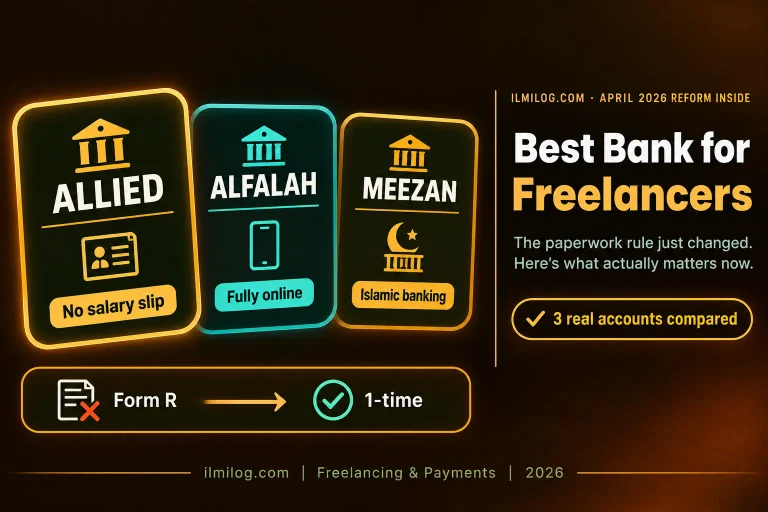
Registering with PSEB is the specific action that unlocks the 0.25% rate on top of your existing filer status. If you don’t have your filer status confirmed yet, the guide linked near the top of this article covers that first step, since PSEB registration alone doesn’t help without it. Once both are active, staying on the Active Taxpayer List and keeping your PSEB registration current — rather than letting either lapse — is what maintains the lower rate over time instead of losing it after the fact. Since the 80% banking channel requirement also matters here, our best bank guide covers the account setup that keeps your qualifying income properly documented.
Common Mistakes With This Tax
Assuming 1% is a fixed cost of freelancing rather than a signal. It specifically signals a missing PSEB registration for an otherwise-filer freelancer, which is a fixable gap, not a permanent feature of earning foreign income.
Mixing local and foreign client income together when filing. These follow entirely different tax treatments, and combining them muddles what should be a straightforward calculation on the export side.
Letting PSEB registration or ATL status lapse without noticing. The lower rate depends on both staying active — a lapse on either one reverts you to a higher rate without necessarily triggering an obvious warning.
Not keeping Proceeds Realization Certificates organized. These documents matter both for confirming the correct rate was applied and for your own return filing later.
Problem Diagnosis: Wrong Rate Withheld?
If a payment comes through withheld at 1% when you expected 0.25%, check your PSEB registration status first — an expired or incomplete registration is the most common reason for this specific gap. If you’re seeing 2% or 0.5% instead of the filer rates, your Active Taxpayer List status is the more likely issue, since non-filer rates apply until that’s resolved. If the transaction’s purpose code looks incorrect on your Proceeds Realization Certificate, that’s worth raising with your bank directly rather than assuming it will self-correct on a future transaction.
When This Doesn’t Apply to You Yet
Skip worrying about this immediately if: you’re not yet earning real foreign freelance income, or your income so far is exclusively from local Pakistani clients — this specific rate structure doesn’t touch either situation. Skip PSEB registration specifically if your income level is low enough that the absolute savings wouldn’t meaningfully offset the time spent completing registration, though this threshold is a personal judgment call rather than an official cutoff.
This is worth addressing now if: you’re already receiving regular foreign freelance income as a confirmed filer and haven’t registered with PSEB — for most people in that specific situation, the registration effort is small relative to the ongoing rate reduction it unlocks.
Decision Checklist
- I understand the 1% rate reflects filer status without PSEB registration, not a fixed freelance tax → the core distinction this topic depends on
- My foreign income genuinely qualifies as IT or IT-enabled services export income → confirms the concessional structure applies to my situation
- At least 80% of my qualifying foreign income comes through approved banking channels → required for the concessional rate to apply at all
- I’m keeping Proceeds Realization Certificates organized for every qualifying transfer → supports both the correct rate and future filing
- I’ve confirmed whether PSEB registration would meaningfully reduce my ongoing rate → the specific action that closes the gap between 1% and 0.25%
Honest Verdict
| What’s Accurate | What Isn’t |
| The 1% rate applies to filers without PSEB registration specifically | Treating 1% as a single, unavoidable “freelancer tax” |
| PSEB registration plus filer status unlocks the 0.25% rate | Assuming the lower rate applies automatically once you’re a filer |
| This is final tax only when every Section 154A condition is met | Assuming withholding automatically closes out your full tax liability regardless |
| Local client income follows a completely different tax structure | Applying export-income tax logic to local Pakistani client earnings |
Best for: confirmed filers earning regular foreign freelance income who haven’t yet registered with PSEB and are leaving the rate reduction on the table.
Skip the urgency if: your income is still irregular or primarily local — the concessional export rate structure isn’t relevant to either situation yet.
FAQ
Q: Is the 1% freelancer tax the same for everyone?
No. It specifically applies to filers without PSEB registration. Filers with active PSEB registration pay 0.25%, and non-filer rates are higher still at 0.5% or 2% depending on PSEB status.
Q: Does this tax apply to income from local Pakistani clients?
No. Local client income follows the normal progressive income tax structure, not this export-income withholding regime.
Q: Is 1% (or 0.25%) really my final tax obligation?
Only if every Section 154A condition is met — filer status, PSEB registration where claimed, the 80% banking channel requirement, and completed return filing. Missing any of these means the withheld amount may not be final.
Q: How much does PSEB registration actually save?
For a freelancer earning in the $10,000 to $50,000 range annually, the difference between 1% and 0.25% commonly works out to roughly PKR 200,000 or more a year, depending on income and exchange rates.
Q: Where do I check current, official rates before relying on any of this?
FBR’s official site and PSEB’s official site both publish current requirements, since Finance Act amendments can adjust these rates and conditions from year to year.
Final Recommendation
Confirm your filer status first, then register with PSEB if your foreign freelance income is regular enough to make the 0.25% rate worth the registration effort — for most active freelancers, it is. Keeping your international payment channel properly set up matters here too, since the 80% banking threshold depends on it; our Payoneer account guide covers getting that foundation right.
Researched and written by the ilmilog.com editorial team. Tax rates and Section 154A requirements cross-referenced against current FBR guidance and Finance Bill 2026-27 coverage as of July 2026. This article is general information, not tax or legal advice — Finance Act amendments can change these rates and conditions annually, so confirm current details directly with FBR, PSEB, or a qualified tax professional.