Ilmilog

Etsy vs Amazon KDP for Pakistani Sellers (2026)

If you make things — templates, printables, art, crafts — Etsy is the better starting point. If you write — fiction, guides, workbooks, journals you can format as a book — KDP has one advantage Etsy can’t match: it pays Pakistani authors directly into a local bank account, no middleman involved. That single difference in how money actually reaches you changes more about this decision than most comparisons admit.
Everything below comes from actually checking how each platform treats Pakistani sellers at the mechanical level — not just comparing marketing pages, but reading the actual payment policies, fee tables, and royalty structures both platforms publish for sellers in this specific country.
How I Actually Compared These Two
I pulled Etsy’s published Payment Processing Fee table and Amazon’s official KDP payment documentation directly, rather than relying on general “how to sell internationally” guides that often blend every country together. I also tracked realistic first-sale and first-royalty timelines from sellers active on each platform, since speed to first income matters as much as the eventual earning potential for someone deciding where to start.
A quick note before the comparison: this isn’t really an either-or decision for everyone. Plenty of Pakistani creators end up running both, once they’ve validated one. But for someone choosing where to put their first real effort, the differences below should make that choice a lot clearer than a generic side-by-side table would.
Round One: How You Actually Get Paid
This is where the two platforms genuinely diverge, and it’s the part most comparisons skip past too quickly.
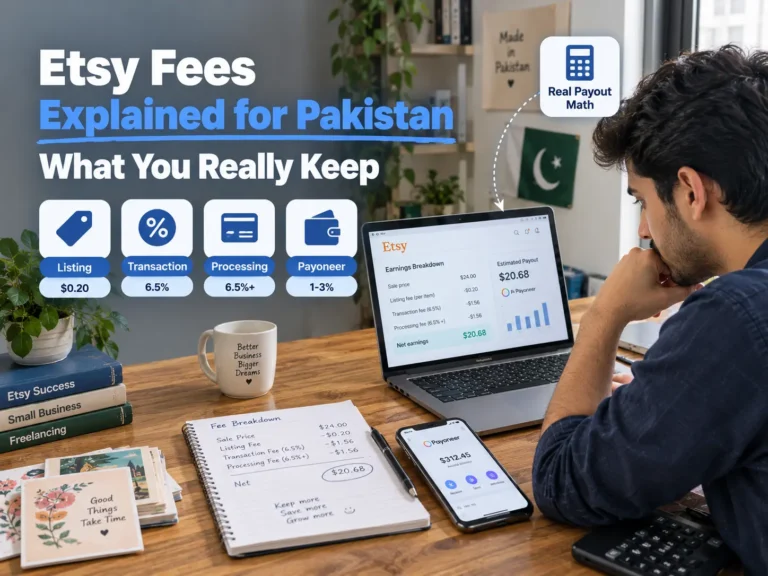
Etsy requires Payoneer for Pakistani sellers. There’s no way around it — Etsy Payments deposits your earnings into a Payoneer account weekly, and from there you withdraw to your Pakistani bank, paying Payoneer’s own conversion fee (roughly 1% to 3%) on top of whatever Etsy has already deducted. It’s a working system, but it’s two companies’ fees stacked on top of each other before money reaches you. If you haven’t gone through that shop setup process yet, this payment chain is exactly what you’re setting up.
KDP works differently, and this surprised me when I checked Amazon’s own documentation directly. Amazon lists Pakistan as a direct deposit country for KDP royalties — funds go straight into a Pakistani bank account using your IBAN, in Pakistani rupees, with no Payoneer, no middleman, and no minimum payout threshold for direct deposit. Amazon’s own payment options page confirms this applies across every major KDP marketplace, not just Amazon.com.
WHY THIS MATTERS: Fewer hops between a sale and your bank account means fewer places for a percentage to quietly disappear, and fewer accounts to manage, verify, and troubleshoot when something goes wrong. For a seller just starting out, one less payment system to learn is a real, practical advantage — not a minor technicality.
Round Two: How Fast You Can Expect a First Payout
Etsy’s first-sale timeline for a new, reasonably well-set-up shop typically lands somewhere between a few days and four weeks, based on what tends to separate fast sellers from slow ones — product choice, listing quality, and competitive pricing, all things you control directly.
KDP’s timeline looks different because the product itself takes longer to create. Writing and formatting even a short book takes real time before anything goes live, so “speed to first sale” isn’t really the right comparison — it’s more honest to compare speed to first royalty once a book is actually published, which can happen within days of publishing if the book targets a specific, searched category well.
That difference matters for how you should think about this decision. Etsy rewards a seller who can move fast with an existing design skill. KDP rewards a writer who’s already sitting on a manuscript, or genuinely enjoys the writing process enough to produce one — the upfront time investment is simply larger and unavoidable.
Round Three: The Real Fee and Royalty Math
Etsy’s fee stack for Pakistani sellers runs close to 13% to 19% of each sale once you combine the listing fee, transaction fee, and Pakistan’s specific payment processing rate — a full breakdown of exactly how that adds up on different sale sizes is covered in this fee math piece, since the number most generic guides quote for Pakistan turns out to be wrong.
KDP’s math works on royalty tiers instead of fees. As of Amazon’s July 2026 update, ebooks priced between $2.99 and $12.99 earn a 70% royalty (minus a small per-megabyte delivery cost); price outside that range and you drop to 35%. Paperbacks earn 50% or 60% of list price (60% once you’re priced at $9.99 or above), minus Amazon’s printing cost per copy. There’s no listing fee, no transaction fee layered on top — the royalty percentage is the whole story.
REALITY CHECK: A $6.99 ebook at the 70% tier earns you roughly $4.80 to $4.90 per sale after the small delivery deduction. The equivalent Etsy digital product at the same price point nets closer to $5.65 before Payoneer’s cut, then a bit less after it — so Etsy’s percentage fee is actually lower than KDP’s on a pure per-sale basis. What changes the real comparison isn’t the percentage; it’s the payment chain sitting underneath it, and how much work went into the product in the first place.
Round Four: Effort, Skill, and What You’re Actually Making
Etsy rewards design-adjacent skills — Canva comfort, layout sense, an eye for what looks finished. Most first products can go from idea to live listing within a day or two for someone comfortable with the basics.
KDP rewards writing and structuring ability. A usable first book, even a short non-fiction guide or workbook, realistically takes anywhere from a few days to several weeks of focused work before it’s ready to publish — formatting, a cover, front and back matter, all need attention before it looks like something a buyer would trust.
Neither is “easier” in any absolute sense. They reward genuinely different skills, which is probably the most useful way to think about this choice rather than treating it as which platform is objectively better.
Three Sellers, Two Platforms
Hira makes Canva templates and chose Etsy specifically because she wanted to start earning within weeks, not months. Her first sale landed on day nine, and her payment chain — Etsy to Payoneer to her bank — has worked reliably since, even if she occasionally wishes there were one fewer step involved.
Usman had a half-finished manuscript sitting untouched for two years and used KDP to finally publish it. His first royalty payment, direct to his bank account with no extra account needed, arrived about six weeks after he hit publish — slower than Hira’s first sale, but the payment process itself was simpler once it started, since there were no second platform’s fees to track.
Mariam runs both. She sells printables on Etsy for steady, faster-moving income and publishes short non-fiction guides on KDP as a slower-building secondary stream. She told me the direct-deposit royalties from KDP are the payments she has to think about least, even though they arrive less often — a useful reminder that “better platform” and “better payment experience” aren’t always describing the same thing.
Where Each Platform Clearly Wins
Etsy wins on speed, on product variety (physical and digital both), and on reaching buyers who are already shopping with intent to purchase something specific right now. If you’re deciding what to make with speed in mind, this ranked look at product ideas covers which digital categories tend to find buyers fastest.
KDP wins on payment simplicity for Pakistani sellers specifically, on long-tail passive income (a good book can sell steadily for years with zero ongoing listing effort), and on not competing against the sheer volume of near-identical listings that crowds many Etsy categories.
Etsy loses by requiring a second payment platform and its added fees. KDP loses by demanding a much larger upfront time investment before any money moves at all, and by being essentially closed to anyone without writing ability or patience to develop it.
Deciding Which One Fits You
Start with what you can actually produce well right now, not which platform sounds more appealing in theory. If you can put together a clean, well-designed digital file within a day or two, Etsy gets you to a first sale fastest. If you have real writing ability, or an unfinished manuscript gathering dust, KDP’s simpler payment chain makes the longer runway worth it.
Check your tolerance for managing a second account. Someone who finds Payoneer genuinely confusing or stressful might lean toward KDP specifically for that reason, even if Etsy would otherwise suit their skills better.
Consider your timeline honestly. Needing income within a month points toward Etsy. Being comfortable with a slower build toward more passive, recurring income points toward KDP.
Signs You’ve Picked the Wrong One For Now
If you’ve been staring at a blank Etsy shop for weeks without listing anything, that’s often less about the platform and more about not having settled on a product — which is a different problem than Etsy itself being wrong for you.
If you’ve started a KDP manuscript three separate times and keep abandoning it, that’s a genuine signal the upfront writing investment isn’t matching your actual working style right now, regardless of how appealing the direct-deposit payment sounded on paper.
A clearer signal either way: if the idea of managing Payoneer specifically fills you with dread, that’s worth weighing seriously — it’s a real, ongoing part of the Etsy experience for Pakistani sellers, not a one-time setup hurdle.
When the Other Platform Deserves a Second Look
If you started on Etsy and find yourself constantly frustrated by how crowded your product category has become, a KDP book in a related niche — a guide, a workbook, a planner you could format as both a KDP paperback and an Etsy printable — might genuinely be worth testing alongside your shop rather than instead of it.
If you started on KDP and your book’s sales have genuinely plateaued, Etsy offers a faster feedback loop for testing new ideas quickly, without the multi-week production cycle a new book demands every time.
What Changes Once You’ve Been Doing This a While
The two platforms age differently, and that’s worth knowing before you pick one based purely on the first-month picture.
An Etsy shop needs ongoing attention to keep growing. New listings, refreshed photos, adjusting prices against competitors, occasionally running a small promotion — the platform rewards activity, and a shop you stop touching for months tends to lose the visibility it built up. That’s not a flaw, just the nature of a marketplace where buyers are comparing dozens of similar listings in real time.
A KDP book, once published and reasonably well-positioned in its category, can keep selling with very little ongoing work. You’re not competing listing-by-listing the same way — a well-targeted book in a specific niche can sit quietly earning small, steady royalties for years, occasionally boosted by a price change or a new related title added to the catalog. The tradeoff is that growth is slower and chunkier: your income jumps when you publish a new book, then plateaus until the next one, rather than the more continuous growth curve an actively managed Etsy shop can produce.
For someone thinking in terms of total time investment over a year rather than just the first month, this difference matters as much as anything else here. Etsy generally asks for more frequent, smaller efforts. KDP asks for occasional, larger pushes followed by long stretches of comparatively passive income. Neither is better in the abstract — it depends entirely on which rhythm actually fits how you work.
Tax treatment is worth a brief mention too, since both forms of income are taxable for Pakistani residents regardless of platform or payment method. Direct bank deposits and Payoneer withdrawals both count as declared income, so neither platform offers a way around that — the payment mechanics discussed above affect convenience and fees, not your actual tax obligation.
Common Questions
Can I run both platforms as a complete beginner?
Yes, but not usually at the same time from day one. Most sellers who end up running both started with one, got comfortable with its basics, and added the second once the first was already generating some income.
Does KDP really have no minimum payout for Pakistan?
Correct, for direct deposit specifically — Amazon’s own documentation confirms no minimum threshold applies to the direct deposit method, unlike wire transfer or check, neither of which Pakistan uses anyway since direct deposit is the default here.
Is writing a book actually realistic without prior writing experience?
Yes, especially for structured non-fiction — guides, workbooks, journals — which rely more on organization and clarity than literary skill. Fiction demands more, but non-fiction is a genuinely approachable starting point for a first KDP title.
Which platform has less competition right now?
Hard to answer universally, since it depends entirely on your specific niche on either platform. A crowded Etsy category and an under-served KDP genre can exist side by side, which is part of why checking your specific product idea matters more than a general competition comparison.
Where can I verify the royalty numbers myself?
Amazon’s KDP overview page covers current royalty structures directly if you want to check anything here against the source before committing time to a manuscript.
Do I need a company or business registration for either platform?
No, individual seller or author status works for both, using personal identification rather than business documentation — the same CNIC-based verification that works for Etsy applies to KDP’s tax interview step as well.
What happens if I start one platform and realize it’s not working for me?
Nothing locks you in. An Etsy shop with no sales can sit dormant with no cost beyond the listing fee already paid, and a half-finished KDP manuscript simply stays a draft until you’re ready to return to it — switching your focus doesn’t cost you anything beyond the time already spent.
Everything compared here came from checking both platforms’ own published policies for Pakistan specifically — not a generic international comparison stretched to fit, but the actual mechanics each one uses for a Pakistani seller or author today. Whichever one you start with, the real decision is less about which platform is objectively stronger and more about which one matches the kind of work you’re actually willing to keep doing for the next several months.