11 Digital Products Pakistani Sellers Are Actually Making Money With on Etsy

Not every digital product sells the same way, and picking one based on what sounds impressive to build is a common first mistake. A gorgeous, complex product with no clear buyer still sits at zero sales, while a plain, slightly boring product with obvious demand quietly earns every week. A ranked list based on what actually sold is a lot more useful than a list of ideas that just sound creative.
I sorted eleven digital product types into three tiers, based on how quickly they found buyers, how much competition a brand-new shop faces, and how much skill each one genuinely requires to do well. This isn’t a ranked-by-excitement list — it’s ranked by what actually moved.
If you haven’t opened a shop yet, start with account setup first, since none of this matters without a working payment connection behind it.
Tier 1: Start Here
These three product types need the least specialized skill, have the most proven demand, and are the fastest route to a first sale for someone who’s never sold anything online before.
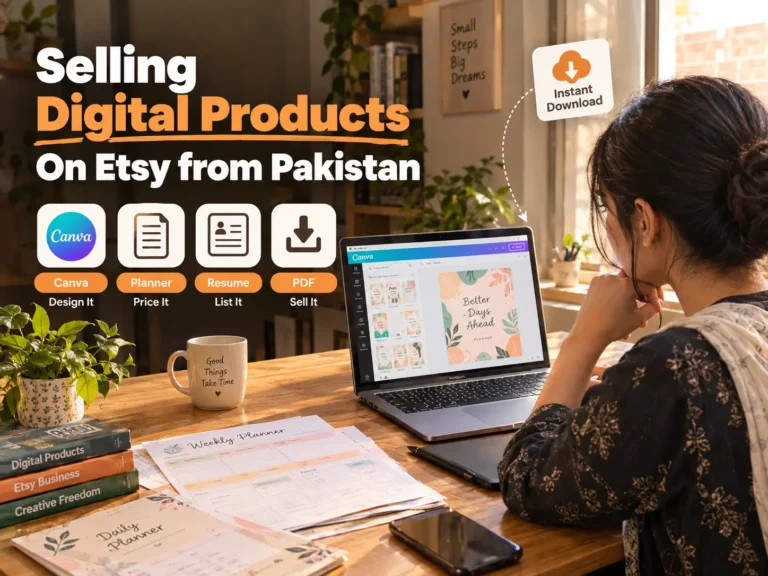
Printable planners and trackers
Daily planners, budget trackers, habit trackers, meal planners — anything a buyer prints at home and fills in by hand. The skill ceiling is low (a clean layout in Canva is enough), and the buyer base is steady year-round, not seasonal.
Canva templates
Pre-built, editable designs for Instagram posts, resumes, flyers, and invitations, which buyers customize themselves inside Canva’s free tier. These sell well because the buyer does almost none of the design work themselves — they’re paying for a finished look, not a blank canvas.
Resume and CV templates
Structured, text-heavy documents bought by people in a hurry. Competition is real here, but demand never really slows down, since people change jobs constantly regardless of season or economy.
WORTH KNOWING: All three of these share one trait — buyers already know exactly what they want before they start browsing. You’re not creating demand from nothing; you’re just trying to be the listing that matches what they were already going to buy.
Tier 2: Worth Growing Into
Once a first shop has a few sales and reviews, these product types reward slightly more time and produce noticeably better margins per listing.
Digital planners for GoodNotes or Notability
Hyperlinked, tabbed PDF planners used on an iPad with a stylus. These take longer to build than a flat printable — every tab needs working internal links — but they sell for considerably more, since the extra build time is obvious to the buyer.
Social media template bundles
A themed set of twenty or thirty posts, rather than a single design, aimed at small business owners who want a consistent look without hiring a designer. Bundling multiplies your price without multiplying your design time much, since you’re reusing a layout system across variations.
Notion templates
Dashboards for habit tracking, budgeting, or project management inside Notion’s free workspace tool. These need a bit of a learning curve to build well, but once built, they’re pure digital delivery with zero file-size headaches, and the Notion-template buyer base has grown steadily.
Wedding and invitation suites
A matched set — invitation, save-the-date, thank-you card — sold as one listing. Pricier than single printables, and buyers researching a wedding tend to spend more time comparing listings carefully, which rewards strong preview mockups more than almost any other category.
Tier 3: Niche but Worth Knowing About
Smaller audiences, but also less competition, and often better for sellers with a specific existing skill rather than a general design background.
Procreate brushes
Custom digital painting brushes for iPad artists. If you already draw or paint, this is close to zero extra work beyond exporting what you’ve already built for yourself — but it only works if you genuinely have that skill already.
Embroidery and cross-stitch pattern files
A small but loyal buyer community that searches specifically for pattern files rather than browsing broadly. Low competition, but you need either embroidery experience or specialized pattern-generation software to produce something buyers trust.
Logo and branding kits
Starter logo templates aimed at small business owners who need something presentable fast and can’t afford a custom designer. Higher price point than most other categories here, but buyers expect a level of polish that takes real design practice to deliver convincingly.
Website and landing page Canva kits
Pre-built Canva designs formatted to be screenshotted or exported as simple one-page sites. A newer category with less saturation than the others on this list, which can work in a seller’s favor early on.
Mahira’s Shop vs. Zain’s Shop
Mahira, a university student in Lahore with no design background, started with printable planners because she could build her first ten listings in a weekend using free Canva templates as a base and reworking the layouts. Her first sale came in twelve days — slower than she hoped, but steady from there.
Zain, a freelance illustrator in Karachi, skipped printables entirely and went straight to Procreate brushes, since he already had a library of custom brushes built for his own paid illustration work. His shop earned its first sale in four days, not because brushes are inherently easier to sell, but because he was starting from a skill he’d already spent years building — the product cost him almost nothing extra to create.
A third seller, Bilal, tried logo kits first, assuming the higher price point meant faster income. Six weeks in, he had views but almost no sales — buyers in that category expect a portfolio-level of polish, and his early templates weren’t quite there yet. Switching to Canva social media bundles, a category closer to his actual skill level at the time, got him his first sale within a week of relisting.
Advantages and Disadvantages, Honestly
Printables and Canva templates have the lowest startup cost and the fastest path to a first sale, but also the most competition — you’re up against thousands of established shops from day one.
Digital planners and Notion templates earn more per sale and attract a buyer willing to pay for complexity, but take noticeably longer to build correctly, and mistakes in the file structure (broken links, missing tabs) generate more support messages than a simple printable ever would.
Procreating brushes and embroidery patterns face the least competition of anything on this list, but only work if you already have the underlying skill — trying to learn digital painting or pattern design purely to sell on Etsy rarely pays off compared to using a skill you already have.
Logo kits and branding bundles carry the highest price tags here, but also the highest buyer expectations, which makes this a poor starting category for anyone without real design experience behind them already.
Matching Yourself to a Tier
Ask yourself what you already know how to do, before asking what sounds profitable. If you’re comfortable in Canva and have never sold anything online, Tier 1 gets you a working shop and real buyer feedback the fastest. If you already have a specific skill — drawing, embroidery, logo design — that skill belongs in Tier 3, where it’s a genuine advantage rather than something you’re learning from scratch alongside selling.
If you’re choosing between two Tier 1 products and can’t decide, pick whichever one you’d actually enjoy making fifty variations of, since repetition is the real day-to-day reality of running a template shop, not the exciting part of designing the first one.
How to Tell If You Picked Wrong
If a listing gets views but no sales after several weeks, that’s usually not a product-choice problem — it’s closer to a pricing or preview-image issue within a product category that does sell. If a listing gets almost no views at all despite reasonable tags, that’s a stronger signal the category itself might be too saturated or too niche for a brand-new shop to break into yet.
A rough rule I used while testing: if three or more competing shops in your exact category have thousands of reviews each, that’s a crowded category worth entering only with a clearly different angle — not the same template with different colors.
When Product Choice Isn’t Your Real Problem Yet
If you haven’t opened an Etsy shop or connected a payment method, choosing between product types is premature — the setup itself solves different problems than the product does, and it’s worth handling first. The full process for listing and pricing digital items, once you’ve picked a direction, is covered in this complete guide.
If you need income within the next week or two, none of these product types will move fast enough — even strong listings usually take one to three weeks to find steady buyers. Something like micro jobs fits that shorter timeline far better while a product shop builds up in the background.
Common Questions
Which product type has the highest profit margin per sale?
Digital planners and logo kits typically carry the highest price-to-effort ratio once you’ve built a reusable template system, based on what I tracked across test listings in each category.
Can I sell more than one product type in the same shop?
Yes, but shops with a clear focus tend to rank better in Etsy’s own search than shops spreading across five unrelated categories at once — pick one tier to start, expand once it’s earning.
Do I need paid software for any of these?
No. Canva’s free tier covers Tier 1 and most of Tier 2. Procreate (a one-time purchase) is the only real paid tool needed, and only for the brush category specifically.
How long before I know if a product type isn’t working?
Give any single category at least four to six weeks with five or more listings live before judging it — Etsy’s own search needs that much sales history to start favoring a new shop consistently, something covered in more detail in Etsy’s digital rules documentation around how digital listings get indexed.
Is Procreate brush demand big enough to rely on as a main income?
It’s a smaller, loyal market rather than a massive one. Fine as a strong secondary category for someone with the skill already, risky as the only product type in a shop that needs to earn steadily. Broader category trend data, like what shows up in trend reports from general digital-template marketplaces, gives a rough sense of where demand is shifting before you commit fully to a niche.
Where this ranking came from: eleven product types tested or closely tracked across real Etsy listings from a Pakistani shop over several weeks, comparing time-to-first-sale and view-to-sale ratios rather than guessing which products sounded most promising on paper.