
Etsy Fees for Pakistani Sellers Explained (2026)
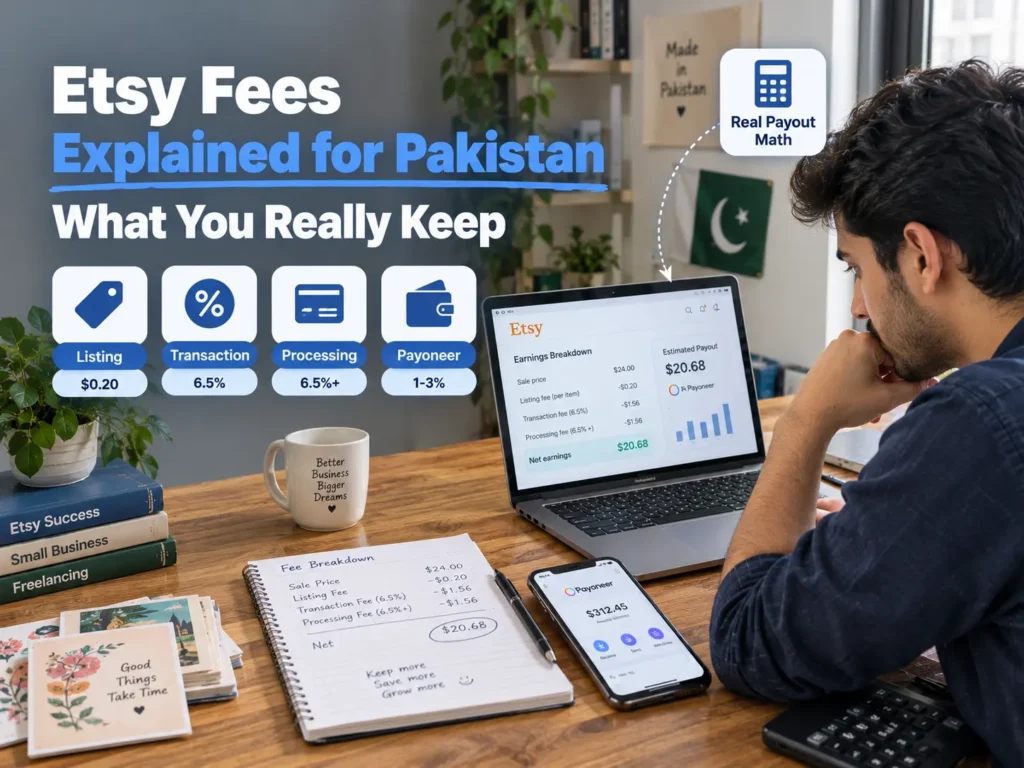
On a $25 sale, a Pakistani seller loses roughly $3.75 to Etsy before Payoneer takes its own cut — close to 15%, not the 10% figure that shows up in most generic fee breakdowns. The gap comes down to one number: almost every guide gets wrong for this specific case.
The Number Most Guides Get Wrong
Nearly every Etsy fee article online quotes a payment processing fee of 3% + $0.25. That number is accurate — for sellers with a US bank account. Etsy’s own fee policy lists processing rates separately by country, and Pakistan isn’t grouped with the US rate at all.
I pulled Etsy’s official payment processing fee table directly rather than trusting secondhand summaries, and confirmed it: Pakistan’s rate is 6.5% + $0.30 USD, more than double the commonly quoted figure. That single difference changes the real math on every sale a Pakistani seller makes, and it’s the main reason profit projections built from US-focused guides come out too optimistic.
If you haven’t opened a shop yet, the account setup process (including getting Payoneer connected) is worth finishing before any of this fee math becomes relevant to you.
What Etsy Actually Deducts From a Pakistani Sale
Four charges stack on a typical sale: a $0.20 listing fee, charged once per listing and lasting four months or until the item sells; a 6.5% transaction fee on the total sale amount, including shipping; the 6.5% + $0.30 payment processing fee specific to Pakistan; and, only if your listing currency differs from your payment account currency, a 2.5% currency conversion fee — which most Pakistani sellers avoid entirely by pricing and getting paid in USD.
None of this includes what happens after Etsy. Once funds land in your Payoneer account, converting USD to PKR for a bank withdrawal adds another 1% to 3%, depending on current rates.
Real Numbers on Three Sale Sizes
I ran the actual math on three common price points for digital products, using Etsy’s confirmed Pakistan rate rather than the generic US figure.
| Sale Price | Listing Fee | Transaction Fee (6.5%) | Processing Fee (6.5% + $0.30) | Total Etsy Fees | Payout to Payoneer |
| $10 | $0.20 | $0.65 | $0.95 | $1.80 | $8.20 |
| $25 | $0.20 | $1.63 | $1.93 | $3.76 | $21.24 |
| $50 | $0.20 | $3.25 | $3.55 | $7.00 | $43.00 |
NOTE: Look at the $10 row. Etsy’s fees eat 18% of that sale, compared to roughly 14% on the $50 sale. The fixed $0.20 and $0.30 charges barely move the needle on a bigger sale, but they hit cheap items disproportionately hard — which is exactly why pricing low to “compete on price” backfires for Pakistani sellers more than sellers elsewhere.
After Payoneer’s conversion cut (figure roughly 2% for a mid-range estimate), that $21.24 payout on a $25 sale lands closer to $20.82 in your account before any transfer to PKR. On the $50 sale, expect around $42.14.
Offsite Ads: The Fee You Might Not Choose
Etsy automatically enrolls every shop in Offsite Ads. If a sale comes through one of these ads, Etsy takes an additional 12% to 15% on top of everything else — 15% if your shop has made under $10,000 in the past year, 12% above that threshold. You can opt out only once your shop has crossed $10,000 in sales within twelve months; new shops don’t get a choice.
This fee applies per sale, only when the specific sale came through an offsite ad, so it doesn’t hit every transaction. But for a new Pakistani shop, it’s worth knowing this isn’t optional the way some articles imply — budgeting as if every sale might carry it is the safer assumption early on.
Where Fees Actually Hurt Different Product Types
Digital products absorb these fees better than almost anything else on Etsy, simply because there’s no material cost eating into the same margin. A $25 printable bundle costs you fees, not fees plus materials plus packaging — the full fee percentage comes straight out of pure profit, but at least there’s no second cost layer underneath it.
Physical products face the same fee stack plus the cost of materials and shipping labels, which is why thin-margin physical items (cheap jewelry, small prints) get squeezed harder than a $25 digital planner ever does. If you’re deciding what to sell with fee impact specifically in mind, this breakdown of product tiers ranks digital categories by how well they tend to hold up after Etsy’s cut.
Print-on-demand items carry a third layer — the production partner’s base cost — stacked under Etsy’s fees and your own markup, which usually means needing a noticeably higher sale price just to clear the same profit a digital product reaches at half the price.
Three Sellers, Three Fee Realities
Zara sells digital wall art prints priced around $8 each. At that price point, Etsy’s fees take close to 19% of every sale once the fixed charges are factored in. She didn’t notice this until she compared her Payoneer deposits against her listed prices directly — raising her baseline price to $12 brought the effective fee percentage down to around 15%, without losing the sales volume she expected to lose.
Hassan runs a small jewelry shop with $15 average sale prices. Between Etsy’s fee stack and his actual material costs, his real margin sat under 20% for months before he recalculated pricing properly — he’d been pricing based on competitor listings rather than his own true cost breakdown, which is an easy trap when competitors may have different material costs or be absorbing thinner margins than they should.
Nimra, selling Canva template bundles around $30, found her fees landed close to the $25-sale example above — roughly 15% of each sale — and simply built that percentage into her pricing from day one rather than discovering it after the fact. Her margins stayed predictable specifically because she planned around the real number instead of the commonly quoted one.
Checking Whether Your Pricing Actually Works
Before finalizing a price, add up your total cost (materials, if any, plus your own time if that matters to you), then calculate what roughly 15% to 19% of your intended sale price would be in fees, adjusting toward the higher end for anything under $15 and the lower end for anything over $40. Subtract both from your sale price. What’s left is your real margin — not your listed price minus what you assumed Etsy would take.
If that number doesn’t leave you with a margin you’re comfortable with, the fix is almost always raising the price slightly rather than trying to find a way around Etsy’s fee structure, which isn’t negotiable per listing.
Is It the Fees, or Is It Your Pricing?
If your Payoneer deposits consistently come in lower than you expected relative to your listed prices, check whether you’ve been calculating against the 3% + $0.25 US rate instead of Pakistan’s actual 6.5% + $0.30 figure — this single mix-up explains a large share of the “Etsy’s fees seem higher than everyone says” confusion I’ve seen from other Pakistani sellers.
If your margins are thin even after using the correct rate, that’s a pricing problem, not a fee problem, and the fix sits in your price, not in Etsy’s policy.
When Etsy’s Fee Structure Doesn’t Work for You
If your product only works at a very low price point — under $5, say — Etsy’s fixed fees alone can eat a third or more of each sale, and no amount of volume comfortably fixes that math. Products with real room above $10 absorb the fixed-fee portion far more comfortably.
If you’re also tracking income from other international platforms alongside Etsy, tracking income properly across all of them matters more once multiple fee structures are involved — Etsy’s math is just one piece of a bigger picture for anyone earning from several sources.
Common Questions
Does Payoneer charge a separate fee on top of Etsy’s?
Yes. Etsy’s fees are deducted before funds reach your Payoneer account; Payoneer’s own currency conversion fee (roughly 1% to 3%) applies separately when you withdraw to a Pakistani bank. Payoneer’s own Payoneer pricing page lists current rates if you want the exact figure for your account type.
Is the shop setup fee a one-time charge or recurring?
One-time, charged when a new shop completes onboarding — it doesn’t repeat per listing or per sale.
Do digital products pay lower fees than physical ones?
No, the fee percentages are identical. Digital products just don’t carry the extra cost of materials or shipping labels sitting underneath those fees, which is why the same fee percentage feels lighter on a digital sale.
Can I avoid the 2.5% currency conversion fee?
Yes, by listing in USD and keeping your Payoneer account in USD, which most Pakistani sellers already do by default — the fee only applies when listing and payment currencies don’t match.
Where can I double-check these numbers myself?
Etsy’s own fee table lists processing rates by country directly, and the general fee policy page covers listing and transaction fees in full if you want to verify anything here against the source.
Figures above come from Etsy’s published fee policy for Pakistan specifically, cross-checked against actual Payoneer payout behavior rather than the commonly repeated US-rate figure.