Midjourney Prompts for Pakistani Designs: Craft Atlas
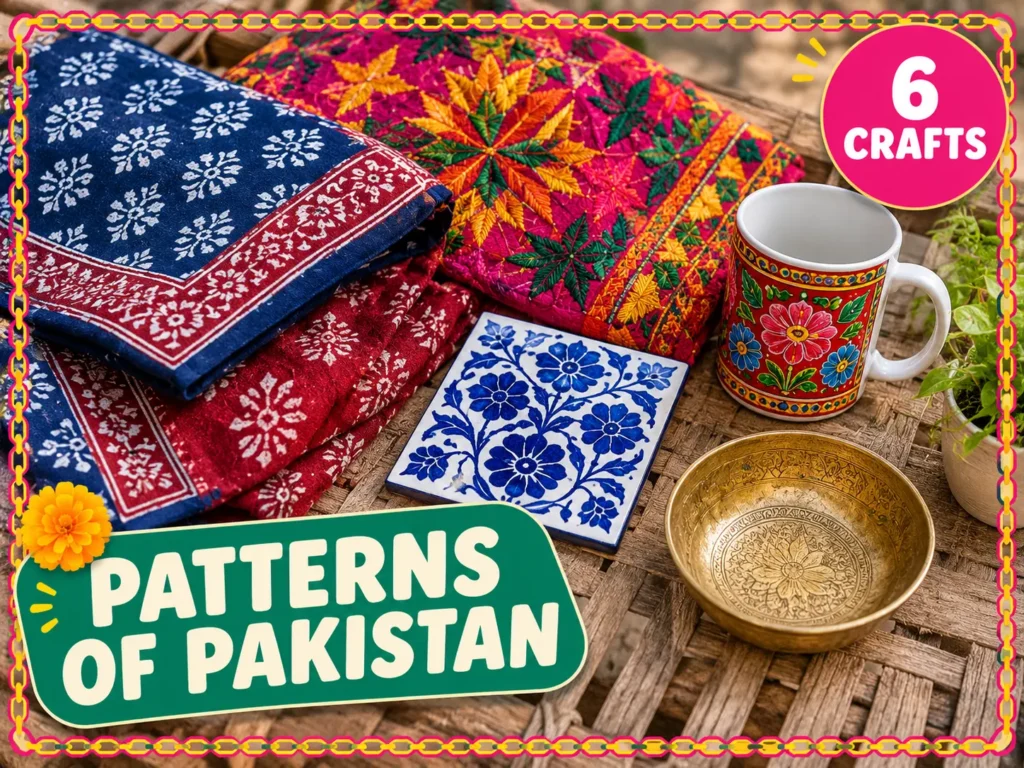
Ask an image tool for “Pakistani style” and you will usually get a blur of everything at once: a little paisley, a random arch, some gold, maybe a lantern. It looks vaguely South Asian, and it belongs to nowhere in particular.
That is not the tool’s fault. Pakistan is not one style. It is dozens of crafts, each with its own colors, motifs and way of making things, and a request this broad gives the tool nothing to hold on to.
This guide works like an atlas. It teaches you to name the craft, then walks region by region through patterns that Midjourney can draw well, with detailed prompts you can copy, adjust and use on products, posters and social posts.
Name the craft, not the country. Add the motifs, three main colors and the surface they appear on. Say “inspired by”, ask for a pattern or a panel with no words, and keep flags and sacred text out of the picture.
If you plan to put these patterns on mugs, bags or posters, our print guide explains sizes and file preparation.
Why names beat adjectives
Words like “colorful”, “ethnic” or “traditional” are too soft. The tool fills the gap with its own guess, and its guess is rarely accurate.
The craft name is different. “Ajrak” or “phulkari” points to a real visual tradition that the tool has seen many times. Add two or three motifs, the exact colors and the material, and the result gets sharper at once.
Here is the pattern every prompt in this guide follows:
[craft]-inspired [surface or panel], [two or three motifs], [color one], [color two] and [color three], [texture detail], [layout] --ar [shape] --no text, letters, people, flags, logosThe Midjourney docs describe each code at the end, and the details shift between versions, so check there if a result looks different from what you expect.
Two small words matter a lot: “inspired by”. They keep you honest about what the picture is. It is a modern image drawn in the spirit of a tradition, not a real handmade piece.
Respect comes first
These crafts belong to living communities. Many are still made by hand today, by people whose families have worked in them for generations. A few habits keep your work respectful and safe.
Do not call it handmade. An AI picture is not an embroidered cloth or a painted tile. Use words like “inspired by” and “pattern” in titles and listings.
Keep sacred text and the national flag out. Verses, names of God and the flag should not appear as decoration on mugs, doormats or clothing. Our prompts exclude them on purpose.
Avoid caricatures. Skip stereotyped people and costumes. Patterns, textiles and objects tell the story well without turning anyone into a cartoon.
Learn the real thing. Before you build a product line around a craft, look at real examples. Museums and heritage bodies document traditional crafts, and the more you know, the better your prompts become.
Credit the tradition. Mention the region and craft in your description. It helps buyers and honors the source.
The atlas at a glance
Every prompt below starts from one of these cards. Change the colors and the surface, but keep the craft name and the motifs, because those hold the look together.
Punjab: embroidery and glazed blue
Phulkari
Phulkari means “flower work”. The look is dense, bright and geometric, with flowers and diamonds stitched in silky threads on dark cloth.
Words to use: satin-stitch texture, geometric flowers, diamonds, symmetrical, thread sheen.
a phulkari-inspired embroidery pattern, dense geometric flowers and diamonds in silky satin-stitch texture, vivid magenta, saffron yellow, leaf green and white on deep indigo cloth, symmetrical repeating layout, fine thread sheen, flat lay textile photograph --tile --ar 1:1 --no text, letters, people, flags, logosa phulkari-inspired cushion cover design, a large central eight-petal flower surrounded by rows of stepped diamonds, magenta, orange, emerald and cream silk thread on dark navy, rich hand-stitched texture, centered square composition with a border --ar 1:1 --no text, letters, people, flags, logosPhulkari colors are a natural fit for event cards. Our wedding card recipes explain how to leave room for names and dates.
Multan blue pottery
This tradition uses cobalt and turquoise on a glossy white glaze, with flowing vines and small blossoms.
Words to use: cobalt, turquoise, glossy white glaze, hand-painted, crackle.
a hand-painted blue pottery tile design inspired by Multan, cobalt blue and turquoise floral motifs with curling vines and small blossoms on a glossy white glaze, symmetrical square tile with a decorative border, subtle crackle glaze texture, soft studio light, flat top-down view --ar 1:1 --no text, letters, people, shadows, flagsa blue pottery inspired plate design seen from above, circular composition with a central flower, a ring of leaves and an outer border of tiny blossoms, cobalt blue and turquoise on white glaze, slightly uneven hand-painted lines, soft glossy highlights --ar 1:1 --no text, letters, people, flags, logosSindh: stamped cloth and patchwork
Ajrak
Ajrak is block-printed cloth with interlocking stars and diamonds in indigo, crimson and white. The patterns repeat in tight, balanced grids.
Words to use: block print, stamped edges, interlocking, indigo, crimson, unbleached white.
an ajrak-inspired block-print pattern, repeating geometric stars and interlocking diamonds, deep indigo, crimson red and unbleached white, crisp stamped edges with slight ink irregularity, balanced symmetrical layout, flat textile design --tile --ar 1:1 --no text, letters, people, flags, logosan ajrak-inspired border panel, rows of small stars between thick bands of interlocking diamonds, indigo, red and white, soft cotton texture, long horizontal panel for a table runner --ar 3:1 --no text, letters, people, flags, logosRilli
Rilli quilts are patchwork and appliqué, built from squares and triangles in rich colors, held together with neat stitch lines.
Words to use: appliqué, patchwork, stitch lines, geometric blocks, handmade quilt.
a rilli-inspired patchwork quilt design, appliqué squares and triangles in red, mustard, teal and black with white running-stitch lines and small round accents, handmade textile look, orderly grid composition, top-down flat lay --ar 4:5 --no text, letters, people, flags, logosa rilli-inspired quilt square, a central diamond made of nested triangles, surrounded by smaller patchwork squares, warm terracotta, indigo, cream and olive, visible stitching and soft fabric folds, centered composition --ar 1:1 --no text, letters, people, flags, logosBalochistan: mirrors and dense stitching
Balochi embroidery is known for its rich, packed stitching, geometric motifs and tiny mirrors. The look is intense and detailed, and it needs a patient prompt.
To see real examples of mirror work before you write a prompt, look at the craft collections that heritage bodies such as Lok Virsa document.
Words to use: mirror work, stepped triangles, coin-like discs, dense stitching, crimson, black, gold.
a dense Balochi-style embroidery panel, intricate geometric motifs of diamonds and stepped triangles with tiny round mirrors and coin-like discs, crimson, black and gold thread on dark fabric, rich hand-stitched texture, centered rectangular panel with a patterned border --ar 4:5 --no text, letters, people, flags, logosa long narrow embroidered border strip in Balochi style, repeating small diamonds and tiny mirrors, crimson, black and mustard thread, hand-stitched texture, suitable for bag straps and bookmarks, flat lay --ar 5:1 --no text, letters, people, flags, logosKhyber Pakhtunkhwa: carved wood and chain stitch
Swat woodcarving
Carved doors, ceilings and panels from Swat show interlocking vines, rosettes and stepped borders, cut deep into dark wood.
Words to use: carved wood, raking light, rosettes, interlocking vines, walnut brown.
a carved wooden panel inspired by Swat valley woodwork, interlocking floral vines, geometric rosettes and a stepped border, deep walnut brown with subtle lighter highlights, soft raking light showing carved depth, centered rectangular panel --ar 4:5 --no text, letters, people, flags, logosPashtun chain-stitch embroidery
Bold flowers and curling vines worked in chain stitch on dark velvet or cotton make a strong, warm look.
Words to use: chain stitch, velvet, bold flowers, curling vines, macro textile.
chain-stitch embroidery inspired by Pashtun dress panels, bold flowers and curling vines in magenta, orange, green and white on black velvet, dense stitching, macro textile detail, symmetrical layout --ar 4:5 --no text, letters, people, flags, logosNorth and Kashmir: paisley and mountain light
Kashmiri paisley
Soft shawls carry fine, flowing paisley and chinar leaves in delicate thread. The mood is quiet and elegant, and it suits stationery and wall art.
Words to use: chinar leaf, paisley, fine chain stitch, soft wool, flowing curves.
a Kashmiri shawl-inspired border of chinar leaves and paisley, fine chain-stitch embroidery in rose, ivory, sage and gold on soft charcoal wool, delicate flowing curves, wide panoramic border strip --ar 3:1 --no text, letters, people, flags, logosValley scenes
Not every piece of Pakistani art is a textile. Mountain valleys make beautiful poster art when drawn in simple, layered shapes.
a Hunza valley in spring, apricot blossoms in the foreground, terraced fields and snow-capped peaks at golden hour, flat illustrated poster style with layered shapes, soft pink, fresh green and warm gold, calm sky with empty space at the top --ar 2:3 --no text, letters, people, flags, logosStreets and roads: truck and rickshaw art
Truck art is the most recognized look in the country. It is loud, glossy and generous, with flowers, birds, chain borders and shiny trim. The key to a good result is to keep the layout tidy while the colors stay wild.
Words to use: kaleidoscopic florals, peacock, chain-link border, reflective tape accents, glossy enamel, symmetrical.
a Pakistani truck art panel, bold kaleidoscopic florals, a central peacock, chain-link borders and shiny reflective tape accents in neon pink, emerald, orange and sky blue on a bright yellow base, flat hand-painted style, symmetrical rectangular tailgate panel --ar 3:2 --no text, letters, people, flags, logosa decorated auto-rickshaw back panel in street art style, parrots, flowering vines and scalloped edges in bright magenta, turquoise, orange and gold, glossy enamel look, flat front view, symmetrical composition --ar 1:1 --no text, letters, people, flags, logosReal truck art often includes poetry and names. Leave those out. The tool cannot write them properly, and you can add safe, original text yourself in an editor if a design needs it.
Old craft, new product
The pictures above look best on surfaces that suit them. But many buyers also like a modern version, with the craft’s colors and motifs in a cleaner, simpler layout. The formula is one craft plus one modern style.
a minimalist wall art poster using the ajrak palette of indigo, crimson and white, large simple geometric stars and diamonds with generous empty space, flat vector style, calm modern composition --ar 2:3 --no text, letters, people, flags, logosa repeating mug wrap pattern inspired by truck art, small peacocks and bold flowers in hot pink, emerald and marigold on cream, tidy horizontal band with even spacing, flat vector style --ar 21:9 --no text, letters, people, flags, logosa soft tote bag illustration inspired by Multan blue pottery, a single large blossom with curling vines in cobalt and turquoise on a plain white background, thin clean lines, lots of empty space --ar 1:1 --no text, letters, people, shadows, flags, logosA tiled ajrak or truck art background also gives a feed instant personality, and our social post guide explains how to place text over it.
Keep one craft per product. A tote with phulkari, truck art and ajrak all at once looks confused, and it blurs the story you are trying to tell.
Make the pattern repeat cleanly
Patterns are the heart of this style, so check that they tile well. Place four copies side by side in an editor and look at the seams. A good tile shows no visible line where two copies meet.
Check the colors against real examples too. Indigo can drift toward purple, and crimson can turn orange. If a color is off, repeat its name at the start and end of the request, and ask for “deep indigo” instead of just “blue”.
Finally, upscale before you print. Fine thread detail turns soft on a large item if the file is too small.
When a result looks off
Even a careful prompt can miss. Change one thing at a time.
If the picture looks too clean and digital, add texture words such as “slight irregularity”, “visible thread” or “hand-painted brush marks”. Real crafts are never perfectly even.
If two crafts blend together, name one craft only and say “single traditional pattern” in the request. Mixed results usually come from mixed words.
If the design feels crowded, reduce the count. Ask for “five large flowers” instead of “many flowers”, and add “generous space between motifs”.
If the colors look washed out, name a darker base, such as “deep indigo ground”, and repeat the three main color names. If the result drifts away from your words, lower the stylize value so the tool follows the request more closely.
Where this art finds buyers
Three groups buy these patterns. People overseas who want a link to home. Local brands that need fresh textures for packaging and posters. And couples planning weddings with color and character.
Event cards are a natural fit, especially for a mehndi night, and social posts are another easy use, because a tiled background gives a feed instant personality.
When you sell designs, be honest. Etsy asks sellers to describe how items were made, including any AI help, and the Etsy standards page explains the current wording. Read your Midjourney plan’s commercial terms too.
Frequently Asked Questions
Can I just ask for a Pakistani style?
You can, but the result will be vague. Name a specific craft, such as ajrak or phulkari, and add motifs and colors, and the result gets much closer to what you imagine.
Is it respectful to use these crafts?
Yes, if you are careful. Say “inspired by”, avoid sacred text and flags, skip caricatures and mention the region and craft. Never present AI art as handmade work.
Can I sell products with these patterns?
Often yes. Read the commercial terms of your Midjourney plan, follow each marketplace’s rules and describe the AI help honestly.
Why do my patterns have visible seams?
Ask for a seamless repeating pattern with the tile code, and test four copies side by side. If a seam still shows, run the prompt again or fix it in an editor.
How do I get the right colors?
Name three exact colors, such as “deep indigo, crimson red and unbleached white”. Repeat them if a color drifts, and compare the result with real examples.
Why does the tool add strange letters?
Image tools draw letters as shapes. Add text to the exclusion list and place any words yourself in an editor.
Should I add people in the picture?
Usually not. Patterns and objects look cleaner, avoid stereotypes and are much easier to use on products.
Which craft is best for beginners?
Ajrak and Multan blue pottery are the easiest. They have clear colors, simple repeating shapes and forgiving layouts.
A note on credit
Good prompts get you good pictures, but the traditions behind them are older and richer than any image tool. Take time to learn the craft you are borrowing from, name it honestly and, when you can, support real artisans by buying their work or sharing it.
If you are ready to turn your patterns into a small shop, our guide to Etsy digital products explains what sells and how to set up listings.