Midjourney Prompts for Coloring Books: Clean Line Art
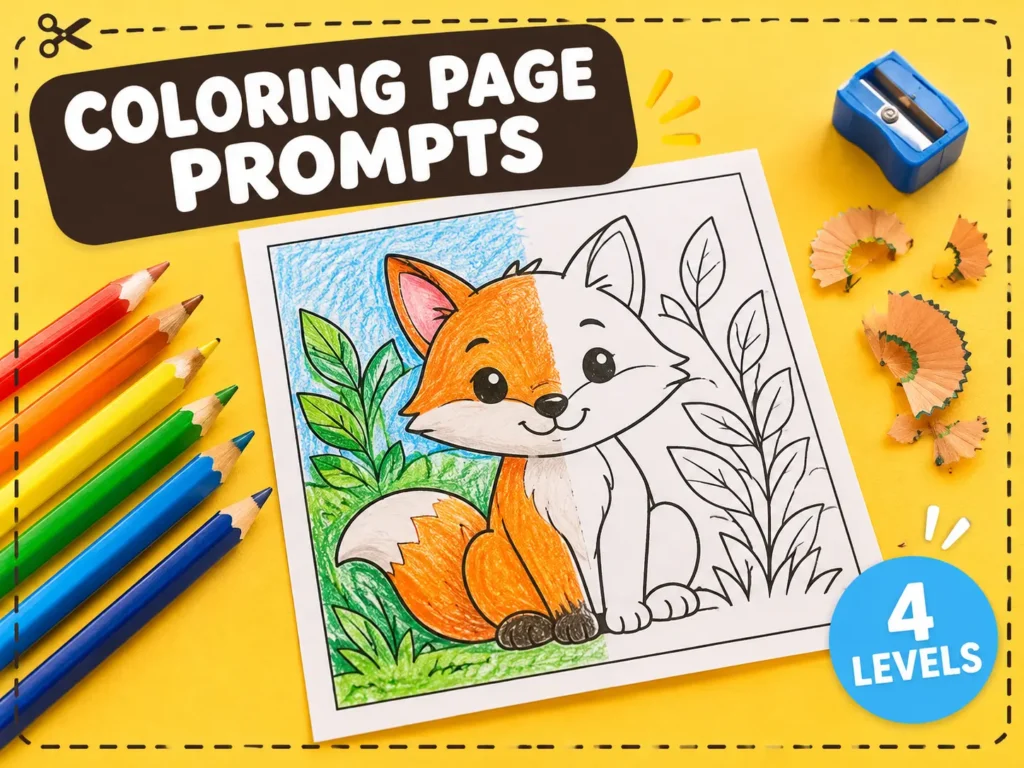
Pick up any good coloring book and study a single page. There is no gray anywhere. No smudges. No tiny gaps in the outline. Every shape is closed, so a crayon cannot leak into the next area.
That page looks simple, but it follows strict rules. Left to its own taste, Midjourney breaks nearly all of them. It loves shading, soft gradients, broken lines and invented text, which are exactly the things a coloring page cannot have.
This guide shows how to steer the tool toward clean line art, with detailed prompts for four difficulty levels, a way to keep a whole book consistent, and the steps for turning images into pages you can print or sell.
Ask for
- Clean black outlines with even weight
- Closed, clearly separated shapes
- A plain white background
- One main subject with wide margins
- A page shape that matches your book size
Leave out
- Shading, gray tones and gradients
- Solid black filled areas
- Words, numbers and signatures
- Busy backgrounds and scenery
- Characters from films, games or brands
Pages that will be printed as a book also need the right file size, which our print guide explains in plain steps.
Five rules every colorable page follows
Before you write a single request, know what you are aiming for. These five rules decide whether a page is a pleasure or a chore to color.
1. Closed shapes
Every area must be fully enclosed. One tiny gap and the color spills out.
2. Even lines
Lines of similar thickness look tidy. Mixed thick and thin lines look accidental.
3. No gray
Gray is shading, and shading cannot be colored over cleanly. Pages must be pure black on pure white.
4. Calm detail
Details should match the age of the colorist. Too much detail tires people out. Too little bores them.
5. Room to breathe
Wide margins keep art safe from trimming and give hands a place to rest.
Everything in this guide is about getting Midjourney to respect those five rules.
The base sentence
Every request in this guide is built from the same simple frame. Learn it once, and you can write your own for any subject.
[subject], coloring book page, clean black outline drawing, uniform line weight, closed shapes, centered with wide white margins, pure white background, no shading, no gray, no solid black fills --ar 17:22 --style raw --s 50 --no shading, gray, color, textHere is what each part does. The subject says what to draw. “Coloring book page” and “clean black outline drawing” set the style. “Uniform line weight” and “closed shapes” protect the rules. The margin and background words keep the page clean. The last line sets the shape and removes common trouble.
The ratio 17:22 matches an 8.5 by 11 inch page. For a square book, use 1:1 instead.
Two codes deserve extra attention. –style raw reduces the tool’s built-in polish, which helps keep lines plain. –s, short for stylize, sets how artistic it gets. Low values stay literal. High values add decoration. The Midjourney docs explain both in detail, and the behavior changes between versions, so check there if a result looks different.
Climb the ladder: four difficulty levels
The same subject can be a toddler’s page or an adult’s evening project. The difference is not the picture. It is the line weight, the number of shapes and the amount of detail. Each level below has a short spec and two detailed prompts you can paste straight in.
Level 1: tiny hands
Line weight: very thick. Shapes: three to six large ones. Detail: almost none. Good for: ages two to four, who need big areas and quick wins.
a big friendly elephant sitting and smiling, coloring book page for toddlers, extra thick bold black outlines, very simple rounded shapes, large empty areas to color, only a few shapes on the page, no tiny details, centered with wide white margins, pure white background, no shading, no gray, no solid black fills --ar 17:22 --style raw --s 0 --no shading, gray, color, text, scenerya smiling sun, a round fluffy cloud and a rainbow with five wide stripes, coloring book page for toddlers, extra thick bold black outlines, huge simple shapes, lots of white space, centered composition, pure white background, no shading, no gray --ar 17:22 --style raw --s 0 --no shading, gray, color, text, tiny detailsLevel 2: busy kids
Line weight: medium-thick. Shapes: eight to fifteen. Detail: light, with a simple setting. Good for: ages five to eight, who like a little story in the picture.
a cheerful dinosaur family having a picnic under a big tree, playful cartoon style, medium-thick clean black outlines, uniform line weight, about ten large clearly separated shapes, simple grass and two flowers in the background, closed shapes everywhere, coloring book page, pure white background, no shading, no gray --ar 17:22 --style raw --s 50 --no shading, gray, color, textan underwater scene with a smiling octopus, a sleepy turtle and three round fish among tall seaweed and bubbles, playful cartoon style, medium-thick clean black outlines, simple shapes, clear separation between objects, coloring book page, wide white margins, pure white background, no shading, no gray --ar 17:22 --style raw --s 50 --no shading, gray, color, text, solid blackLevel 3: relaxed teens and beginners
Line weight: medium to thin. Shapes: dozens. Detail: patterned, but readable. Good for: older kids and adults who want something calm without feeling overwhelmed.
a detailed owl perched on a branch, its feathers made of layered leaf and teardrop patterns, zentangle-inspired coloring book page, clean medium-thin black outlines, balanced pattern detail, every shape closed, a thin simple border frame, plain white background, no shading, no gray, no solid black fills --ar 17:22 --style raw --s 100 --no shading, gray, color, text, solid black areasa cozy reading nook with a stack of books, a sleeping cat on a cushion, a hanging plant and a round window with stars, detailed hand-drawn coloring book page, clean medium-thin black outlines, patterned cushions and shelves, every area closed, wide white margins, pure white background, no shading, no gray --ar 17:22 --style raw --s 100 --no shading, gray, color, text, solid blackLevel 4: intricate adult pages
Line weight: thin and crisp. Shapes: hundreds of small areas. Detail: dense and symmetrical. Good for: experienced colorists who like fine pencils and long sessions.
an intricate botanical garden scene with peonies, ferns and butterflies, elegant adult coloring book page, fine detail with hundreds of small closed regions, thin crisp black outlines of even weight, balanced symmetrical composition, wide white margins, pure white background, no shading, no gray, no solid black fills --ar 17:22 --style raw --s 150 --no shading, gray, color, text, solid blacka mandala with eight-fold symmetry, layered petals, geometric lace and tiny teardrop shapes, intricate adult coloring book page, thin crisp black outlines of even weight, circular composition centered on the page, every area closed, pure white background, no shading, no gray, no solid black fills --ar 1:1 --style raw --s 150 --no shading, gray, color, text, solid blackNotice how the stylized value climbs with the level. Higher levels can handle more of the tool’s own invention, while the youngest level needs the plainest possible result.
A bank of themes to swap in
You do not need a new recipe for every page. Keep the frame and swap the subject. Here are twelve themes that work well across all four levels:
friendly farm animals | ocean creatures | space explorers and planets | dinosaurs in a jungle | garden insects and flowers | a fairy-tale castle and forest | vehicles in a busy town | bakery treats and cupcakes | a wildflower meadow | festival lanterns and lights | a mountain village | gentle mythical creaturesChoose one theme per book. A book of thirty pages about ocean creatures feels planned and gives buyers a clear reason to pick it. A book of thirty random subjects feels like a pile of leftovers.
Within a theme, vary the page. Mix close-ups of a single animal with wide scenes. Mix pages with a lot of white space with pages full of patterns. Variety keeps long sessions fun.
Frames and borders
A border turns a loose drawing into a finished page, and it hides small imperfections near the edges. A special page type is the “draw your own” page, where a frame surrounds an empty middle for a child to add a picture.
The same border thinking that works for cards, which we cover in these border recipes, carries over here, as long as you keep the line art plain.
a coloring book page with a decorative frame of wildflowers and leaves along the page edge, large empty middle where a child can draw their own picture, clean medium black outlines, uniform line weight, every shape closed, pure white background, no shading, no gray --ar 17:22 --style raw --s 50 --no shading, gray, color, text, solid blacka geometric coloring book page with a border of repeating triangles, circles and stars, symmetrical, clean thin black outlines, every shape closed, large open center, pure white background, no shading, no gray --ar 17:22 --style raw --s 50 --no shading, gray, color, text, solid blackKeep forty pages looking like one book
The biggest giveaway of a rushed book is a change in style halfway through. One page has thick cartoon lines, the next has fine delicate ones. Buyers notice at once.
The fix is boring and effective. Pick one anchor block of words and paste it after every subject. Do not change it for the whole book.
coloring book page, clean black outline drawing, uniform medium line weight, closed shapes, centered with wide white margins, pure white background, no shading, no gray, no solid black fills --ar 17:22 --style raw --s 50 --no shading, gray, color, textThen change only the subject at the start of the line. These three subjects, each with the anchor block after it, will look like pages from the same book:
a hedgehog reading a book under a giant mushroom | a smiling whale with a small boat on its back | a fox curled up asleep in a pile of autumn leavesIf you change versions of Midjourney in the middle of a project, run one old page and one new page side by side. Versions read words differently, and a quick test saves you from a book with two personalities.
Page repair: problem, cause, fix
Even good requests misfire. Change one thing at a time so you know what worked.
Gray shading appears
The tool is adding depth. Add “flat, no shading, no gray” and put shading gray in the exclusion list. Lower the stylized value.
Lines have gaps
Fine detail often breaks. Ask for “thicker outlines, closed shapes” and cut the number of tiny areas.
Random text appears
Letters sneak into signs and banners. Add text to the exclusion list and avoid subjects like posters or books with covers showing.
Shapes merge together
Two objects touch and become one blob. Ask for “clear separation between objects” and “space between shapes”.
The background is cluttered
State “plain white background, no scenery”, and reduce the setting to one or two simple items.
Large black areas show up
Add “no solid black fills” and name the area you want open, for example “white fur, not black”.
From image to printable page
A Midjourney result is not yet a coloring page. It needs a short cleanup before it is ready for paper.
- Upscale. Make the image large enough for the page. An 8.5 by 11 inch page at 300 DPI is 2550 by 3300 pixels, and the Amazon KDP site lists the current print specs.
- Make it pure black and white. Most free editors have a threshold or black-and-white adjustment. This turns faint gray into clean lines and removes tiny specks.
- Thicken if needed. If lines look thin at full size, a small expand or stroke adjustment helps them print well.
- Run the leak test. Open the page in an editor and use the paint bucket on a few shapes. If color escapes, the shape is open. Close the gap with a short brush stroke.
- Check the margins. Keep art well inside the edge so nothing is trimmed or lost near the spine of a book.
- Print a test. Print one page and color it with the tools your buyers will use, such as crayons, markers or gel pens. Problems show up fast on paper.
Free editors such as Inkscape can also trace line art into clean shapes. The Inkscape editor works well for simple pages, though very dense pages may be easier to fix in a regular image editor.
Building the book
A pile of good pages is not yet a book. A few layout decisions make the finished product feel professional.
Order. Start with easy pages and move to harder ones, or group by theme. A buyer who opens a book and finds a calm first page feels welcome.
Blank backs. Markers and pens bleed through paper. Many books put a blank page behind each picture, or repeat the same picture on the back, so a colorist never ruins the next page.
Front pages. Add a title page, a short “this book belongs to” page and a test page where people can try their colors.
Page count. Print-on-demand platforms set a minimum number of pages, and the rules change, so check the current limit before you plan the book.
When the book is ready, you have two main routes. You can publish it as a paperback, or sell the pages as printable downloads. Our comparison of Etsy and KDP explains the trade-offs for sellers in Pakistan.
Test with a real colorist
Before you commit to a whole book, hand three finished pages to someone in your target age group. A child, a parent or a friend who colors is perfect. Watch what they do without explaining anything.
Do they pick up the page happily, or hesitate at a dense corner? Do they ask what a shape is? Do they color over the lines in one spot because the gap was too small? Their small frowns are free advice, and they are far more honest than any review you will read later.
Write down every complaint, fix the recipe and rebuild the page before you make the rest of the book.
Rules that protect you
Coloring books attract copycats, and platforms watch closely. Three habits keep you safe.
Be open about AI. Amazon asks publishers to say whether content was made with AI, and Etsy asks sellers to describe how an item was made. The Etsy standards page explains the current wording. Rules change, so read the latest version before every new listing.
Avoid famous characters. Never ask for a cartoon character, a film hero or a brand mascot. Kids love them, which is exactly why those pages get removed.
Check your plan’s terms. Midjourney’s rules about commercial use depend on your plan. Read them before you sell a book.
Also review your finished pages by eye. Make sure there is no hidden text, no odd symbols and nothing unsuitable for the age you chose.
Quick answers
Can I use Midjourney images straight from the tool in a coloring book?
Rarely. They usually need upscaling, a pure black and white conversion and a quick check for gaps before they are ready for paper.
What page shape should I use?
Use the ratio 17:22 for an 8.5 by 11 inch page, or 1:1 for a square book. Check the trim size you plan to publish before you start.
Why do I keep getting gray shading?
The tool adds depth by habit. Say “flat, no shading, no gray”, add shading and gray to the exclusion list and lower the stylize value.
How many pages should a book have?
Check the minimum for your platform first. Many sellers start with twenty-five to forty pages in one theme, then expand if the book sells.
Do I need to tell buyers the pages were made with AI?
Platforms like Amazon and Etsy ask for disclosure, and being honest builds trust. Follow the current wording on each platform.
Can I ask for pages of famous cartoon characters?
No. Those characters belong to other people, and pages using them get removed. Create original animals and scenes instead.
How do I keep every page in the same style?
Use one anchor block of words after every subject, keep the same version of the tool, and test one old page beside a new one before you continue.
The last page
A coloring book looks easy until you hold your own printout and realize how many small things must go right. The good news is that most of those things are repeatable. Once you have an anchor block, a level in mind and a cleanup routine, each page takes a few minutes.
Start with one theme and one level, and make ten pages. Print them, color a few yourself and note what annoys you. That small test will teach you more than another hundred requests.
When you are ready to sell the pages as downloads, our guide to Etsy printables shows how to package, price and list them.