Gumroad vs. Etsy vs. Your Own Website: Where to Sell AI-Made Products
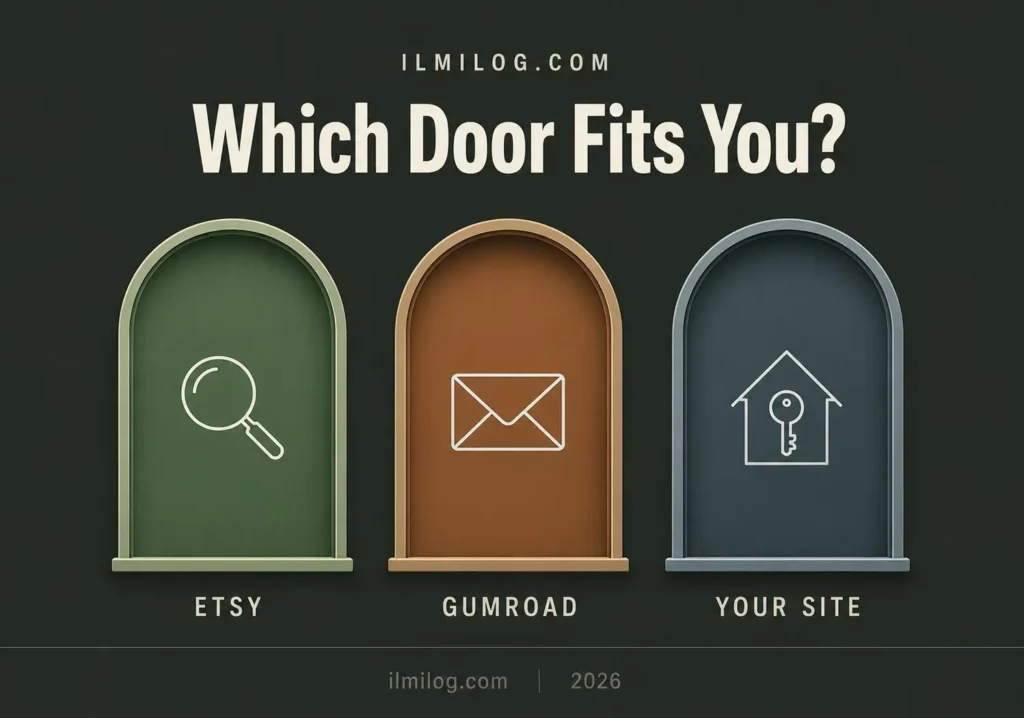
Quick Answer: There’s no single best platform — there’s a best platform for where you are right now. Etsy wins if you have no audience and need built-in buyers actively searching. Gumroad wins once you have any following at all, because it keeps more of each sale but generates almost no traffic on its own. Your own site, through something like Payhip or Shopify, only makes sense once you have consistent traffic from elsewhere to send there. Most sellers figuring out where to sell AI-made digital products end up using two of these together, not picking just one and staying there forever.
What you’ll learn: → Real fee and traffic data for Etsy, Gumroad, and running your own store → Which platform fits which product type, backed by category-level sales data → The sequencing strategy most successful sellers use, instead of picking one platform for life → A comparison table you can check yourself against before listing anywhere → A self-check to figure out which platform matches your current situation, not your eventual goal
The Trade-Off Underneath All Three Options
Every platform in this comparison sells the same basic thing: a place for a stranger to find your product and pay for it. What differs is who’s responsible for the “find” part. Etsy finds buyers for you and charges more for the privilege. Gumroad charges less but expects you to bring your own buyers. Your own site gives you full ownership of the customer relationship and takes the biggest cut of your time to build an audience for.
Digital products with AI cover a lot of ground — printables, ebooks, templates, prompt packs — and the platform question sits underneath all of them. Our complete guide to creating and selling digital products with AI covers the product side; this one is specifically about where those products end up getting sold.
Etsy: Built-In Buyers, Higher Fees
Etsy’s core advantage is search traffic you don’t have to build. With well over 90 million active buyers already searching the platform, a new listing with decent SEO can start showing up in search within days, not months. That built-in discovery is worth the trade-off for most beginners, because the alternative — building your own audience from zero — takes far longer than getting a first sale through Etsy’s existing search traffic.
The fees reflect that convenience: a $0.20 listing fee, a 6.5% transaction fee, and payment processing around 3% plus $0.25. On a $10 printable, that combination takes a real bite. Etsy’s own fee policy spells out the full structure, and it’s worth running your specific price through it before assuming a listing fee here or there won’t add up. This platform’s strength is concentrated in specific categories — printables, planners, templates, and craft-adjacent digital goods perform far better here than software or higher-priced business products, which tend to underperform Etsy’s buyer expectations. If printables specifically are your product, our guide to selling AI-generated printables on Etsy covers the platform-specific details that affect whether a shop here gets found.
Gumroad: Lower Fees, Zero Built-In Traffic
Gumroad flips the equation. There’s no listing fee and a flat transaction cut of roughly 10%, which is often cheaper than Etsy’s combined fees once a product’s price climbs past $15 or so. What Gumroad doesn’t give you is discovery. Published data on Gumroad’s traffic sources shows organic search driving only a small share of sales — the majority comes from email marketing and social media, meaning you’re expected to bring buyers with you rather than find them on the platform.
This makes Gumroad a poor first stop for someone with zero existing audience, and a strong second platform once you have any following at all — a newsletter, a social account, even a small one. It also tends to perform better for higher-priced, less impulse-driven products: software, structured courses, and business-focused digital goods, where buyers are already coming from somewhere specific rather than browsing casually. Our guide to building and selling prompt packs covers a product type that fits this pattern well, since prompt packs sell better to a buyer who already trusts the seller than to cold marketplace traffic. Gumroad’s published fee structure is worth checking directly, since it varies slightly depending on whether a sale comes through your own link or the platform’s internal discovery feed.
Your Own Website: Full Control, All the Marketing Is on You
Running your own storefront — through a tool like Payhip, or a fuller platform like Shopify — gives you complete ownership of the customer relationship, your pricing, your branding, and every email address from every sale. Nobody can suspend your account for a policy violation you didn’t know existed, because there’s no marketplace policy governing you in the first place.
The cost of that control is that literally none of your traffic is built in. A brand-new store on your own domain, with no outside marketing, gets close to zero organic visitors for months. This only becomes the right move once you already have a way to drive people there — an audience from Etsy or Gumroad you’re migrating to, a social following, or paid traffic you’re comfortable running. Payhip’s pricing structure is a reasonable starting point for a first store, since its free plan carries a 5% fee with no monthly cost, which is a sensible way to test whether your own site is worth the added marketing effort before committing to a paid plan.
How I Cross-Checked This
Across earlier products built for this series — a printable shop, a documented prompt pack, and a short ebook — I listed the same or similar products across more than one of these three platforms to see how traffic and conversion compared in practice, rather than relying only on the fee structures each platform publishes.
What lined up with the published data:
Etsy generated visits with zero outside promotion within the first couple of weeks, in a way neither Gumroad nor a standalone page did. Gumroad and a standalone listing both sat at close to zero traffic until I linked to them from somewhere else — at which point conversion on both was noticeably higher than the same traffic converted on Etsy, likely because visitors were arriving with more context and trust already established.
What that means practically: the platform choice isn’t really about which one is “best.” It’s about whether you currently have any traffic of your own to send somewhere, or whether you need a platform to generate that traffic for you.
Platform Comparison at a Glance
| Etsy | Gumroad | Your Own Website | |
| Built-in traffic | Strong | Minimal | None |
| Typical fees | ~10% combined | ~10% flat | 0–5% + hosting/tool cost |
| Best product fit | Printables, templates, planners | Software, courses, higher-priced items | Anything, once you have traffic |
| Customer data ownership | Platform owns it | You own it | You own it |
| Setup time | Fast | Fast | Slower, more decisions |
The Sequencing Strategy Most Sellers Actually Use
The pattern that shows up consistently among sellers who use more than one platform: start on Etsy to validate that a product idea has real demand and to get initial sales without needing an audience first. Once that product has some traction, add a Gumroad listing or a simple standalone page, and start directing any new traffic — a link in the digital download itself, a mention on social media — toward the lower-fee direct option instead of only the marketplace.
This isn’t an either-or decision most successful sellers make once. It’s a sequence: marketplace for discovery first, direct sales for margin second, and eventually a fuller own-site setup once there’s a real audience worth building a proper storefront around.
Mistakes That Waste Money on the Wrong Platform
Starting on Gumroad or a standalone site with zero audience. Without existing traffic to send, both sit essentially empty regardless of product quality — this is the single most common wasted-effort mistake in this comparison.
Staying on Etsy long after building a real following elsewhere. Sellers who’ve grown a social or email audience but keep paying Etsy’s full marketplace fees on every sale are leaving margin on the table they’ve already earned the right to keep.
Picking a platform based on fees alone. The lower-fee option isn’t better if it generates zero traffic for your specific situation — fee percentage only matters relative to the sales a platform can produce.
Assuming a mismatch in product type won’t matter. A higher-priced software product listed on Etsy, or a $3 printable listed as a standalone Gumroad product with no promotion, both fight the platform’s natural buyer behavior instead of working with it.
When None of These Are the Right Choice Yet
Skip listing anywhere yet if: you haven’t finished a sellable product — the platform decision is premature until there’s something real to test demand for. Skip building your own site specifically if you have zero existing traffic source; that setup only pays off once there’s an audience to point at it.
This is the right time to choose a platform if: you have a finished, tested product and are ready to find out whether real buyers want it — in which case Etsy is almost always the more useful starting point specifically because it doesn’t require you to already have an audience.
Decision Checklist
- I have zero existing audience and a printable-style or search-friendly product → start on Etsy
- I have some audience already — even a small one → add Gumroad alongside or instead of a marketplace
- My product is higher-priced or software-adjacent → Gumroad or your own site tend to fit buyer expectations better than Etsy
- I have real, consistent traffic from somewhere else → a standalone site starts making sense
- I’m choosing based on fees alone without considering traffic → worth reconsidering before committing anywhere
Honest Verdict
| What Works | What Doesn’t |
| Etsy first for discovery with no existing audience | Starting on Gumroad or your own site with zero traffic |
| Gumroad or a direct site once you have any following | Staying on Etsy’s full fees after building an audience elsewhere |
| Matching product type to each platform’s buyer behavior | Choosing a platform on fee percentage alone |
| Using more than one platform in sequence | Treating this as a one-time, permanent decision |
Best for: sellers willing to start where their current traffic situation is, not where they’d like it to eventually be.
Skip overthinking it if: you have no audience yet — Etsy is close to the obvious starting point for most AI-made digital products in that situation.
FAQ
Q: Can I sell the same product on Etsy and Gumroad at the same time?
Yes, neither platform requires exclusivity, and using both is the most common strategy among sellers who eventually build a real income from this.
Q: Is Gumroad actually cheaper than Etsy?
Per-sale, often yes, especially on higher-priced items. But a lower fee on a platform that generates no traffic for you isn’t actually cheaper in practice — the comparison only matters relative to what each platform can sell.
Q: When does building my own website make sense?
Once you have a real source of traffic — an email list, a social following, or consistent referral traffic — that you can direct toward it. Before that point, a standalone site with no marketing behind it produces close to no visitors.
Q: Which platform is best for software or SaaS-style digital products?
Gumroad or a merchant-of-record tool like Lemon Squeezy, both of which handle the licensing and tax complexity that a marketplace like Etsy isn’t built for.
Q: Do I need to pick just one platform and commit?
No. Most sellers who reach meaningful income use Etsy or a similar marketplace for discovery and a direct platform for margin, rather than treating this as a single permanent choice.
Final Recommendation
If you have no audience yet, start on Etsy and treat the first few sales as market validation, not a long-term platform decision. Once you have any traffic of your own — even a small amount — add a direct platform and start moving new buyers there instead of paying full marketplace fees indefinitely. If you’re still deciding which digital product to build before any of this platform decision matters, the Digital Life Blueprint Generator walks through a short set of questions and points you toward the format most likely to fit your specific skills and time.
Researched and written by the ilmilog.com editorial team. Platform comparisons cross-checked against products listed across this series, alongside published fee structures and traffic data, through July 2026. Editorial policy: fee figures and traffic patterns reflect published platform data and our own tracked results, not guarantees — individual results vary by product, niche, and effort.