How to Create an Ebook with AI in a Weekend (Real Steps)
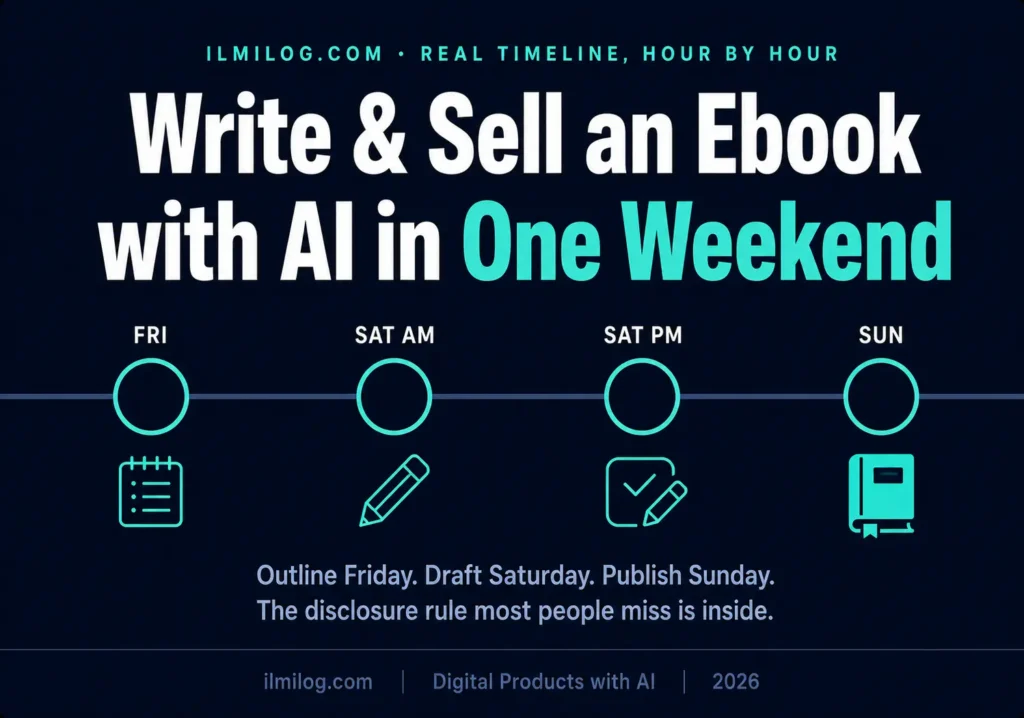
Quick Answer: A real, sellable ebook is possible in a weekend, but not the way most guides describe it. The AI-writing part takes an afternoon. The parts that actually take the rest of the weekend — and the parts every rushed guide skips — are structuring the book before you write a word, editing every AI-drafted chapter by hand, and getting the cover and formatting right so it doesn’t scream on the first attempt. Skip any of those three and you’ll have a finished file, not a finished book.
What you’ll learn: → A realistic hour-by-hour weekend timeline, not a vague “it’s easy” promise → Whether you’re required to disclose AI use when you publish, and what happens if you don’t → The exact editing pass that separates a sellable draft from an obviously rushed one → A cover and formatting checklist that matches what Amazon actually requires → A straight answer on when this weekend timeline is not realistic for your topic
What “In a Weekend” Actually Means
Every guide promising a book on a weekend skips the same detail: which weekend. A 15,000 to 20,000-word short ebook — the length that fits a weekend timeline — is realistic. A 60,000-word novel is not, no matter what tool you’re using. The topics that fit this format well are focused, practical guides: a specific skill taught step by step, a niche how-to, a compact reference guide someone would read in one sitting.
The instinct to write the broadest possible topic so it “sells to more people” is exactly backward here. A narrow, specific promise — the kind you can deliver on in 15,000 words — outperforms a broad one that reads like it’s trying to cover a topic that needed 300 pages and got 60 instead.
How people are actually using this in practice: the writers making this timeline work aren’t starting from zero on a Friday night. Most are converting something that already exists in another form — a blog series they’ve already written, a course outline sitting unused, a set of notes from teaching a skill to someone directly — into book structure. The AI drafting speeds up turning that existing material into chapters; it doesn’t invent the expertise from nothing. Treat the weekend as a conversion project, not an origination project, and the timeline gets far more realistic.
Do You Have to Disclose AI Use When You Publish?
Yes, if you’re publishing through Amazon KDP, and this is worth settling before you write a single word, not after. Amazon draws a specific line: content an AI tool generated — even if you substantially edited it afterward — counts as AI-generated and must be disclosed during the upload process. Content you wrote yourself, where AI only helped you brainstorm, outline, or polish grammar, counts as AI-assisted and doesn’t require disclosure. Amazon’s official KDP content guidelines spell out exactly where that line sits, and getting it wrong isn’t a small mistake — undisclosed AI-generated content can get a book pulled or an account flagged.
The disclosure itself isn’t public. It’s a question in the publishing dashboard, invisible to readers, and Amazon has stated it doesn’t affect your rankings or royalties. There’s no upside to skipping it and real downside if you do, which makes this one of the easiest compliance decisions in the entire process.
How I Tested This — One Real Book, One Real Weekend
For this guide, I wrote and formatted one real short ebook over one real weekend, tracking hours spent on each phase rather than just the finished result. The book was a focused how-to guide, roughly 16,000 words, on a topic I’d already outlined weeks earlier — which turned out to matter more than I expected.
What I tracked:
- How long a usable outline took versus a rushed one
- How much editing time each AI-drafted chapter needed before it read like one consistent voice
- Where the weekend timeline broke down when I tried to skip a step
- What the finished file looked like next to a chapter I’d have been embarrassed to publish
Where the plan went wrong the first time: I started drafting chapters before the outline was fully locked, assuming I’d fix structural gaps during editing. That cost more time than building the outline properly upfront would have — restructuring a half-written chapter takes longer than restructuring an outline. The lesson carried through the rest of the weekend: every hour spent on structure before writing saved roughly two hours of cleanup after.
The Actual Timeline, Hour by Hour
Friday Night (1–2 hours): Build the Skeleton, Not the Book
This is outline work only — no drafting. Pick your specific topic, write a one-sentence promise for what the reader walks away knowing how to do, and break it into 6 to 10 chapters with 2 to 4 bullet points each describing what that chapter needs to cover. A loose, incomplete outline is the single biggest reason weekend ebook attempts stall out on Saturday afternoon.
Saturday Morning to Afternoon (5–7 hours): Draft the Chapters
Feed your outline into a writing tool one chapter at a time, not the whole book in a single prompt — asking for the entire manuscript at once tends to produce thinner, more generic later chapters as the tool loses track of what earlier sections already covered. If you haven’t settled on which AI writing tool fits this kind of long-form work best, our tested roundup of the best AI tools for digital products breaks down which ones hold a long outline consistently and which ones drift.
Saturday Evening (2–3 hours): The Edit Pass That Actually Matters
This is the step every rushed guide treats as optional, and it’s the one that decides whether the finished book reads like a real person wrote it. Read every chapter out loud, or close to it — this catches repetitive phrasing and unnatural transitions between AI-drafted sections faster than silent reading does. Cut anything that repeats a point already made two paragraphs earlier, which AI drafting does constantly across a long document. Add at least one real personal detail, example, or opinion per chapter — this is what separates a book that reads as yours from one that reads as generated.
Sunday Morning (2 hours): Design the Cover
Amazon’s Kindle cover specifications are specific and unforgiving: the official requirement is 2,560 by 1,600 pixels, minimum 300 DPI, saved as a JPEG. A cover built at the wrong dimensions either gets rejected on upload or displays blurry in the store — an easy, avoidable first impression to lose. A clean, high-contrast design with a readable title at thumbnail size consistently outperforms a busy, detailed cover that only looks good full-size, since almost every buyer sees it as a thumbnail first.
Sunday Afternoon (2–3 hours): Format and Publish
Convert your draft into a clean, properly formatted file — consistent heading styles, a working table of contents, no leftover formatting artifacts from your writing tool. Upload, complete the AI disclosure honestly, fill in your metadata without keyword-stuffing the title or description, and publish. This step takes longer than people expect the first time through, mostly from fixing formatting inconsistencies that didn’t show up until the file was previewed.
Can You Copyright an AI-Assisted Ebook?
This question stops more people than it should, mostly because the answer is more workable than the headlines about AI and copyright suggest. Purely AI-generated text, with no meaningful human authorship, isn’t eligible for copyright protection under current U.S. Copyright Office guidance. But a book where you built the outline, selected and arranged the content, and edited the AI-drafted text into your own voice generally does qualify for protection on those human-authored elements. The Copyright Office’s official AI guidance lays out exactly which contributions count and requires you to disclose AI-generated portions if you register the work.
The practical takeaway: keep a simple record of your process as you go — your outline, the decisions you made about structure, what you cut or rewrote during editing. That record is what demonstrates the human authorship that matters here, and it costs nothing to maintain if you’re already working through the weekend timeline in order.
Realistic Word Count vs. Weekend Time Budget
| Target Length | Realistic in a Weekend? | Editing Time Needed |
| 5,000–8,000 words (short guide) | Yes, comfortably | 1–2 hours |
| 12,000–18,000 words (standard short ebook) | Yes, tightly | 2–3 hours |
| 25,000–35,000 words | Only with prior outline experience | 4–6 hours, likely spills past the weekend |
| 50,000+ words (novel-length) | No | Not a one-weekend project regardless of tools |
Mistakes That Make a Weekend Ebook Look Rushed
Skipping the outline to “save time”
This is the single biggest false economy in the entire process — every skipped hour of outlining costs roughly double that in editing later.
Publishing without disclosing AI-generated content
Covered above, but worth repeating as its own mistake: it’s a checkbox, not a confession, and skipping it risks the entire book.
Uploading a cover at the wrong dimensions
A blurry or rejected cover on the first attempt sets a bad tone for the whole launch, and it’s entirely preventable by checking the spec once before designing.
One long drafting prompt instead of chapter-by-chapter
Books drafted this way read noticeably thinner in the back half, and readers notice even when they can’t say exactly why.
No personal voice added during editing
A book that’s 100% unedited AI draft reads as generic no matter how accurate the information is. The editing pass is where the book becomes yours.
When This Timeline Is Not Realistic
Skip the weekend timeline if: your topic needs deep original research, personal case studies you haven’t gathered yet, or interviews — none of that compresses into two days regardless of how fast the writing tool works. Skip it too if this is your first time outlining a nonfiction book at all; budget an extra evening for outline practice before you commit to a live weekend attempt, since a shaky outline is what derails the whole schedule.
If your product idea is more visual than written — something closer to a template or printable than a full manuscript — a weekend ebook might not be the right format to start with at all. Our guide on building and selling AI-generated printables covers a lighter-weight product type that can go from idea to listed in a single afternoon rather than a full weekend.
This is realistic for you if: you already have a clear topic and rough structure in mind before Friday night, you’re comfortable doing an honest edit pass rather than publishing a first draft, and your target length is a short, focused guide rather than a full-length book.
Decision Checklist Before You Start Friday Night
- I have a specific, narrow topic — not a broad category → good, this is what makes the timeline realistic
- I’m targeting 12,000–20,000 words, not a full-length book → keeps the weekend achievable
- I understand AI-generated content needs disclosure on KDP → non-negotiable, settle this before you publish
- I’ve budgeted real editing time, not just drafting time → this is where a rushed book becomes a finished one
- I know my cover needs to be 2,560 x 1,600 pixels before I start designing → prevents a wasted Sunday morning
Advantages and Disadvantages of the Weekend Approach
The real advantages: it forces a scope small enough to finish, which solves the most common reason writing projects die — indefinite scope creep. It also gives you a fast, low-cost way to test whether you can complete and publish a book at all before committing to something longer. And because the timeline is compressed, you get real feedback (sales, reviews, questions from readers) within weeks instead of months.
The real disadvantages: the compressed length means you’re competing in a crowded short-guide category rather than a full-length book category, which caps your pricing lower. The speed also means less time for the kind of research-heavy or highly technical topics where depth is the entire selling point. And a weekend timeline leaves very little room for a second opinion or beta reader before publishing — you’re largely relying on your own edit pass to catch what needs catching.
Honest Verdict
| What Works | What Doesn’t |
| Locking the outline completely before drafting a single chapter | Drafting first and restructuring later |
| Chapter-by-chapter drafting prompts | One massive prompt for the entire manuscript |
| An honest edit pass with added personal voice | Publishing the first AI draft unedited |
| Checking KDP’s cover and disclosure requirements before Sunday | Discovering formatting or disclosure issues at upload |
Best for: writers with a clear, narrow topic who are willing to spend real time on outlining and editing, not just generating text.
Skip it if: your topic needs original research or a longer format — this timeline works because the scope is deliberately small.
FAQ
Q: Do I have to disclose AI use if I only used it for brainstorming or editing?
No. Amazon’s KDP policy only requires disclosure when an AI tool generates the actual text, images, or translations in the book. Using AI to brainstorm ideas or polish your own writing counts as AI-assisted, not AI-generated, and doesn’t need disclosure.
Q: Can a weekend ebook actually make money?
Yes, but treat the first one as a proof of concept rather than a primary income source. Realistic first-month results are modest; the value of the first weekend project is proving you can complete and publish one at all.
Q: What length should a first weekend ebook target?
12,000 to 18,000 words is the sweet spot — long enough to deliver real value, short enough to draft and properly edit within two days.
Q: Is it legal to sell a book I wrote using AI tools?
Yes, as long as you disclose AI-generated content on the platform you’re publishing through and you’re not reproducing someone else’s copyrighted work. The legal risk sits with misrepresentation and copyright infringement, not with using AI tools themselves.
Q: What’s the most common reason a weekend ebook attempt fails?
Starting to draft before the outline is complete. It feels like progress in the moment but almost always costs more time later than finishing the outline first would have.
Final Recommendation
Spend Friday night on the outline and nothing else, even if it feels like you’re not making visible progress yet — that hour is what keeps Saturday and Sunday on schedule. If you’re still narrowing down whether an ebook is even the right digital product for your specific skills and time, versus a template, printable, or something else, the Digital Life Blueprint Generator walks through a short set of questions and points you toward the format most likely to fit before you commit a weekend to it.
Researched and written by the ilmilog.com editorial team. Process tested by writing and formatting one real short ebook over one real weekend, tracking time spent on each phase, through July 2026. KDP and Copyright Office guidance confirmed against official sources as of July 2026. Editorial policy: we test the processes we recommend before publishing.