5 Mistakes Killing Your AI Digital Product Sales
Quick Answer: Across every product type in this space — printables, ebooks, prompt packs, Notion templates, print-on-demand — the same five mistakes show up again and again, regardless of which platform or product a beginner picks. None of them are about picking the wrong AI tool. They’re about what happens after the AI part is done: how many products you build, which platform you choose and when, whether you handle compliance, whether you edit before publishing, and how narrow your niche actually is. Fix these five and the specific product type matters far less than most guides suggest.
What you’ll learn: → The five mistakes that repeat across every AI digital product category, not just one → Why the platform decision usually gets made too early, not too late → The compliance step that quietly gets more accounts flagged than any AI-detection concern → A self-check to find out which of these you’re making right now → What to actually do differently, mistake by mistake
Mistake 1: Publishing Once and Calling It a Business
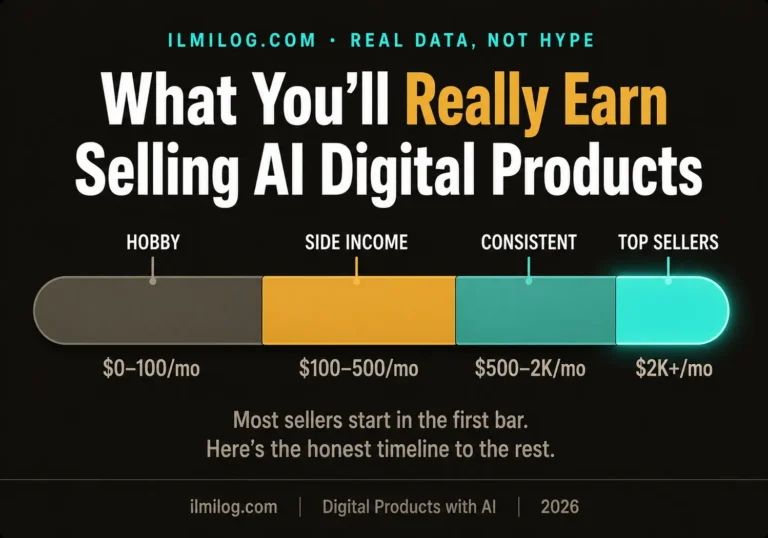
This is the single most common pattern behind beginners quitting after their first product doesn’t sell. One printable, one ebook, one prompt pack — published, checked daily for a week, and abandoned when it doesn’t produce income fast. Income in this space is a function of catalog size and consistency, not any individual product’s quality, and no amount of polish on a single listing changes that math.
Real seller data across product types backs this up consistently: authors with one or two books, sellers with one or two printables, creators with a single template all cluster in the lowest income band almost universally, regardless of how well-made that first product is. Our breakdown of realistic income across product types covers the actual numbers behind this, and the pattern is the same in every category: the sellers earning real money built a catalog over months, not a single product over a weekend.
This list pulls together the recurring failure points across everything covered in this series — if you haven’t picked a starting product yet, our complete guide to creating and selling digital products with AI is the place to start before any of these five mistakes become relevant.
Mistake 2: Picking the Platform Before the Product Has Proven Anything
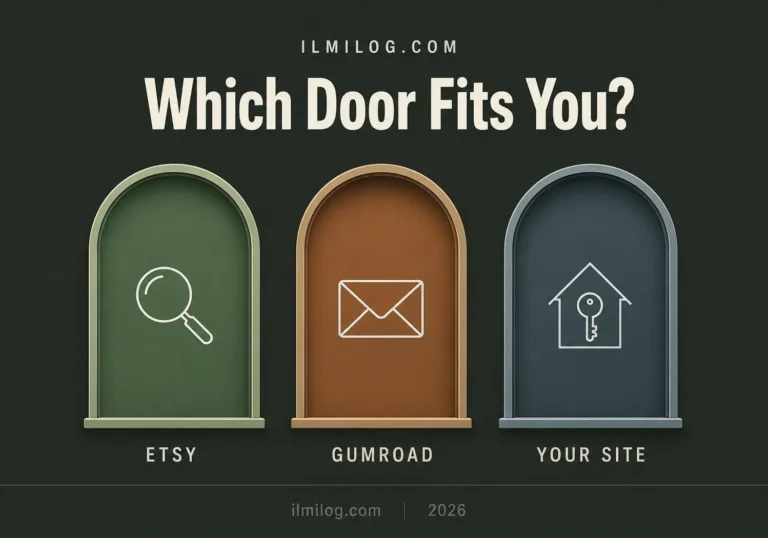
Beginners routinely spend more time debating Etsy versus Gumroad versus building their own site than they spend testing whether their product idea has any demand at all. The platform decision matters far less than most guides suggest, and it matters even less before you know whether anyone wants what you’ve made.
The practical fix is sequencing, not agonizing: start wherever gets you a real signal fastest — usually a marketplace with built-in search traffic — and only reconsider the platform once you have actual sales data to react to. Gumroad’s own fee structure, for example, only becomes the better economic choice once you have traffic of your own to send there; picking it first, with zero audience, often means picking the platform with less traffic before you’ve validated anything. Our comparison of Gumroad, Etsy, and running your own site walks through exactly when each platform actually makes sense, rather than which one sounds best in theory.
Mistake 3: Skipping Compliance Because It Feels Optional
This mistake costs more accounts than any AI-quality concern, and it’s the one beginners most consistently assume doesn’t apply to them.
On Etsy, the platform’s Creativity Standards require disclosure whenever AI plays a meaningful role in a listing’s artwork or design, and skipping that disclosure is a policy violation, not a gray area — sellers who assume nobody checks are wrong more often than they expect.
On Amazon KDP, the official content guidelines draw a specific line between AI-generated content, which requires disclosure, and AI-assisted content, which doesn’t — and beginners who guess wrong on which side of that line their book falls on risk the entire listing, not just a warning.
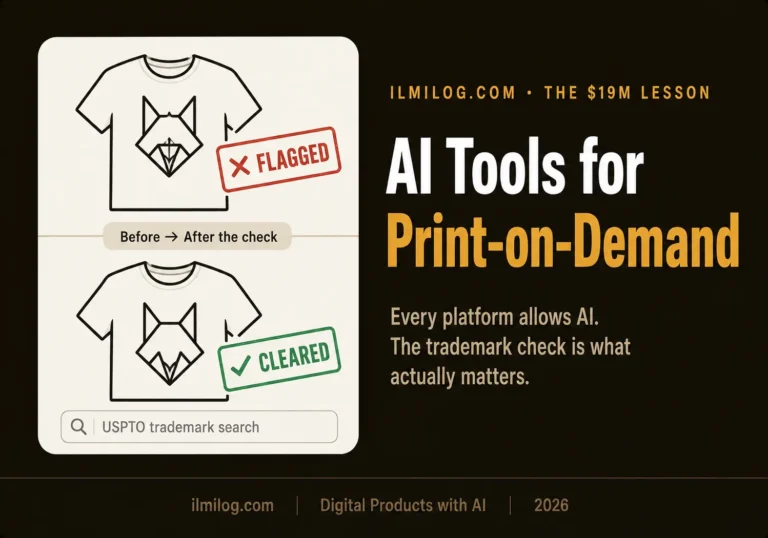
In print-on-demand specifically, the compliance risk shifts from disclosure to intellectual property. Running a design’s text or phrasing through the USPTO’s trademark database before listing takes a few minutes and catches a meaningful share of the conflicts that otherwise end in a takedown or suspended account.
The pattern across all three: beginners treat compliance as something that applies to other people’s careless listings, not their own careful ones. It applies to everyone, and it’s one of the few mistakes on this list that’s completely avoidable with a few minutes of checking.
Mistake 4: Selling the First Draft Instead of the Edited Version
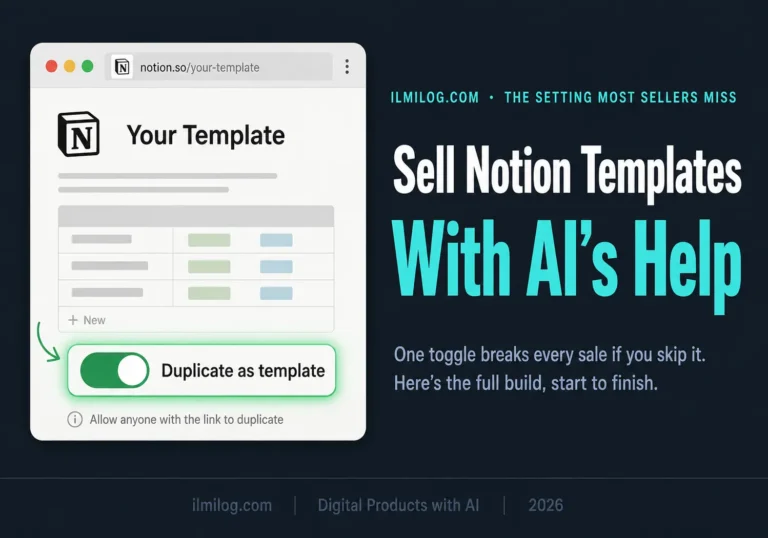
Every product type in this space has the same failure mode: generating something with an AI tool and listing it exactly as it came out, with no real editing pass in between. This shows up as repetitive phrasing in an ebook chapter, a Notion template built for the creator’s own use rather than a stranger’s understanding, a printable design with spacing and contrast nobody adjusted, or a prompt pack full of prompts that were never actually run and checked.
Buyers can tell the difference between edited and unedited AI output faster than most sellers expect, even when they can’t articulate exactly what feels off. If you’re still comparing which AI tools produce output that needs the least correction before it’s sellable, our tested comparison of AI tools for digital products breaks down where each tool’s raw output tends to fall short, so the editing pass your budget for matches what the tool actually needs.
Mistake 5: Building for “Everyone” Instead of One Specific Buyer
This mistake shows up in every single product category covered across this series, without exception. A “productivity template,” a “wall art printable,” a “prompts for entrepreneurs” pack — all broad, all competing against thousands of nearly identical listings, all converting at a fraction of the rate a specific version would.
The fix is the same regardless of product type: name the exact person and exact situation your product solves for, not the widest possible audience it could theoretically help. Our guide to building and pricing prompt packs covers this pattern in detail for that specific product, but the underlying lesson holds everywhere — the narrower the stated problem, the easier the entire rest of the process becomes, from the listing title to the actual conversion rate.
How These Patterns Held Up Across Every Product I Tested
Across this series, I built and listed a real product in most of these categories — a printable, a short ebook, a prompt pack, a Notion template — and the same five mistakes above are the ones that showed up as actual friction points during that process, not theoretical concerns pulled from someone else’s advice.
What surprised me: I expected the mistakes to be different for each product type. Instead, the same five patterns repeated almost identically across categories that otherwise have very little in common. That consistency is what convinced me these are worth writing up as a single list rather than scattering them across each individual product guide.
Self-Check: Which of These Are You Making Right Now?
- I’ve published one product and I’m waiting to see if it sells before building a second → Mistake 1, and it’s the most common one
- I’ve spent more time researching platforms than testing whether my product idea has demand → Mistake 2
- I haven’t checked my specific platform’s AI disclosure rules, or trademark-checked a POD design → Mistake 3
- I listed my product close to exactly how the AI tool generated it → Mistake 4
- My product description could apply to almost anyone, not one specific buyer → Mistake 5
Decision Checklist
- I’m treating this as a catalog to build over months, not one product to judge in a week → addresses Mistake 1
- I picked my starting platform based on getting a fast signal, not on theoretical fee comparisons → addresses Mistake 2
- I’ve checked my specific platform’s compliance rules before publishing, not after a warning → addresses Mistake 3
- Every product has had a real editing pass, not just an AI generation pass → addresses Mistake 4
- My product description names a specific buyer, not a broad category → addresses Mistake 5
When None of This Applies to You Yet
Skip worrying about these mistakes if: you haven’t actually built or listed a product yet — most of this list applies to decisions made during and after publishing, not before you’ve made anything. Get a first product built and listed before auditing yourself against a mistakes list; auditing a product that doesn’t exist yet isn’t useful.
This is worth reviewing carefully if: you’ve published at least one product with disappointing results and aren’t sure why. Nine times out of ten in this space, the answer is one or more of these five, not a fundamental flaw in the product idea itself.
Honest Verdict
| What Actually Predicts Success | What Doesn’t Matter As Much As Beginners Think |
| Catalog size built consistently over months | Which single product launches first |
| Starting on whatever platform gets a fast signal | Picking the theoretically “best” platform up front |
| Checking compliance rules before publishing | Worrying about AI detection tools |
| A real editing pass on every AI-generated draft | Which specific AI tool generated the first draft |
| A narrow, specific buyer named in the listing | A broader product that “could help more people” |
Best for: beginners who’ve published something and are trying to diagnose why it isn’t working, rather than people still deciding whether to start at all.
Skip the self-audit if: you haven’t built anything yet — build first, then check this list against what actually happened.
FAQ
Q: Which of these five mistakes costs beginners the most money?
Publishing once and stopping. Catalog size is the single strongest predictor of income across every product type covered in this series, more than product quality, platform choice, or pricing.
Q: Do these mistakes apply the same way to every product type?
The five patterns repeat across categories, but the specific mechanics differ — compliance means AI disclosure on Etsy and KDP, but trademark risk in print-on-demand. The underlying mistake is the same; the fix looks slightly different per platform.
Q: How do I know if I’m being too broad with my product niche?
If your product description could reasonably apply to more than one clearly different type of buyer, it’s likely too broad. A specific niche description should make one kind of person feel like the product was built for them specifically.
Q: Is it worth going back and fixing an already-published product?
Often yes, especially for Mistake 3 and Mistake 4 — adding a missing disclosure or doing a delayed editing pass on an existing listing is usually faster than starting over, and it directly reduces real account risk.
Q: What’s the fastest of these five mistakes to fix?
Compliance. Checking your platform’s disclosure rules or running a design through a trademark database takes minutes and immediately removes one of the more serious risks on this entire list.
Final Recommendation
Audit your current or planned product against these five before publishing the next one, not after. If you’re still deciding which digital product type fits your specific skills and time before any of this becomes relevant, the Digital Life Blueprint Generator walks through a short set of questions and points you toward the format most likely to fit, so the catalog you start building goes toward the right product from the start.
Researched and written by the ilmilog.com editorial team. Mistakes cross-referenced against products built and listed across this entire series — printables, ebooks, prompt packs, and Notion templates — through July 2026. Platform compliance details confirmed against official sources as of July 2026. Editorial policy: we test the processes we recommend before publishing.