AI Tools for Creating Print-on-Demand Designs
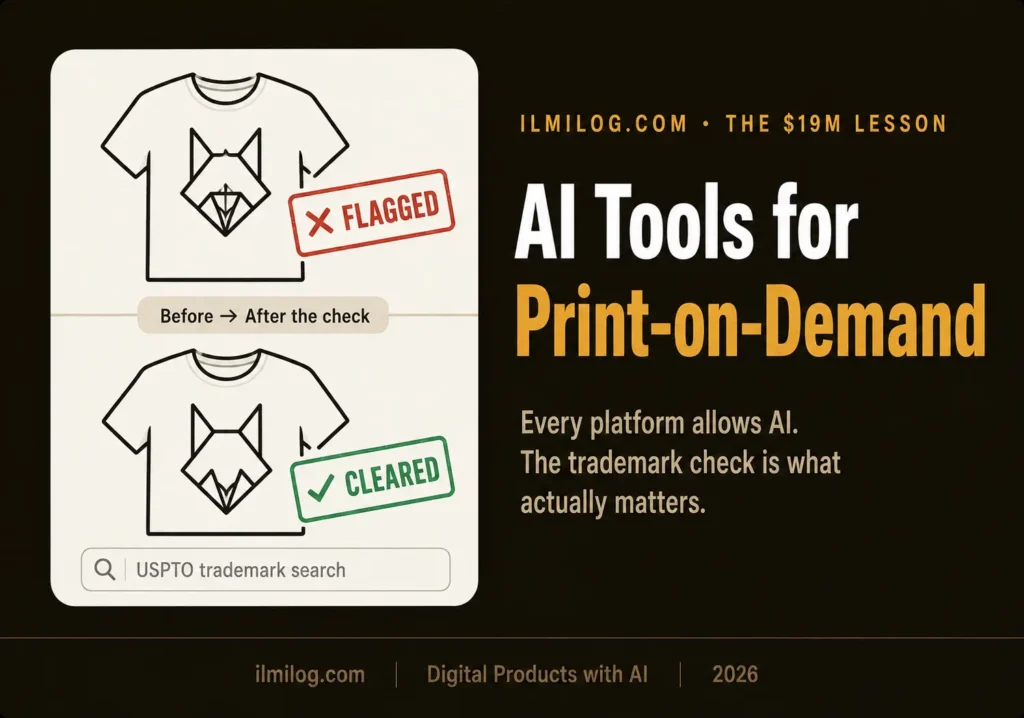
Quick Answer: Every major print-on-demand platform — Printful, Printify, Redbubble, TeePublic, and Amazon’s Merch program — currently allows AI-assisted designs. The question that actually determines whether you keep your account isn’t whether AI is allowed. It’s whether your designs cross into trademark or copyright territory, which is the single most common reason POD accounts get suspended, disclosed or not. Get the intellectual property side right and the AI tool you use barely matters.
What you’ll learn: → Why every platform’s real concern is intellectual property, not AI use itself → The exact prompt patterns that trigger takedowns, and how to avoid them → A step-by-step process from niche selection to a listed, sellable design → A platform comparison based on built-in traffic versus how much control you keep → A straight answer on when this product type carries more risk than it’s worth for you
The Question Most Guides Get Backward
Most beginner guides spend their opening paragraphs answering “is AI allowed for print-on-demand,” as if that’s the hard part. It isn’t. Every platform worth using has already settled that question — AI-assisted work goes through the same review as anything else, and none of them ban it outright. Notion templates, printables, and prompt packs each have their own platform-specific rules worth knowing before you start; this space is different, because the rule that matters here isn’t about AI at all.
Building a print-on-demand business is one of several paths into this space — our complete guide to creating and selling digital products with AI covers where it fits alongside printables, ebooks, and templates if you’re still weighing your options.
The real gatekeeper is intellectual property. A beautifully designed shirt built from a prompt referencing a real brand, a movie character, or a named artist’s style gets removed regardless of how well it was made, and repeat violations get accounts banned outright. That’s the actual skill this business requires, and it’s the part almost no beginner guide covers in enough depth to be useful.
The Real Risk: Trademark and Copyright, Not AI Itself
Printful’s own guidance on this frames it well: think of yourself as either the director of the AI or just its customer. If you type a couple of words into a generator, download the first result, and slap it on a mug, the law sees almost no meaningful human contribution — which is a legal weak spot if anyone ever disputes ownership. If you use AI to rough out an idea, then redraw, adjust, and genuinely shape the final design, your position is far stronger both for defending originality and for standing behind the product as genuinely yours.
The consequences for getting the trademark side wrong are not hypothetical. Harley-Davidson won a federal lawsuit worth more than $19 million against a print-on-demand platform for failing to police designs using its trademarks — a case worth knowing about because it shows platforms and sellers both carry real exposure here, not just a risk of a single listing getting pulled. Before publishing anything built around a specific phrase, name, or recognizable style, running it through the USPTO’s official trademark search database takes a few minutes and catches the most obvious conflicts before they cost you an account.
How I Tested This
For this guide, I built a small batch of designs using AI tools, ran each through a trademark check before finalizing anything, and submitted a portion to a fulfillment platform to see what got approved without issue and what got flagged.
What I tracked:
- Which prompt styles produced results close enough to existing brands or characters to warrant a second look
- How much editing a raw AI output typically needed before it read as an original design rather than a generated one
- Whether niche-specific, edited designs performed differently in early visibility than generic, unedited ones
- What got flagged during platform review, and why
Where I was wrong going in: I assumed vague, non-branded prompts were automatically safe. One generated a design close enough to a well-known logo’s shape and color scheme that I pulled it before listing, even though I never mentioned the brand by name. AI models trained on huge amounts of visual data sometimes reproduce brand-adjacent elements without being asked to, which means every output needs a human review pass regardless of how the prompt was written.
Building a Sellable Design Step by Step
Step 1: Pick a Specific Niche and Audience
“Funny t-shirts” competes against an enormous, oversaturated category. “Shirts for night-shift nurses” or “gifts for people who foster rescue dogs” gives you a specific buyer to design for and a specific search term they’re likely to type. The narrower the niche, the more the rest of this process writes itself.
Step 2: Generate With an Original, Descriptive Prompt
Describe the subject, composition, color palette, and mood without naming a living artist, brand, franchise, or existing product. A prompt like “minimalist line-art fox in autumn colors” is safe territory. A prompt like “in the style of [named illustrator]” or referencing a known character is a direct path to a takedown, even when you never intended to copy anyone. If you’re comparing which AI tools produce the most usable results for this kind of visual work, our tested roundup of the best AI tools for digital products breaks down which ones handle original illustration work best.
Step 3: Edit the Output Before It’s Anywhere Near “Final”
This is the step most beginners skip, and it’s both a quality issue and a legal one. Adjust the composition, fix any garbled elements, redo the typography if there’s text involved, and make deliberate creative choices rather than uploading the first generation untouched. This is also where a design stops looking like every other AI-generated shirt in the same broad category and starts looking like something a buyer would actually choose.
Step 4: Search Before You List
Take any specific phrase, name, or slogan in your design and run it through the USPTO’s trademark database, especially if it functions like a tagline or brand phrase. This is a screening step, not a legal guarantee, but it catches a meaningful share of obvious conflicts before they become a suspended account.
Step 5: Choose Your Platform and List With Real Titles
Write listing titles and tags the way a real buyer searches, not a string of keywords stacked together — platforms increasingly suppress spammy-looking listings, and mass-uploading dozens of unedited designs with generic titles is treated as a spam signal, not a volume strategy.
Platform Comparison
| Platform | Setup | Built-In Traffic | Best For |
| Printful / Printify | Connect to your own store (Shopify, Etsy, etc.) | None — you drive traffic | Sellers who want full control over branding and pricing |
| Redbubble / TeePublic | Built-in marketplace, no separate store needed | Strong — active marketplace search | Beginners who want to start selling without building a store first |
| Amazon Merch on Demand | Invite-only application, tiered account limits | Very strong — Amazon’s own search and traffic | Sellers willing to go through a vetting process for Amazon’s audience |
Amazon’s Merch on Demand program specifically starts new accounts at a limited tier of live designs, requires an application with banking and tax details, and approval can take anywhere from two weeks to a few months. It’s worth applying early if you’re serious about that channel, since the wait time itself is often the longest part of the process.
Mistakes That Get Designs Removed or Accounts Suspended
Referencing named brands, characters, or artists in prompts. This is the single most common reason for takedowns, and it happens even when sellers don’t intend to copy anyone — the prompt itself creates the risk.
Mass-uploading unedited AI output. Platforms increasingly flag large batches of raw, unedited generations as spam rather than a real catalog, which can suppress visibility across your entire account, not just the flagged designs.
Skipping the trademark search on text-based designs. A visually original design can still fail because of a protected phrase or slogan hiding inside it. This takes minutes to check and gets skipped constantly.
Assuming a vague prompt is automatically safe. As covered above, AI models can produce brand-adjacent results without being asked to. Every output still needs a human review before it goes anywhere near a listing.
Treating this as a one-and-done listing strategy. Like most digital and print product categories, income here scales with a real catalog built over time, not a handful of designs uploaded once.
When This Is Not the Right Product for You
Skip this if: you’re not willing to do a genuine editing pass on every AI output before listing it — the legal and quality risks both concentrate in that skipped step. Skip it too if you’re uncomfortable with an unpredictable review and approval process, since platforms like Amazon’s Merch program involve real waiting periods and rejection risk that don’t exist with lower-friction product types like printables.
This is a good fit if: you’re comfortable doing the extra diligence trademark checking requires, you’re willing to genuinely edit and shape AI output rather than uploading it raw, and you can commit to building a real catalog over months rather than expecting a handful of designs to carry the whole business.
Decision Checklist
- I’ve picked a specific niche and audience, not a broad category → the actual foundation of a design that gets found
- My prompts describe subject and style without naming real brands, artists, or characters → the single biggest risk reduction available
- I edit every AI output before it’s anywhere near final → both a quality and legal safeguard
- I check text-based designs against the USPTO trademark database before listing → catches conflicts a visual review alone would miss
- I’m prepared for a real catalog and, if pursuing Amazon specifically, a genuine waiting period → sets realistic expectations from the start
Honest Verdict
| What Works | What Doesn’t |
| Original, descriptive prompts with a genuine editing pass | Prompts referencing named brands, artists, or characters |
| Checking text-based designs against the trademark database | Assuming a vague-sounding prompt is automatically safe |
| Building a real catalog with distinct, niche-specific designs | Mass-uploading unedited AI output as a volume strategy |
| Treating platform review and wait times as normal | Expecting instant approval, especially on invite-only programs |
Best for: sellers willing to treat intellectual property diligence as part of the actual job, not an afterthought.
Skip it if: you want the lowest-friction, lowest-risk digital product to start with — our guide to AI-generated printables on Etsy covers a comparable creative product with fewer platform review hurdles and no physical inventory or shipping involved.
FAQ
Q: Is it actually legal to sell AI-generated print-on-demand designs?
Yes, generally, as long as the design doesn’t infringe on someone else’s trademark or copyright and you’ve made a genuine creative contribution rather than uploading a raw, untouched AI output. The legal risk sits with the IP question, not with using AI as a tool.
Q: How do I know if a design is too close to an existing trademark?
Search any specific name, phrase, or slogan in the design through the USPTO’s trademark database before listing. For visual similarity to logos or characters, when in doubt, redesign that element rather than risk a takedown.
Q: Which platform is easiest to start on?
Redbubble or TeePublic, since both provide a built-in marketplace and require no separate store setup. Amazon’s Merch program has the strongest built-in traffic but the longest approval process.
Q: How many designs do I need before this becomes real income?
Similar to other digital product categories, a handful of listings rarely produces meaningful income. A real catalog built consistently over months is what moves this from a hobby-level result into a genuine side income.
Q: Can I use the exact same design across multiple platforms?
Generally yes, since most platforms don’t require exclusivity, but each platform reviews independently, so a design approved on one isn’t guaranteed to pass review on another.
Final Recommendation
Treat the editing pass and the trademark check as non-negotiable steps, not optional extras — they’re what separates a sustainable catalog from an account that gets suspended a few months in. If you’re still deciding whether print-on-demand is the right fit for your specific skills and risk tolerance versus a lower-friction product type, the Digital Life Blueprint Generator walks through a short set of questions and points you toward the format most likely to fit before you commit to a platform’s review process.
Researched and written by the ilmilog.com editorial team. Process tested by generating, editing, trademark-checking, and submitting a batch of real designs to a fulfillment platform through July 2026. Platform policies and legal references confirmed against official and public sources as of July 2026. Editorial policy: we test the processes we recommend before publishing. This article is general information, not legal advice — consult a qualified professional for guidance specific to your situation.